Ice houses in Camden, North London, represent a fascinating chapter in the area’s industrial past, where innovative underground storage preserved ice for a growing Victorian city. These structures, built in the 1830s, highlight Camden’s pivotal role in London’s early ice trade, blending engineering ingenuity with the demands of urban luxury.
Historical Origins
Camden’s ice houses emerged during the 19th century when refrigeration was nonexistent, and preserving summer perishables required creative solutions. William Leftwich, a confectioner, constructed the first major ice well at Cumberland Basin near Regent’s Park in 1825, but expanded to Camden Town in the 1830s with even larger facilities. These egg-shaped pits, dug up to 100 feet deep, stored thousands of tons of ice harvested from Norwegian lakes and transported via the Regent’s Canal, revolutionizing food storage for West End restaurants and elite households.
The wells featured brick-lined cylinders with domed roofs, wooden platforms, and straw insulation to minimize melting, allowing ice blocks—each weighing 200-400 pounds—to last through London’s sweltering summers. By 1873, reports claimed Camden’s primary well held 4,000 tons, dubbing it London’s largest, underscoring North London’s transformation from rural outskirts to an industrial hub.

Key Figures and Rivals
Leftwich dominated the trade until Carlo Gatti entered in 1857, establishing competing wells at Battlebridge Basin (now the London Canal Museum site) using canal ice initially before switching to imports. Gatti’s operation, open to the public today, drew from his confectionery background, supplying ice for drinks, ice cream, and even ornamental “ice pyramids” at banquets—carved blocks adorned with flowers that doubled as cooling centerpieces.
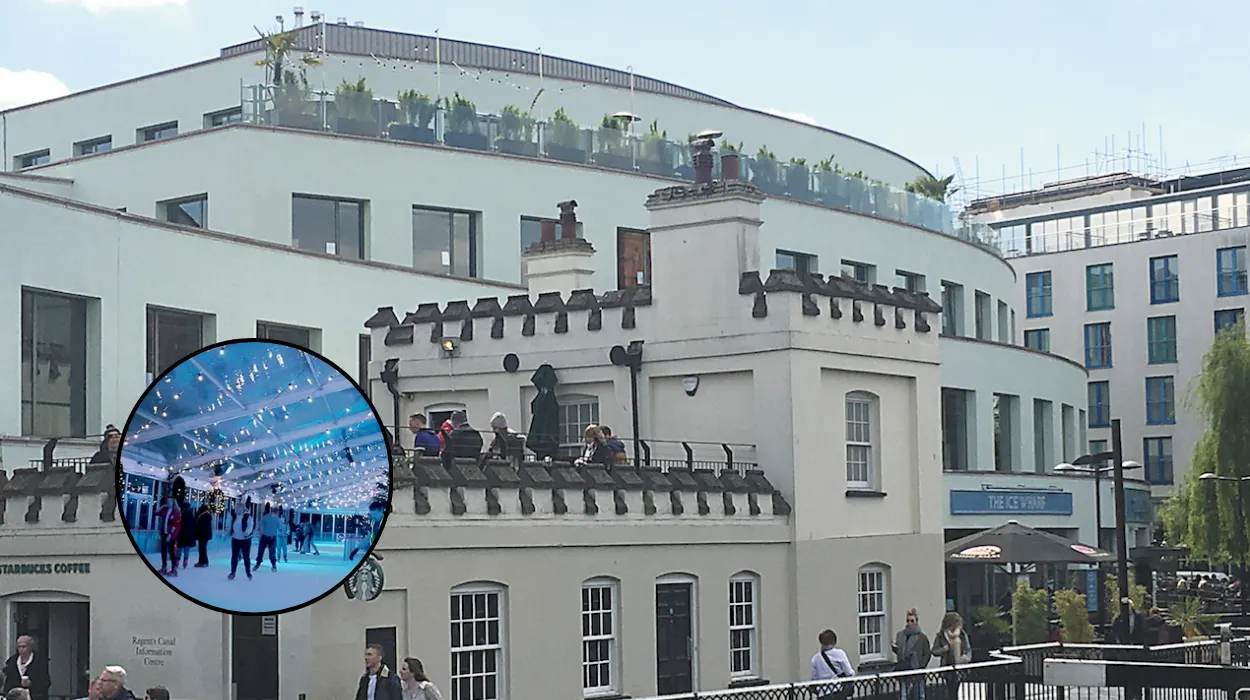
Leftwich’s Norwegian ice, prized for its purity over murky canal varieties tainted by impurities, gave Camden a competitive edge, with boats hauling blocks from Limehouse along the canal straight to Ice Wharf docks. This rivalry fueled Camden’s ice boom, employing boatmen and laborers while catering to a burgeoning middle class craving chilled luxuries.
Engineering Marvels
Constructed with precision, Camden’s ice wells were multi-level “lifts” excavated into chalk bedrock, complete with drainage sumps 300 feet below to pump away meltwater. A 1839 survey details the main well as 34 feet wide and 82 feet initially deep at Cumberland, but Camden’s reached 100 feet—equivalent to a 10-story building subterranean—surrounded by open brick sheds for cart loading.
Nearby, a smaller second well enhanced capacity, with remnants visible into the 1990s, showcasing durable Victorian brickwork resilient to time and urban development. These weren’t mere pits; they were insulated fortresses against heat, proving North London’s geological suitability for such feats.
Camden’s Ice Trade Impact
The ice houses propelled Camden’s economy, linking it to global trade routes and the Regent’s Canal’s heyday. Ice fueled culinary innovations like ice cream parlors and chilled beverages, elevating Camden from warehouse district to gastronomic supplier. Socially, they democratized luxuries once reserved for nobility, with Gatti selling affordable ice blocks to the working class by the 1860s.
Environmentally, the shift to Norwegian imports curbed local canal harvesting, which polluted waterways with debris, though it introduced transatlantic shipping demands. Camden’s facilities declined post-1880s with mechanical refrigeration, but their legacy endures in preserved sites like Gatti’s wells.

Modern Legacy and Visits
Today, Camden’s ice houses offer glimpses into hidden history amid the area’s vibrant markets and locks. The London Canal Museum at 12-13 New Wharf Road houses Gatti’s two wells, accessible via tours revealing 20-foot-deep chambers and original mechanisms—perfect for history buffs exploring North London.
Grays Inn Road excavations remind us these structures lurk beneath modern builds, occasionally unearthed during construction. For locals, they symbolize Camden’s inventive spirit, from punk rock to punk engineering.
Why Camden’s Ice Houses Matter Today
These relics underscore North London’s evolution, blending industrial grit with cultural allure. Visiting evokes the chill of innovation in a warming world, reminding us how Camden quenched London’s thirst—literally—for progress.