Key points
- Enfield Council in north London has lost Labour control after the 2026 local elections, with the Conservatives emerging as the largest group and the Green Party gaining new seats.
- The proposed 21,000‑home “new town” scheme at Crews Hill and Chase Park, backed by the UK government’s New Towns Taskforce, now faces strong opposition from the newly dominant Conservative and Green blocs.
- Both the Enfield Conservatives and the Green councillors have pledged to oppose the release of Green Belt land needed for the development, casting doubt on whether the scheme can proceed via the council’s planning powers.
- The existing local‑plan framework, which had opened the door to thousands of homes on Green Belt‑adjacent land, is now under political challenge, with the Greens holding the balance of power and signalling a joint strategy with the Tories.
- National government and housing‑sector analysts warn that blocking the Enfield new town could delay efforts to meet London’s acute housing need, especially given the scale and affordability commitments attached to the site.
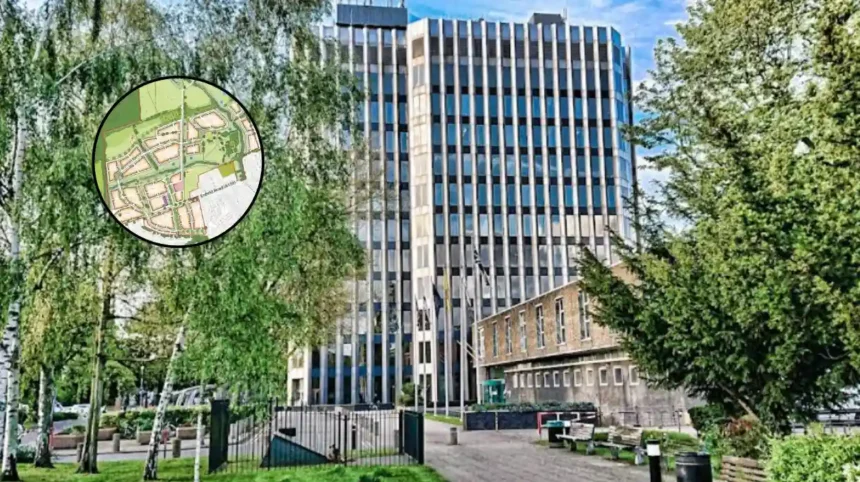
Enfield, (North London News) May 13, 2026 – The proposed 21,000‑home new town at Crews Hill and Chase Park is now at risk following Labour’s loss of control of Enfield Council in the 2026 local elections, with the Conservative and Green Parties both pledging to block the release of Green Belt land required for the development.
- Key points
- What has changed in Enfield politics?
- How does the new town plan fit into national policy?
- Green Belt opposition and local campaign dynamics
- Planning‑process risks and timeline implications
- Housing‑need context and sector reaction
- Background: How the Enfield new town idea emerged
- Prediction: How this development could affect different audiences
What has changed in Enfield politics?
Labour had led Enfield Council for several years, overseeing the drafting of a local plan that designated parts of Crews Hill and Chase Park for substantial housebuilding, originally on the basis of around 5,500–9,200 homes with significant infrastructure and school provisions.
In the May 2026 elections, Labour fell from majority status, winning 27 seats, while the Conservatives secured 31 and the Greens gained enough councillors to hold the balance of power in a hung council.
As reported by Dave Hill of OnLondon, Green councillors in Enfield
“are to join forces with the borough’s Conservatives to oppose Labour plans for building thousands of new homes on local Green Belt land”,
and the two groups are
“set to hold talks over how they can work together to save the Green Belt”.
Labour councillor and local‑plan‑backer Arjun Saha has said that the Conservatives “have that in common with us” in wanting to protect green spaces, while adding that coalition work would be necessary if the borough is to “do what is best for Enfield”.
Explore More Enfield Council News
Sarah Jons Named Enfield Green Party Leader Amid Council Deadlock Talks Begin
Enfield Council Sells 2nd Ex-Library: Winchmore Hill 2026
How does the new town plan fit into national policy?
At the national level, the government’s New Towns Taskforce has earmarked Crews Hill and Chase Park as one of the shortlisted sites for a new town, with a target of up to 21,000 homes, more than double the council’s earlier 9,200‑home plan.
Government documents presented in March 2026 describe the site as capable of delivering a “new town” that would combine residential, employment and infrastructure elements, with an ambition that 50 per cent of units be “affordable”, a much higher proportion than recent private schemes in London.
As noted by David Jones of Building Design (BD), the national‑government designation of Crews Hill and Chase Park as a new town
“looks uncertain following Labour’s loss of control of Enfield Council in last week’s local election”,
because the Conservatives and Greens “both campaigned on a pledge to oppose the development”. BD’s reporting underlines that, while the government can impose a new‑town framework, the council’s local‑plan‑making role and planning‑consent decisions remain key levers for blocking or reshaping the scheme.
Green Belt opposition and local campaign dynamics
The Enfield Conservatives have long opposed releasing Green Belt land for housing, and made that stance a central plank of their 2026 election campaign. A local conservationist group, The Enfield Society, has circulated a petition against the release of Green Belt sites, arguing that such land should be preserved for community and environmental benefit.
The Green Party’s Enfield manifesto focused heavily on “protecting green spaces” and “making green homes affordable for all”, framing the new‑town plan as a threat to local biodiversity and recreational land.
Green Party leader and London Assembly member Zack Polanski has separately criticised Labour’s record on “affordable” housing, arguing that his party would deliver more genuinely affordable homes while safeguarding green infrastructure.
Enfield’s Green councillors have indicated they will use their position on the council to scrutinise any planning applications that would unlock Green Belt land, and to push for alternative densities and brown‑field‑first options.
Planning‑process risks and timeline implications
Enfield’s current local plan, which had been drafted under Labour leadership, has yet to be fully adopted by the council and is subject to ongoing inspection and legal challenge risks. The shift in political control means that the new Conservative–Green‑leaning administration can delay or revise the plan, potentially removing or narrowing the Green Belt releases that would enable the 21,000‑home scheme.
If the council chooses to withhold support for the new‑town‑compatible revisions, the government faces two options: either to use its New Towns powers to override local planning objections, or to negotiate revised phasing and site configurations that reduce Green Belt loss.
Analysts familiar with housing policy, quoted in Planning Resource, note that Enfield’s new‑town proposal is
“one of the government’s seven shortlisted new‑towns sites earmarked for up to 21,000 new homes”,
and that political uncertainty here could
“delay, if not derail, the wider rollout of the new‑town programme in London”.
Housing‑need context and sector reaction
The government’s New Towns Taskforce has framed the Crews Hill and Chase Park site as a response to “London’s acute housing need”, with projections showing shortfalls of tens of thousands of homes over the next decade.
The proposed 50 per cent‑affordable‑housing target for the Enfield new town is significantly above the averages seen on many recent London schemes, where “affordable” percentages have often fallen below 15–20 per cent.
Non‑governmental organisations and housing‑advocacy bodies have expressed concern that blocking the Enfield scheme could exacerbate London’s affordability crisis, particularly for low‑ and middle‑income households for whom such large‑scale, mixed‑tenure schemes are seen as one of the few credible supply‑side options.
At the same time, green‑campaign groups and local residents’ associations argue that the environmental and amenity costs of building on Green Belt land are too high, and that smaller‑scale, infill development and brown‑field use should be prioritised.
Background: How the Enfield new town idea emerged
The push for a large‑scale housing development in northern Enfield began several years ago, when earlier Labour‑led administrations first explored the potential of Crews Hill and surrounding farmland, locally known as “Chase Park”, for tens of thousands of homes.
In 2021, the council’s Local Plan proposals flagged more than 6,000 homes at Crews Hill alone, with additional dwellings on low‑quality greenfield land, setting the stage for a wider debate about Green Belt use.
London Mayor Sadiq Khan, who had long opposed Green Belt development, initially criticised those early Enfield‑plan ideas but later accepted that “Green Belt release had become unavoidable” under the new Labour‑led national government’s drive to accelerate housebuilding.
By 2025–2026, the national government’s New Towns Taskforce formally selected Crews Hill and Chase Park as a candidate new‑town site, integrating the borough‑level plans into a broader national‑town‑building strategy.
Prediction: How this development could affect different audiences
For local residents and green‑space users, the halt or scaling‑back of the 21,000‑home scheme could mean that existing Green Belt land and open spaces around Crews Hill and Chase Park remain largely undeveloped, preserving walking routes, wildlife habitats and recreational areas.
However, it may also limit the creation of new local‑area housing, schools and transport upgrades that were expected to accompany the new town, potentially pushing demand and pressure into neighbouring boroughs.
For first‑time buyers and renters in north London, delays or cancellation of the Enfield new town would reduce the pipeline of large‑scale, mixed‑tenure schemes in the outer‑London housing market, tightening supply at a time when private and “affordable” housing output has been volatile.
If the government seeks other sites to compensate for Enfield’s uncertainty, those may be located further from central London, affecting commute times and transport‑cost expectations for lower‑income households.
For developers and investors, the political resistance in Enfield highlights the risk that flagship, government‑backed new‑town bids can still founder on local planning and Green Belt politics, even with national‑level support. This could make investors more cautious about committing large sums to other proposed new‑town sites unless there is clearer alignment between local councils and national housing policy.
For local‑government and policymakers, the Enfield case illustrates how shifts in borough‑level political control can directly challenge the delivery of national‑scale housing ambitions, forcing Whitehall to balance its new‑town rollout against local‑democracy concerns and environmental‑protection arguments. How Enfield’s council, the Mayor of London and the national government ultimately negotiate the fate of the 21,000‑home scheme will likely serve as a test case for future new‑town initiatives across England.