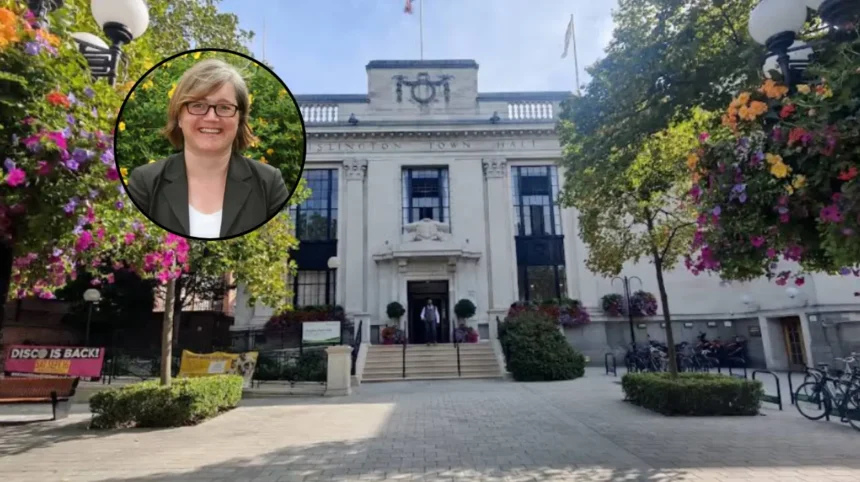
Key Points
- Caroline Russell has stepped down from Islington Town Hall after 12 years as the Green Party’s longest-serving councillor in the borough.
- She was the party’s only councillor in Islington for eight years after first being elected in 2014.
- For much of that period, she was also the only opposition councillor in the council chamber.
- Ms Russell said being alone in the chamber was “isolating and intimidating”, but she relied on local residents to support her campaigning.
- She described a wrongly sent email inviting her to a “secret meeting” on budget cuts as evidence of a wider “cultural problem” at the Town Hall.
- The development marks her farewell from council politics as she focuses more on her role as a London Assembly Member.
Islington (North London News) May 18, 2026 – Caroline Russell has left Islington Town Hall after 12 years as the Green Party’s longest-standing councillor in the borough, drawing a line under a period in which she was often the party’s lone voice in the council chamber. As reported by the Tribune, Ms Russell said her years as Islington’s only Green councillor — and for eight years its only opposition councillor full stop — were difficult, but that she drew strength from residents and campaigners around her.
- What was Caroline Russell’s role in Islington politics?
- Why did she describe the Town Hall as intimidating?
- What did the ‘secret meeting’ email reveal?
- How did she campaign while being on her own?
- What does her departure mean for Islington Greens?
- Why does her move matter beyond the council chamber?
- What is the background to this development?
- What is the likely effect on residents?
Ms Russell told the Tribune that the experience of being on her own in the chamber “felt isolating and intimidating”. She said she responded by working closely with the community outside the Town Hall, including local people, children and families, to press the council on the issues that mattered to them.
“I realised that in order to be on my own, I needed to work with the community around me to ask questions of the council, bring petitions and do demonstrations,”
She said, as quoted by the Tribune.
“And in that way, I wasn’t on my own in the chamber because I had the voices of local people, local children and local families with me.”
What was Caroline Russell’s role in Islington politics?
Caroline Russell first won election in 2014 and went on to become the Greens’ most established councillor in Islington, according to the Tribune. For eight of her 12 years, she was the Green Party’s only councillor in the borough, which meant she also carried the burden of representing opposition views on her own.
That context matters because it shaped how she operated, how visible her campaigns became, and how frequently she had to challenge the council without a party group behind her in the chamber.
Her departure is significant not just because of her longevity, but because of the unusual position she occupied in local politics.
As the borough’s lone Green voice for much of her time in office, she became closely associated with scrutiny of council decisions and with community-led campaigning.
Why did she describe the Town Hall as intimidating?
Ms Russell said the experience of serving alone was not just politically difficult, but personally unsettling. She told the Tribune that the chamber environment could feel hostile when she had no fellow opposition councillors beside her.
Her comments point to the imbalance she faced in a council dominated by one political group, with limited formal support inside the chamber.
She also pointed to an early incident that, in her view, reflected deeper problems in the council’s culture. According to the Tribune, Ms Russell recalled being mistakenly included in an email that invited Labour councillors to a “secret meeting” about budget cuts, although she had been intended to be excluded. She turned up anyway to make her case.
What did the ‘secret meeting’ email reveal?
Ms Russell said the wrongly sent email highlighted what she saw as a serious issue in the way the council operated at the time.
As reported by the Tribune, she described the incident as evidence of a “real cultural problem” in the Town Hall and criticised what she saw as a lack of separation between the council as a formal institution and the Labour group.
She said, in the Tribune’s account, that writing to Labour councillors to attend a “star chamber meeting” on budget cuts was “a real misstep”.
Her remarks suggest that the episode stayed with her because it went beyond a simple administrative mistake and, in her view, pointed to how power was being exercised inside the council.
How did she campaign while being on her own?
Ms Russell said her answer to political isolation was to widen the circle around her. Rather than treat her position as a weakness, she used it to connect with residents, petition organisers and local campaigners who shared concerns about council decisions. That approach allowed her to turn community pressure into a form of influence in the chamber.
Her comments indicate that her style of politics was rooted in local activism as much as in formal council debate.
The Tribune reported that she brought questions, petitions and demonstrations into the council process, using public backing to amplify issues she could not carry alone from within the chamber. This made her role less about party arithmetic and more about sustained grassroots pressure.
What does her departure mean for Islington Greens?
Her exit marks the end of an era for the Islington Green Party, which had relied heavily on her presence and persistence over more than a decade.
The Tribune’s reporting shows that she was more than just a councillor; she was effectively the public face of the Greens in a borough where they had limited formal representation for many years.
A departure like this can also alter how a smaller party operates locally. Without a councillor who has spent years building recognition, relationships and procedural knowledge, a party must often rebuild its profile from scratch.
In practical terms, that can affect visibility, scrutiny of council decisions and the ability to keep local campaigns in the public eye.
Why does her move matter beyond the council chamber?
Ms Russell’s farewell is also linked to her wider political work, including her role as a London Assembly Member.
The Tribune reported that she is stepping away from the Town Hall to focus more on that position, which suggests a shift from local ward politics to a broader citywide platform.
That move matters because it reflects how councillors sometimes balance local service with regional responsibility.
In her case, the transition appears to be from fighting one borough’s battles in detail to contributing to wider scrutiny across London. It also means her experience of Islington politics will now be channelled into a different forum.
What is the background to this development?
Caroline Russell’s departure comes after 12 years on Islington Council and follows a long period in which the Greens had only limited representation locally.
According to the Tribune, she first entered the council in 2014 and then spent eight years as the party’s sole councillor in Islington.
That gave her a distinctive role in the borough’s political landscape, especially when she was the only opposition voice in the chamber.
The background also includes tensions over council culture and decision-making, illustrated by the mistakenly sent email about a “secret meeting” on budget cuts. Ms Russell used that episode to argue that there were problems with how the council operated and how formal decision-making related to the governing Labour group.
Her departure now closes a chapter that combined lone opposition politics, community campaigning and wider London representation.
What is the likely effect on residents?
For local residents, the immediate effect is the loss of a well-known councillor who had built a reputation for challenging the council and bringing community concerns into Town Hall debates. People who supported her campaigns may feel that one of their most visible advocates has moved on from the local chamber. That could leave a gap in scrutiny, especially if no similarly prominent Green voice quickly emerges.
At the same time, her move to focus on the London Assembly may mean some issues she previously pursued locally could still be raised in a wider political setting. For the audience most affected — Islington residents, Green supporters and local campaigners — the development may change the way their concerns are represented, but it does not necessarily remove them from the political agenda. The key question now is whether the Greens can translate her long service into a stronger local presence, or whether her departure leaves a temporary void in opposition politics at the Town Hall.