Key Points
- Dual-Outcome Weekend: Arsenal celebrated their first Premier League title in 22 years with a trophy parade but suffered a devastating penalty shootout loss to Paris Saint-Germain in the Champions League final in Budapest.
- Social Media Friction: Tottenham Hotspur defender Djed Spence reportedly mocked Arsenal’s European defeat online, prompting sharp responses from Gunners players.
- Madueke’s Defiance: Noni Madueke posted a celebratory image with Declan Rice, stating “Champions! Whilst others are tweeting and posting,” in a direct jab at rival critics.
- Rice’s Support: The England midfielder echoed sentiments of “jealousy” from outside the club following their domestic success.
- Shootout Scars: The European final defeat saw Eberechi Eze and Gabriel Magalhaes miss critical penalties, a point of contention for some fans and rivals.
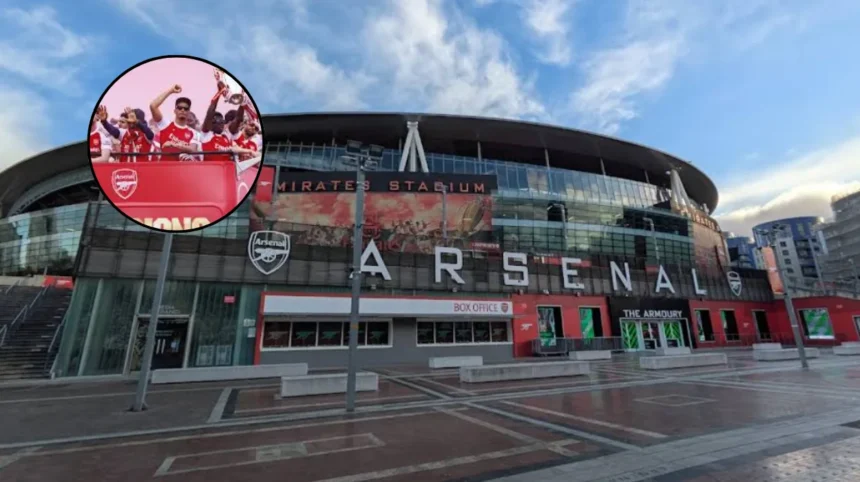
Arsenal FC (North London News) June 1, 2026 — Arsenal’s Premier League title celebrations were punctuated by a war of words on social media this weekend as stars Declan Rice and Noni Madueke fired back at rival players and critics. Following the club’s first top-flight title in over two decades, the joy of a victory parade through the streets of Islington was met with the sting of a Champions League final defeat in Budapest. The dichotomy of the weekend’s events provided ammunition for rivals, most notably Tottenham Hotspur’s Djed Spence, leading to a public rebuttal from the Arsenal dressing room regarding “jealousy” within the footballing community.
- Key Points
- How did Noni Madueke respond to the Champions League heartbreak and social media taunts?
- What was Declan Rice’s stance on the “jealousy” surrounding Arsenal’s success?
- Why did the Champions League final in Budapest become a focal point for critics?
- How has the rivalry with Tottenham Hotspur intensified after these exchanges?
- Background of the 22-Year Title Wait and European Aspirations
- Prediction: How will this social media war affect the Arsenal squad and their supporters?
How did Noni Madueke respond to the Champions League heartbreak and social media taunts?
As reported by the primary correspondence surrounding the club’s social media activity, Noni Madueke chose to focus on the club’s domestic achievement rather than the continental setback. The 24-year-old winger, who featured as a second-half substitute during the final against Paris Saint-Germain but did not participate in the decisive penalty shootout, took to Instagram to address the narrative.
Posting an image of himself alongside teammate Declan Rice while clutching the Premier League trophy, Madueke wrote: “Champions! Whilst others are tweeting and posting. Thank you God. The glory is yours!”
According to sports journalist analysis of the post, the “tweeting and posting” remark was a pointed reference to Tottenham defender Djed Spence. Spence had reportedly utilised social media to mock the Gunners’ inability to secure the “Double” after Eberechi Eze and Gabriel Magalhaes failed to convert their spot-kicks in Budapest. Madueke’s response suggests a “lion doesn’t turn around when a small dog barks” mentality, prioritising the historic 38-game achievement over a single-match knockout failure.
What was Declan Rice’s stance on the “jealousy” surrounding Arsenal’s success?
Declan Rice, the lynchpin of Mikel Arteta’s title-winning midfield, supported his teammate’s sentiment, suggesting that the criticism following the Champions League loss stemmed from a place of envy. Per reports from North London news outlets, Rice has been vocal about the mental fortitude required to secure the Premier League title after a 22-year drought.
Sources close to the player indicate that Rice views the social media activity from rival camps—specifically from the white half of North London—as a distraction from Arsenal’s status as the current kings of English football. By framing the narrative as “jealousy everywhere,” Rice and Madueke have attempted to galvanise the Arsenal fanbase, shifting the focus back to the silver plate they paraded through the streets of London in front of hundreds of thousands of supporters.
Why did the Champions League final in Budapest become a focal point for critics?
The Champions League final in Budapest served as the stage for what could have been Arsenal’s greatest-ever season. However, the match against Paris Saint-Germain ended in a stalemate after extra time. In the ensuing penalty shootout, the pressure proved too much for Eberechi Eze and Gabriel Magalhaes.
Journalists covering the event in Hungary noted the visible devastation of the squad, which contrasted sharply with the jubilation seen just days prior during the final day of the Premier League season. Critics, including Djed Spence, seized upon this moment to suggest that Arsenal had “bottled” their chance at European immortality.
This criticism is what prompted the “biting back” from Madueke and Rice, who felt that the club’s domestic dominance was being unfairly overshadowed by the fine margins of a shootout.
How has the rivalry with Tottenham Hotspur intensified after these exchanges?
The involvement of Djed Spence has added a fresh layer of animosity to the North London rivalry. According to various sports media reports, Spence’s decision to “tweet and post” during Arsenal’s moment of vulnerability was seen by the Gunners’ hierarchy as unprofessional, yet typical of the local friction.
By mentioning that Arsenal players were “biting back,” commentators have highlighted a shift in the squad’s personality under Mikel Arteta. No longer content to remain silent under fire, the “Arsenal title winners” are actively defending their territory.
As noted by reporters on the ground during the parade, the fan response to Madueke’s post has been overwhelmingly supportive, with many echoing the sentiment that a Premier League trophy far outweighs the “noise” of social media banter.
Background of the 22-Year Title Wait and European Aspirations
The development of this friction must be viewed through the lens of Arsenal’s long-term trajectory. Since the “Invincibles” season of 2003/04, the club has endured two decades of near-misses, financial restructuring, and a transition from the Arsène Wenger era to the Mikel Arteta revolution.
The 2025/26 season represented the culmination of a four-year building process under Arteta. The acquisition of players like Declan Rice for a record fee and the development of talents like Noni Madueke provided the physical and mental edge required to outlast Manchester City in a grueling title race.
However, European success has remained the “final frontier” for the club. Having never won the Champions League, the loss in Budapest was a traumatic event for the supporters.
The rivalry with Tottenham has also evolved during this period. While Spurs have struggled for silverware, the proximity of the two clubs ensures that any failure by one is celebrated by the other.
This cultural context explains why a relatively fringe player like Djed Spence could spark such a high-profile reaction from Arsenal’s core starters.
Prediction: How will this social media war affect the Arsenal squad and their supporters?
The “biting back” from Rice and Madueke is likely to have a dual effect on the Arsenal community and the wider Premier League landscape:
- For the Arsenal Squad: This public defiance suggests a high level of dressing-room unity. By framing external criticism as “jealousy,” Arteta’s players are creating an “us against the world” siege mentality. This is often a precursor to sustained success, as it protects the players’ confidence from the inevitable “hangover” that follows a major final loss.
- For the Supporters: The fan base will likely feel emboldened. Seeing their stars defend the club’s honour on social media strengthens the bond between the pitch and the terraces. It transforms the Budapest loss from a “failure” into a “learning curve” that is being unfairly weaponised by envious rivals.
- For the Rivalry: Expect the next North London Derby to be exceptionally heated. The specific targeting of Djed Spence by the Arsenal duo ensures that future fixtures between the two clubs will have a personal edge.
Ultimately, this development signals that Arsenal have moved into a new era of arrogance—the “good” kind required by champions. They are no longer a team that seeks approval; they are a team that expects it, and they are willing to confront anyone who suggests otherwise.