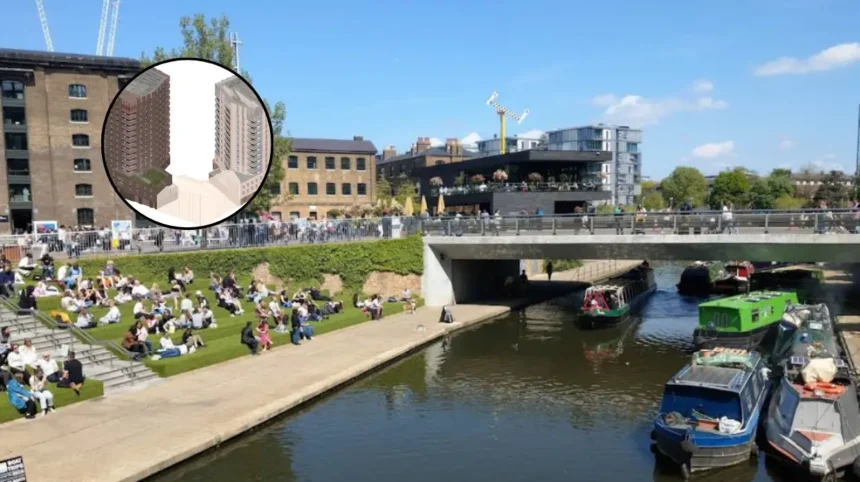
Key Points
- Major Urban Regeneration Scheme: Prominent architecture practices Allford Hall Monaghan Morris (AHMM) and Gort Scott have submitted plans to transform a 1.5-hectare brownfield site in north London into a modern, multi-use hub.
- Replaced Industrial Infrastructure: The proposed masterplan will see the demolition of an existing Parcelforce sorting office to make way for five new multi-storey buildings.
- Commercial and Scientific Focus: The development will deliver three nine-storey buildings dedicated to commercial, research, office, and hospitality operations, aimed at expanding London’s science and innovation sector.
- Residential Provision: Two 15-storey residential blocks will be constructed to provide 127 new homes, with a dedicated allocation for affordable housing.
- Community and Retail Integration: The ground levels across the development are designed to integrate retail spaces, cafés, restaurants, and dedicated community floorspace to encourage public engagement.
- Strategic Partnerships: Formulated by developer Reef + Partners on behalf of the Royal College Street Unit Trust, the project expands upon nearby high-profile science and research installations in the Knowledge Quarter. Royal College Depot
Camden (North London News) June 16, 2026 – As reported by architectural correspondents across leading regional property titles, developer Reef + Partners, acting on behalf of the Royal College Street Unit Trust, submitted a major planning application to Camden Council last week. The submission marks the official entry of a comprehensive masterplan designed by Allford Hall Monaghan Morris (AHMM) and Gort Scott to redevelop a prominent 1.5-hectare brownfield plot in north London. The proposed framework looks to substitute light industrial logistics infrastructure with five contemporary structures configured to support commercial research, retail, hospitality, and residential communities.
- Key Points
- What Are the Core Structural Details of the Proposed Masterplan?
- Who Are the Key Stakeholders and Designers Behind the Camden Scheme?
- How Does This Proposal Fit Into Camden’s Local Planning Framework?
- Background of the Royal College Depot Development
- Prediction: How This Development Can Affect Local Communities and Businesses
- For Commercial Tenants and Independent Businesses
- For the Scientific and Academic Sector
What Are the Core Structural Details of the Proposed Masterplan?
The proposed infrastructure scheme is sited on a triangular layout bounded directly by Royal College Street, St Pancras Way, and Pratt Street. Under the design configurations submitted by the project team, the plot—currently occupied by an active Parcelforce sorting office—will be completely cleared.
In its place, the spatial layout will be partitioned into distinct commercial and residential zones, distributed across five newly erected buildings.
As outlined in the design and access documentation published by Camden Council, the architectural responsibilities have been split according to specialist typologies. AHMM is serving as both the overall masterplan architect and the design lead for the commercial plots. Gort Scott has taken direct responsibility for the residential element of the scheme.
The commercial and research cluster is set to comprise three distinct nine-storey buildings. These blocks are intended to accommodate mixed-use offices alongside high-specification laboratory and research space. According to statements released within the developer’s public consultation logs, these buildings will be structurally unified via a central glazed atrium, forming a combined innovation hub.
Adjacent to this commercial core, the residential allocation will be contained within two 15-storey towers. The towers are slated to deliver 127 residential units.
The ground-floor levels across both the commercial and residential footprints are designed to establish an active street frontage.
This will be achieved through the integration of standard retail outlets, neighborhood cafés, restaurants, and open-plan community floorspace.
Who Are the Key Stakeholders and Designers Behind the Camden Scheme?
The progression of the planning application is driven by a combination of institutional property investors, specialist urban regeneration developers, and award-winning architectural practices.
The land itself is held by the Royal College Street Unit Trust, with development management led by Reef + Partners (operating under the broader Reef Group corporate umbrella).
Reef + Partners has a documented history of delivering highly technical life-sciences and commercial real estate within the immediate sub-market, notably driving the nearby Tribeca development along the Regent’s Canal.
On the design front, AHMM brings extensive experience in complex masterplanning and commercial architecture. Simon Allford, co-founder of Allford Hall Monaghan Morris, has previously spearheaded major commercial projects in central London that blend corporate workspaces with accessible public realms.
For the residential phase, Gort Scott’s involvement brings a practice known for context-driven housing and urban strategy, ensuring the high-density residential towers conform to Camden Council’s strict local planning regulations regarding light, massing, and community integration.
How Does This Proposal Fit Into Camden’s Local Planning Framework?
The application arrives at a time when Camden Council is actively balancing the demand for high-tech commercial space with an acute regional need for affordable housing.
According to the planning documentation filed last week, the inclusion of 127 homes across the two 15-storey blocks directly addresses the local authority’s housing delivery targets.
A central point of evaluation during the upcoming committee reviews will be the specific proportion and tenure split of the affordable housing component. Camden Council’s current local plan enforces strict guidelines requiring major developments to maximize on-site affordable housing, typically targeting a 50% contribution where viable.
Additionally, the transition of the 1.5-hectare site from a low-density industrial sorting office to a high-density, mixed-use scientific and commercial hub aligns with the borough’s economic development objectives.
The site sits on the periphery of the internationally recognized London Knowledge Quarter—a dense consortium of academic, cultural, and scientific institutions encompassing King’s Cross, Euston, and Bloomsbury. By introducing dedicated research and laboratory space, the development intends to act as a natural geographic extension of this cluster.
Background of the Royal College Depot Development
The filing of the formal planning application follows a multi-year period of pre-application design development, local engagement schemes, and spatial iterations.
The site, broadly referred to in development circles as the Royal College Depot, has been the focus of urban regeneration discussions for over a decade due to its low-density industrial utilization within an otherwise rapidly intensifying central London zone.
Prior to the submission last week, Reef + Partners underwent successive rounds of public consultation to alter the masterplan based on direct feedback from Camden Council planners and nearby resident associations. These design adjustments were essential to mitigate concerns regarding the massing of 15-storey towers adjacent to traditional low-rise residential streets and historic public houses.
According to official consultation records released by the project team, several notable modifications were integrated into the final design before it was submitted to the council:
- Pocket Park Repositioning: The original placement of a proposed pocket park along Royal College Street was relocated. The adjustment was made to increase visual permeability from the main road into a central, publicly accessible garden located at the interior heart of the scheme. Royal College Depot+ 1
- Atrium Integration: Architects introduced a unified innovation hub layout, connecting the independent commercial blocks via a large, shared glazed atrium to foster collaborative environments for future scientific tenants. Royal College Depot
- Massing Isolation: An undercroft section that previously linked “Building A” and “Building B” structurally was eliminated from the masterplan to create cleaner spatial separation and better airflow between buildings. Royal College Depot
- Boundary Security Adjustments: In response to safety feedback from neighboring properties, a secure gateway entry system was added between the proposed residential block on Pratt Street and the adjacent Golden Lion public house. Royal College Depot
This development follows the momentum of Reef Group’s adjacent Tribeca King’s Cross project, an 830,000-square-foot life-sciences development located nearby along the Regent’s Canal.
That project has already successfully attracted anchor tenants such as the London BioScience Innovation Centre (LBIC), proving the commercial viability and institutional demand for specialized lab spaces within the Camden borough.
Explore More Camden Council News
UK Property Verdicts: Major Tower and Church Plans Face Councils Kentish Town Glasgow 2026
Bright Horizons Abuse Families Launch Camden Council Legal Action West Hampstead 2026
Prediction: How This Development Can Affect Local Communities and Businesses
If approved by Camden Council’s planning committee, this major development will significantly alter the socioeconomic and physical landscape for residents, local business owners, and real estate occupiers in the Camden and Kentish Town areas.
The addition of 127 new residential units will directly alter local housing supply. For individuals on Camden’s social housing registers, the finalized affordable housing quota within the 15-storey blocks will dictate how many local families are successfully rehoused.
In terms of public infrastructure, the introduction of a central publicly accessible garden and a reconfigured pocket park on Royal College Street will provide much-needed green space in a heavily built-up urban environment.
However, during the projected multi-year construction phase, immediate neighbors along Pratt Street and St Pancras Way will face persistent environmental disruption, including increased heavy goods vehicle traffic, dust, and localized noise diversions.
For Commercial Tenants and Independent Businesses
The displacement of the Parcelforce sorting office marks a permanent shift away from traditional industrial employment on the site toward high-skilled office and laboratory jobs.
Local retailers, independent cafés, and pubs—such as the adjacent Golden Lion—are likely to see a substantial increase in weekday footfall driven by the influx of researchers, scientists, and commercial office workers.
The inclusion of new ground-floor retail and restaurant spaces within the masterplan will simultaneously introduce fresh commercial competition into the area. While this will diversify the options available to consumers, it may pressure existing, smaller commercial tenants by driving up surrounding commercial land values and rental rates.
For the Scientific and Academic Sector
For the broader scientific community within London’s Knowledge Quarter, this development will provide critical real estate relief. Commercial laboratory space across central London has historically faced a shortage of supply, limiting the expansion of biotech startups and spin-out companies from institutions like University College London (UCL) and the Francis Crick Institute.
The delivery of three nine-storey research buildings will allow Camden to solidify its position as a primary European center for scientific innovation, encouraging further international capital investment into the borough’s life-sciences pipeline.