- Fatal Incident: One person has been confirmed dead, and more than 100 others have been injured following a double passenger train collision.
- Location and Timing: The emergency services were called to the scene at approximately 5:15 p.m. on Friday, 19 June 2026, near Elstow, south of Bedford.
- Trains Involved: Two East Midlands Railway (EMR) services collided: the 15:50 Nottingham to London St Pancras service and the 16:40 Corby to London St Pancras service.
- Victim Named: The British Transport Police confirmed that the driver of the Corby train, 60-year-old Shaun Burton, died at the scene.
- Casualty Numbers: Emergency responders reported that 11 individuals suffered very serious injuries, 22 were seriously injured, and 56 sustained minor injuries.
- Investigative Findings: An interim report by the Rail Accident Investigation Branch (RAIB) revealed the stationary Nottingham train had experienced an automatic brake application due to a warning system fault, before being struck from behind by the Corby train, which had passed a red signal.
North London (North London News) July 2, 2026 — A major incident on the British railway network has claimed the life of a dedicated train driver and left more than 100 passengers injured after a rear-end collision between two passenger trains. Emergency services were dispatched to the Midland Main Line at Elstow, approximately 2.5 miles south of Bedford station, following reports of a severe collision involving two London-bound services at approximately 5:15 p.m.. The British Transport Police (BTP) stated on social media that multiple resources had been mobilised to handle the critical scene, which brought immediate suspensions to rail services north of London.
- What do social media and witness accounts reveal about the crash site?
- How did emergency services and officials respond to the incident?
- What did the Rail Accident Investigation Branch discover in its initial report?
- Background of the technical safety systems and historical context
- Prediction of how this development will affect rail commuters and passengers
As reported by Gwyn Topham, Transport Correspondent for The Guardian, the collision occurred when an express service originating from Corby ran directly into the rear of a stationary Nottingham-to-London train on the same track.
The deceased worker has been formally identified as 60-year-old Shaun Burton, an East Midlands Railway driver described by his employers as a “dedicated railway professional”.
According to reports from the East of England Ambulance Service, one person died at the scene, 11 people sustained very serious injuries, 22 suffered serious injuries, and 56 presented with minor injuries.
What do social media and witness accounts reveal about the crash site?
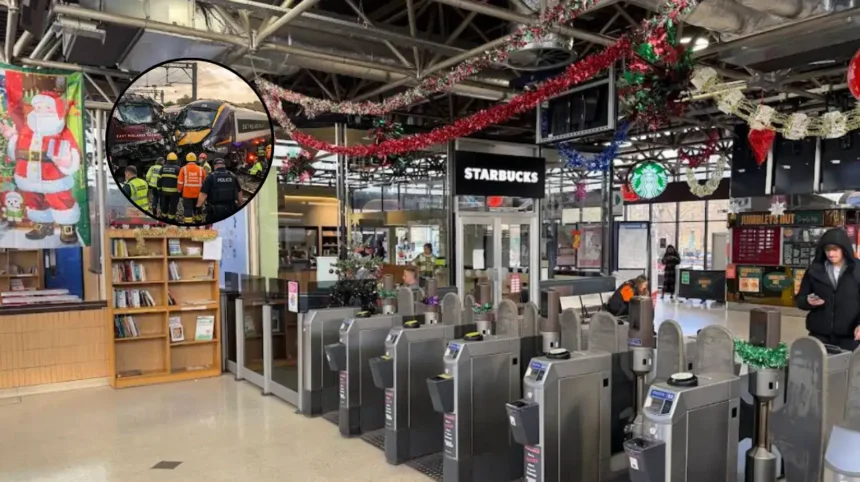
In the immediate aftermath of the disaster, unverified video footage and photographs circulated across social media networks, capturing the scale of the emergency response.
As reported by Matt Spivey of BBC News, digital uploads appeared to show two East Midlands Railway trains making physical contact, with one carriage having struck the rear of the other.
Despite the impact forces, the initial imagery indicated that both individual train sets managed to remain upright on the physical tracks, preventing a larger-scale multi-line derailment.
Furthermore, media dispatches described crowded scenes adjacent to the railway infrastructure. Photos and videos posted online by stranded passengers and local onlookers depicted dozens of individuals—some visibly bandaged and wrapped in blankets, others appearing physically uninjured—waiting alongside emergency vehicles.
Local emergency responders parked a fleet of ambulances, fire engines, and police cars on a service road running parallel to the line to systematically triage the high volume of casualties.
How did emergency services and officials respond to the incident?
A large-scale joint emergency protocol was enacted within minutes of the initial 999 emergency calls. Writing in an official statement from the Department for Transport, the Secretary of State for Transport, the Rt Hon Heidi Alexander MP, detailed that the emergency response included regional fire and rescue teams, the ambulance service, the National Police Air Service, the BTP, Bedfordshire Police, and local railway staff.
The East of England Ambulance Service confirmed it sent significant physical infrastructure to the scene south of Bedford, including land ambulances, specialized response vehicles, and an air ambulance helicopter.
As recorded in the official parliamentary record of the statement by Heidi Alexander, emergency personnel completely evacuated all remaining passengers from the site by 11:00 p.m. on Friday evening. Alexander expressed condolences to the House of Commons, stating:
“Madam Deputy Speaker, it deeply saddens me to confirm to the House that the driver of the Corby to London St Pancras train died in the collision. His family have asked for privacy at this horrendously difficult time, but I am sure I speak for the whole House when I offer them our deepest condolences.”
What did the Rail Accident Investigation Branch discover in its initial report?
The independent Rail Accident Investigation Branch (RAIB) deployed inspectors to the Elstow site within hours of the crash to secure physical and digital evidence.
According to the preliminary safety report released by the RAIB on 24 June 2026, the collision involved train 1B67 (the 15:50 Nottingham to London St Pancras service, a new five-car Class 810 Hitachi Aurora unit) and train 1H46 (the 16:40 Corby to London St Pancras service, a four-car Class 360 unit).
The RAIB’s initial physical examinations indicated that the stationary Nottingham train had come to an unexpected halt on the Up Fast line because a technical fault had developed within its on-board Automatic Warning System (AWS) equipment.
This specific equipment failure automatically triggered the train’s emergency braking system, leaving the vehicle stranded on the active main line.
Investigators further established that the oncoming Corby service subsequently passed a signal at danger (a red light) designed to protect the rear of the stationary train.
Analysis of the recovered On-Train Data Recorder (OTDR)—commonly known as the train’s black box—indicated that driver Shaun Burton initiated a manual braking command approximately nine seconds before the impact occurred.
At the moment the brakes were applied, the Corby service was moving at roughly 76 mph (122 km/h); the emergency braking action successfully reduced the physical speed to approximately 49 mph (79 km/h) at the exact point of the rear-end impact.
Background of the technical safety systems and historical context
To understand why this collision occurred despite modern rail safety standards, it is necessary to examine the specific safety infrastructure installed along the Midland Main Line.
The UK rail network relies heavily on two primary legacy systems to prevent trains from colliding: the Automatic Warning System (AWS) and the Train Protection and Warning System (TPWS).
AWS provides visual and audible indicators inside the driver’s cab as they approach signals, warning them if a signal shows a caution (yellow) or danger (red) state.
If a driver fails to acknowledge an AWS warning within a fixed timeframe, the system automatically applies the brakes to stop the train.
In this specific case, a fault within the Hitachi Class 810 unit’s AWS apparatus caused a false intervention, triggering a sudden brake application that left the Nottingham train incapacitated on a high-speed line.
The second system, TPWS, is specifically engineered to automatically apply a train’s emergency brakes if it detects that a driver is about to pass, or has passed, a red signal at speed.
Following the RAIB’s initial briefing, rail union officials highlighted a significant infrastructure gap on this specific portion of the network.
Representatives from the train drivers’ union, Aslef, noted that while TPWS is widely deployed across most British main lines, it had not been fully active or installed on this particular section of the Midland Main Line near Elstow.
Union officials publicly argued that had a fully operational TPWS trackside loop been present to detect the Corby train passing the red signal, an automated intervention would have stopped the train far earlier, likely preventing the collision entirely.
This incident marks the fourth significant passenger train collision on the United Kingdom’s mainline rail network since 2020.
The increase in incidents follows an unprecedented ten-year period of zero passenger fatalities resulting from train-on-train collisions across Great Britain, raising fresh systemic questions among safety regulators regarding rolling-stock component reliability and trackside signal protection upgrades.
Prediction of how this development will affect rail commuters and passengers
This fatal accident is expected to have long-lasting operational and structural impacts on rail commuters and passengers utilizing the Midland Main Line and connected commuter routes into London.
In the immediate short term, thousands of daily travelers face severe travel disruptions and extended journey times. Mark Budden, the East Midlands Route Director for Network Rail, confirmed that a complete suspension of passenger services between Bedford and Luton had to be enforced to allow engineering crews to lift the heavily damaged carriages, repair deformed steel rails, and completely replace torn-down overhead electrical lines. Commuters are being forced onto complex rail-replacement bus networks, significantly adding to daily travel times between Bedfordshire and London St Pancras.
In the medium to long term, the travelling public will likely experience widespread rolling-stock alterations and potential timetable delays.
Because the investigation centers on an automated equipment failure inside a relatively new fleet of Class 810 Aurora trains, safety regulators from the Office of Rail and Road (ORR) may mandate emergency inspections or temporary speed restrictions on similar models across the network.
Passengers may see temporary train shortages or adjusted schedules while tech teams check and fix software or hardware components in these automated braking units.
Additionally, passengers will likely bear the indirect costs of accelerated safety mandates. If the final RAIB report demands the urgent, retroactive installation of trackside TPWS or the acceleration of the European Train Control System (ETCS) digital signalling across the remaining legacy sections of the Midland Main Line, Network Rail will have to schedule extensive weekend line closures.
This will result in ongoing planned disruptions for passengers over the coming years as the industry works to eliminate the safety vulnerabilities exposed by the Elstow collision.