Key Points
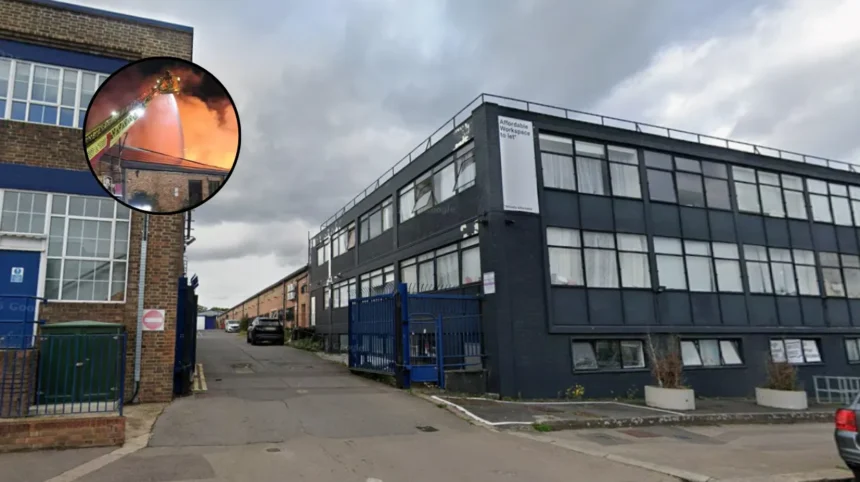
- A catastrophic building fire at Oxgate House in Brent has completely destroyed over 200 local independent businesses.
- Megan Wing, the 28-year-old owner of sustainable fashion boutique Wings World, lost her entire business infrastructure alongside priceless memorabilia belonging to her late father, Peter.
- Serious safety concerns have been raised by displaced tenants who allege structural shortcomings, including non-functional fire sprinkler systems during the emergency and substandard property maintenance.
- Simultaneously, Barnet Council has validated a contentious wave of planning applications, highlighted by a major “non-material amendment” seeking significantly taller and denser structures at the Hyde Estate mega-scheme.
- Further residential applications within Barnet include extensive loft conversions on Haslemere Avenue and major arboricultural clearance works at Heathcroft, highlighting ongoing suburban densification.
Brent (North London News) July 4, 2026 – Independent traders inside the prominent industrial hub of Oxgate House are counting the cost of an absolute economic obliteration this week after a massive, unchecked blaze swept through the multi-occupancy business estate in Brent, systematically leveling more than 200 operational commercial premises. July 4, 2026 – Concurrently, just across the borough boundaries, local planning authorities at Barnet Council have validated highly consequential structural revisions submitted by major property corporations. These revisions quietly seek to elevate building heights and maximize residential delivery units within pre-approved master plans, triggering local scrutiny over rapid infrastructural changes in North London.
- Key Points
- How Has the Oxgate House Fire Impacted the Local Business Community?
- What Changes Are Being Proposed for the Hyde Estate Mega-Scheme?
- Which Suburban Residential Alterations Have Been Submitted to Barnet This Week?
- Background of the Particular Development
- The Prediction: How These Combined Developments Can Affect Local Residents and Small Businesses
As initially reported by Senior Multimedia Journalist Ayokunle Oluwalana of MyLondon, the devastating industrial fire completely broke out within the Oxgate House business park on June 11, reducing the expansive commercial facility into an empty shell of charred concrete and twisted metalwork.
Among the worst affected is Megan Wing, the founder of Wings World, an eco-conscious clothing brand launched dynamically through social marketplace apps from her mother’s kitchen table in 2020.
Wing, who established the permanent brick-and-mortar location as a direct tribute to her deceased father, Peter, stated to reporters that she has been stripped of both her livelihood and irreplaceable physical connections to her past.
The scale of the destruction has left hundreds of local entrepreneurs entirely vulnerable, with many older traders facing structural financial ruin due to gaps in commercial insurance coverage.
How Has the Oxgate House Fire Impacted the Local Business Community?
The fallout from the fire has exposed deep systemic issues regarding industrial space leasing, maintenance standards, and corporate accountability in the capital.
According to details compiled by MyLondon, Wing’s business specialized in intercepting consumer apparel destined for landfill sites, using interactive live-stream auctions to re-home garments directly to a dedicated nationwide community.
Reflecting on the emotional weight of the loss, Wing explained that the shop was built as a way of “turning pain into purpose” after her father passed away when she was 20 years old.
Her father had been a well-known wholesale figure in the British military memorabilia circuit, and the unit housed his historic market stall uniforms and gear.
The structural integrity of the complex prior to the disaster has now drawn formal scrutiny. Wing revealed that upon moving into the premises, components of the upper mezzanine floor were visibly held together by standard sellotape.
Despite receiving formal assurances from the management agency that the masonry would be appropriately plastered and reinforced, no corrective engineering took place.
Crucially, because raw concrete and structural imperfections remained unaddressed by the landlords, Wing found herself unable to secure public liability insurance.
This insurance gap was replicated across the estate; a 70-year-old Persian rug merchant occupying an adjacent unit lost his entire uninsured inventory, rendering immediate economic recovery highly unlikely.
Tenants have further noted that the building’s internal fire suppression systems completely failed to activate as the flames advanced through the units, raising critical regulatory questions for emergency service inspectors.
Rumours are currently circulating among displaced business owners that the land will be cleared within weeks to clear the path for a high-density modern residential development block.
What Changes Are Being Proposed for the Hyde Estate Mega-Scheme?
While emergency responses dominate the western industrial sectors, Barnet Council’s planning directorate has formally registered a series of urban development filings that threaten to reshape the local skyline.
The most significant among these is Reference Number 26/2462/NMA, a Non-Material Amendment application targeting Unit 4 on Hyde Estate Road, London NW9 6JX.
As detailed within the public planning registry published by the Ham & High, the applicant is seeking to alter a previously approved major mixed-use development framework.
The requested adjustment proposes a complete revision of the master development phasing plan. More importantly, the application explicitly outlines an intention to increase the total volume of residential homes and elevate the absolute storey heights across several designated buildings.
By utilizing the “non-material amendment” legal pathway, developers can bypass a full re-application process, allowing them to adjust building profiles and density allocations under the existing umbrella consent.
The push for greater height on Hyde Estate Road mirrors wider macro-trends across outer London boroughs, where developers are attempting to maximize layout efficiencies against rising construction material costs.
Which Suburban Residential Alterations Have Been Submitted to Barnet This Week?
Beyond the large-scale commercial changes at Hyde Estate, Barnet Council has validated separate domestic applications indicating a sharp rise in high-density suburban expansion. Homeowners are increasingly maximizing their internal footprints to combat urban spacing constraints.
Under Reference Number 26/2512/192, a comprehensive architectural overhaul has been submitted for 32 Haslemere Avenue, Barnet EN4 8EZ. The proposed roof extension involves:
- Transforming the existing roof line from a standard hip to a prominent gable design.
- Integrating a substantial rear dormer window assembly.
- Mounting three distinct front-facing rooflights alongside a completely new side gable window structure.
- Constructing a detached outbuilding at the rear perimeter of the property.
Simultaneously, environmental and landscape modifications are progressing in the borough’s conservation enclaves. Application TPP/0378/26 details extensive arboricultural management planned at Heathcroft, London NW11 7HJ.
The schedule demands extensive reduction, structural thinning, and maintenance operations targeting an array of mature trees, including Magnolia, Hornbeam, Laurel, Sycamore, Prunus, Cypress, Holly, and the removal of a Dead Cherry tree.
Background of the Particular Development
The loss of Oxgate House and the expansion of the Hyde Estate reflect a broader structural shift in North London’s urban landscape. Over the last decade, industrial units across Brent and Barnet have faced intense redevelopment pressure as municipal authorities try to meet challenging housing targets.
Oxgate House was a vital remnant of the area’s mid-century manufacturing history, providing affordable, flexible spaces for start-ups, artisans, and independent wholesalers who are priced out of modern commercial developments.
The Hyde Estate regeneration area has been transitioning from light industrial use to high-density housing for several years.
This shift is part of the wider Brent Cross Cricklewood and West Hendon regeneration schemes, which aim to deliver thousands of new homes along the A5 corridor.
However, the use of non-material amendments to pack more homes and taller buildings into existing approvals has sparked ongoing debates about infrastructure capacity, strain on local healthcare and transport links, and the gradual loss of the area’s light industrial identity.
The Prediction: How These Combined Developments Can Affect Local Residents and Small Businesses
The combination of the Oxgate House fire and the densification of the Hyde Estate will likely accelerate the gentrification of the Brent and Barnet borderlands. For local small business owners and independent traders, the sudden loss of 200 affordable commercial units will create an immediate space shortage.
Since modern mixed-use developments typically command much higher commercial rents, many displaced traders may be forced to leave the area entirely or close down for good.
For local residents, the approved changes at the Hyde Estate mean the area will become noticeably denser and taller than originally planned. While this will bring more housing options to the market, it will also put extra pressure on local services and public transport hubs, like nearby Hendon Thameslink station.
At the same time, the steady rise in home extensions and tree clearance across Barnet highlights a continuing shift toward suburban densification, which will gradually alter the character, green spaces, and parking availability of these traditional residential neighborhoods.