Key Points
- Older residents of Haringey participated as models in the “Big Swish and Swagger Fashion Show” held outside Tottenham Town Hall.
- The event coincided with the national “Age Without Limits Day,” an initiative designed to challenge ageist stereotypes and celebrate positive ageing.
- The catwalk featured original, upcycled garments created by participants during weekly workshops led by fashion designer Donald Waugh.
- Haringey Reach and Connect organised the workshops, utilizing second-hand clothing and recycled materials donated by the charity Traid.
- Funding and structural support for the community event were provided by the Centre for Ageing Better and Haringey People Need Parks.
- In addition to the fashion show, the gathering served as a community hub, bringing together local organisations to provide information on health, wellbeing, and social activities for older residents.
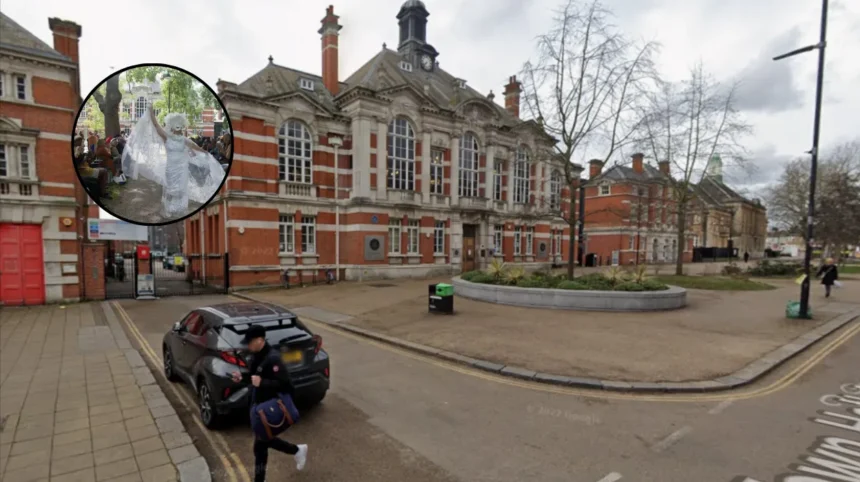
Tottenham (North London News) July 7, 2026 – Older residents in the London Borough of Haringey took to the catwalk outside Tottenham Town Hall to participate in the “Big S wish and Swagger Fashion Show,” a unique community event celebrating creativity, confidence, and positive ageing.
As reported by local media covering the Haringey borough, the vibrant outdoor showcase coincided with the national Age Without Limits Day, an annual campaign aiming to dismantle ageist stereotypes and highlight the societal value of older generations.
The runway featured custom, upcycled garments designed and crafted by local seniors during a series of intensive weekly workshops.
These sessions were organised by Haringey Reach and Connect, a service dedicated to supporting isolated residents, and were led by Donald Waugh, the professional fashion designer and founder of the community interest company Pavement2Catwalk CIC.
What Was the Purpose of the Big Swish and Swagger Fashion Show?
The primary objective of the event was to challenge entrenched societal assumptions regarding ageing while fostering community cohesion.
Hosted at The Old Nursery in Tottenham Green, the preceding workshops encouraged participants to explore self-expression by transforming recycled materials and second-hand clothing into high-fashion pieces.
According to event organizers from Haringey Reach and Connect, the initiative aimed to prove that creativity has no upper age limit.
The clothing materials used throughout the project were donated by Traid, a UK-based charity working to reduce the environmental and social impacts of clothing waste.
Under the guidance of Donald Waugh, participants learned advanced upcycling techniques, altering discarded fabrics into striking, runway-ready garments.
Financial and promotional backing for the initiative was secured through joint funding from the Centre for Ageing Better—a national charity funded by an endowment from the National Lottery Community Fund—and Haringey People Need Parks, a local authority initiative designed to revitalise community green spaces.
How Did Local Initiatives Collaborate to Support Haringey’s Older Residents?
Beyond the visual spectacle of the catwalk, the event functioned as a holistic support hub for the elderly population within the borough.
Haringey Reach and Connect utilized the gathering to centralise access to various local services. Multiple community organisations set up information stalls surrounding Tottenham Town Hall, offering guidance on social activities, walking groups, health and wellbeing programmes, and independent living support services.
By integrating these resources into a celebratory cultural event, organisers sought to reach vulnerable or isolated older residents who might otherwise struggle to navigate local healthcare and social infrastructure. The collaborative effort highlighted the intersection of creative arts, environmental sustainability through textile recycling, and public health outreach within municipal community spaces.
Background of the Tottenham Green Positive Ageing Initiative
The “Big Swish and Swagger Fashion Show” is situated within a broader, multi-year effort by British social policymakers to address the challenges of an ageing population, specifically loneliness and ageism.
According to statistical data from the Office for National Statistics (ONS), urban areas like London present unique challenges for older demographics, where social isolation can be exacerbated by rapid urban development and shifting local populations.
The Centre for Ageing Better launched the national “Age Without Limits” campaign to directly counter age discrimination, which research indicates negatively impacts physical and mental health.
Concurrently, the charity Traid has increasingly partnered with grassroots organisations to promote textile circularity, using fashion design as a medium for social inclusion.
In Haringey, a borough marked by high levels of economic diversity, Reach and Connect has historically focused on bridging the gap between isolated individuals and community networks.
This fashion show represents the culmination of combining these distinct agendas—anti-ageism, environmental sustainability, and local health integration—into a single, replicable municipal framework.
Prediction: How This Development Can Affect Older Audiences and Urban Communities
This development is highly likely to catalyze increased participation in grassroots community programing among older audiences across Greater London.
By reframing support services through the lens of high-energy visibility and artistic validity rather than clinical vulnerability, future initiatives will likely see reduced stigma associated with seeking aid.
Participants and attendees are expected to experience measurable improvements in localized social connectivity, directly mitigating the risks of long-term isolation.
Broader Public Policy Shift
For municipal councils and public health commissioners, the success of the Tottenham Green event provides a benchmark for asset-based community development.
It predicts a structural shift toward funding multi-disciplinary projects where environmental charities (such as Traid), creative enterprises (such as Pavement2Catwalk), and local government bodies pool resources.
This collaborative model will likely be duplicated across other boroughs, altering how local parks and historical town halls are utilized for public health delivery.