Key Points:
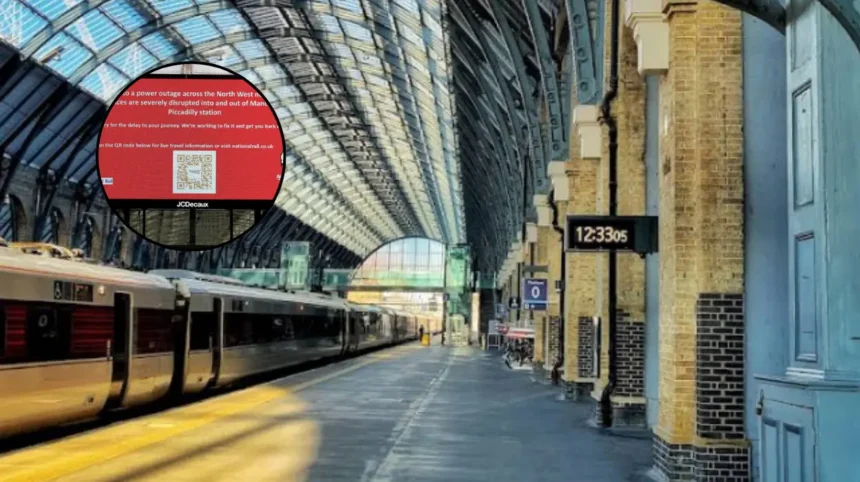
- A power failure at a regional signalling centre shortly before 2:00 pm on Thursday caused severe disruptions to rail services across north-west England.
- The system failure led to widespread delays and cancellations affecting multiple regional and cross-country train operating companies.
- Operators impacted include Avanti West Coast, East Midlands Railway, Northern, TransPennine Express, Transport for Wales, CrossCountry, and London Northwestern Railway.
- Although power has been restored and trains can run, National Rail warned that delays and disruptions will persist until at least noon on Friday.
- Morning service delays are primarily driven by train crews and rolling stock being displaced from their scheduled starting locations.
Manchester (North London News) August 7, 2026 – Rail passengers across north-west England are experiencing a second consecutive day of major travel disruption following a major power failure at a key regional signalling centre. The technical fault, which occurred shortly before 2:00 pm on Thursday, knocked out essential control systems and caused widespread cancellations and delays across several key trunk lines. Although power to the signalling infrastructure has since been restored and tracks have reopened for service, National Rail confirmed on Friday morning that operational recovery remains ongoing, with service interruptions expected to linger until at least noon.
- Key Points:
- What Caused the Widespread Rail Disruptions in North-West England?
- Which Train Operators and Routes Have Been Affected by the Power Outage?
- Why Is Disruption Continuing Despite Trains Resuming Operations?
- What Is the Background of This Particular Development?
- How Will This Disruption Affect Commuters and Rail Passengers?
What Caused the Widespread Rail Disruptions in North-West England?
The operational chaos was initiated on Thursday afternoon when a sudden power outage disrupted the regional signalling centre responsible for managing train movements across the north-west rail network. Without active signalling controls, safety protocols mandated an immediate halt or severe speed restriction on train operations across affected corridors.
The initial impact resulted in immediate cancellations for services operated by CrossCountry and London Northwestern Railway, alongside significant timetable degradation for regional connections. Infrastructure engineers worked throughout Thursday evening and overnight to stabilize the power supply and restore primary signalling function to the regional network grid.
Which Train Operators and Routes Have Been Affected by the Power Outage?
While technical functionality has been returned to the signalling network, the ripple effect of Thursday’s outage continued into Friday morning peak transit hours. Operators confirming ongoing impacts to their scheduled services include:
- Avanti West Coast: Experiencing delays and revised schedules on long-distance intercity routes connecting the north-west to London Euston and Scotland.
- Northern: Reporting cancellations and route alterations across regional lines serving key metropolitan areas, including Manchester, Liverpool, and Preston.
- TransPennine Express (TPE): Experiencing ongoing schedule alterations across cross-country northern routes.
- East Midlands Railway: Facing knock-on delays on services linking the East Midlands to north-western destinations.
- Transport for Wales: Disruption reported on cross-border services operating between Wales and the north-west of England.
Why Is Disruption Continuing Despite Trains Resuming Operations?
According to statements issued by National Rail on Friday morning, the continuation of passenger delays is due to secondary operational logistics rather than ongoing electrical failures. Because the power outage occurred during active afternoon operations on Thursday, dozens of trains were halted mid-journey or forced to terminate at secondary stations.
Consequently, both rolling stock and train crew members were left out of position at the end of the operating day. To resume standard timetables, operators must reposition trains and train drivers to their designated depot baselines, leading to morning cancellations, shortened services, and rolling delays through the early afternoon.
What Is the Background of This Particular Development?
Regional rail networks in the north-west of England rely heavily on centralized signalling locations to coordinate passenger and freight movements across high-density corridors. When a central facility suffers a power interruption, safety systems automatically set signals to red to prevent collisions, bringing movement to a standstill.
While primary power grids usually feature secondary and tertiary redundancy systems—such as backup generators and uninterruptible power supply (UPS) units—major faults can occasionally cause temporary system drops. Over recent years, rail infrastructure managers have faced ongoing challenges in upgrading power resilience and modernizing legacy signalling architecture across northern England to prevent single-point failures from paralyzing regional transport networks.
How Will This Disruption Affect Commuters and Rail Passengers?
The ongoing operational recovery will directly affect thousands of daily commuters, business travelers, and long-distance passengers across the north-west region throughout Friday. In the short term, passengers are likely to face overcrowded carriages, last-minute platform changes, and unexpected connections as operators work to return displaced rolling stock to standard service lines.
For daily commuters, morning and mid-day travel times will remain lengthened, increasing the risk of missed connection points at major hubs such as Manchester Piccadilly, Liverpool Lime Street, and Preston. In the broader perspective, repeated network disruptions of this scale place operational friction on local businesses reliant on commuter transit, while reinforcing passenger demand for accelerated infrastructure investment in network redundancy and power grid reliability.