Key Points
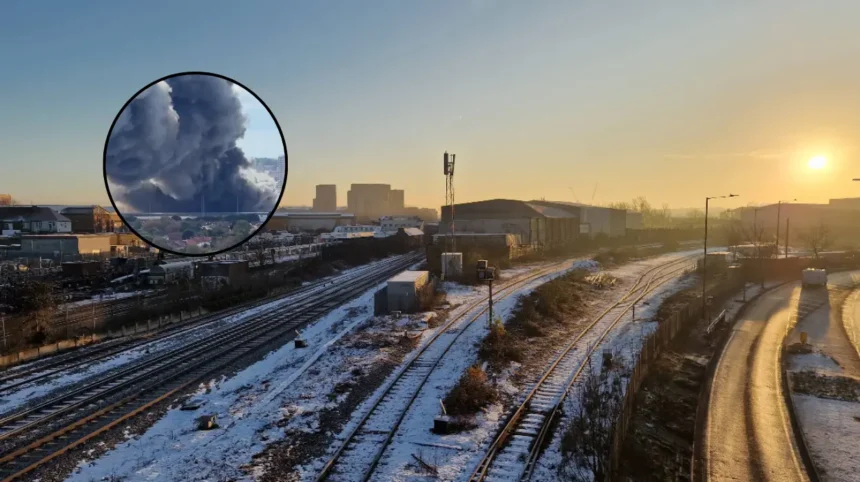
- A large fire at a mixed waste disposal site on an industrial estate in Neasden, North London, began at around 11:30am on Friday.
- Around 125 firefighters and 20 fire engines were deployed to tackle the blaze near Wembley Stadium.
- Thick smoke led to the closure of the entire Metropolitan line on the London Underground, along with a partial closure of the Jubilee line and disruption to Chiltern Railways services.
- The London Fire Brigade is investigating the exact cause of the fire.
- There have been no reports of fatalities or injuries resulting from the incident so far.
Neasden (North London News) August 29, 2026 – Fire investigators have launched a formal inquiry into the cause of a massive industrial blaze near Wembley Stadium that triggered severe transport disruptions across London. The incident, which began shortly after 11:30 am on Friday at a mixed waste facility on an industrial estate in Neasden, North London, required the immediate deployment of around 125 firefighters and 20 fire engines. Due to the proximity of the facility to major railway tracks, smoke and safety risks forced Transport for London to suspend services entirely on the Metropolitan Line and partially on the Jubilee Line, causing widespread commuter chaos that has extended into a second day.
- Key Points
- What caused the major waste facility fire in Neasden?
- How has the Wembley blaze affected London transport networks?
- What steps are emergency services taking to control the situation?
- Background of the Neasden industrial fire
- Predictions: How this development will affect commuters and local businesses
What caused the major waste facility fire in Neasden?
According to reports by transport and local news correspondents, the exact cause of the fire remains under investigation. The London Fire Brigade confirmed that crews arrived rapidly to find a substantial quantity of mixed waste alight within the industrial compound. Firefighting operations continued well into Friday evening to control the flames and extinguish deep-seated hotspots. Emergency services have maintained a perimeter around the site to allow specialist fire investigators to assess the area safely and determine whether the ignition was accidental or linked to specific site materials.
How has the Wembley blaze affected London transport networks?
As reported by transport reporters across national news outlets, the fire’s close proximity to key rail lines resulted in immediate safety shutdowns across multiple transit corridors. Transport for London confirmed that the entire Metropolitan Line was suspended to prevent trains from running through dense smoke plumes and potential hazards on the tracks. Furthermore, the Jubilee Line experienced a partial suspension alongside severe delays on its remaining active stretches. National rail operator Chiltern Railways was also impacted, with services running through Wembley Stadium and surrounding stations subjected to cancellations, speed restrictions, and rerouting.
What steps are emergency services taking to control the situation?
As detailed by emergency service bulletins, crews implemented structural damping and containment procedures to prevent the flames from spreading to adjacent industrial properties. London Fire Brigade commanders highlighted that tackling waste fires presents unique challenges due to buried combustible materials, requiring prolonged damping-down operations. Residents in the immediate vicinity of Neasden and Wembley were advised to keep windows and doors closed to minimise smoke inhalation while the fire was brought fully under control.
Background of the Neasden industrial fire
Industrial sites in North West London, particularly around Neasden and Wembley, host several recycling, waste management, and heavy logistics facilities situated close to key national transport corridors. Waste site fires in urban areas present complex operational challenges for emergency services due to the varied composition of materials stored, which can include plastics, timber, and general refuse. These types of fires frequently require large-scale deployments of personnel and specialist equipment to ensure water supplies are maintained over extended periods. Because major railway lines run alongside these industrial zones, any substantial incident routinely impacts mainline train operators and London Underground infrastructure simultaneously.
Predictions: How this development will affect commuters and local businesses
The ongoing transport disruption and subsequent investigation are predicted to impact local stakeholders across several areas:
- Commuters and Travellers: Passengers using the Metropolitan Line, Jubilee Line, and Chiltern Railways should anticipate lingering delays, potential timetable revisions, and crowd congestion as transport operators work to clear backlogs and perform required track safety inspections.
- Local Residents and Air Quality: Nearby communities in Neasden and Wembley may experience localized air quality issues or residual odor until dampening-down operations are fully completed.
- Industrial Site Operators: Waste management facilities across North London are likely to face increased scrutiny, safety compliance audits, and potential operational reviews regarding site storage capacities and fire prevention measures.