Key Points
- Government-funded uniforms issue: The Barnet Hill Academy, a faith school in north London moving from private sponsorship to Voluntary Aided status with government funding, faces strong criticism over their mandatory hijab requirement for Muslim female students above seven years of age.
- Conservative Party reaction: The Shadow Education Secretary Laura Trott and Shadow Minister for Women and Equalities Joy Morrissey criticized this policy on grounds that it may contravene equality legislation and human rights law.
- Public disagreement through social media: Presenter Mehdi Hasan compared the case of compulsory hijab for Muslims at faith schools with compulsory kippah for Jews at government-funded schools.
- Government response: Education Secretary Lucy Powell expressed her view against compelling young female children to wear religious scarfs in schools in Parliament.
- Policy change: The school’s online uniform policy statement was updated by the school and now specifies that girls who are not Muslim are exempt from wearing scarfs.
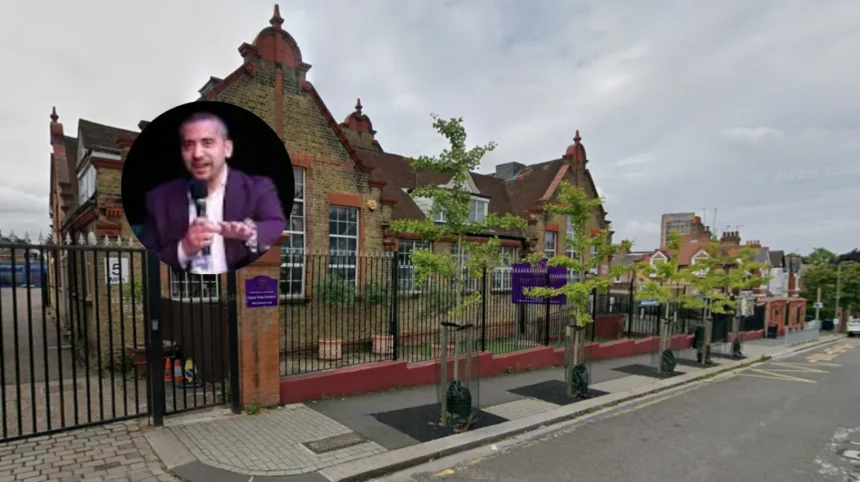
Barnet (North London News) September 17, 2026 – A severe national row over freedom of religion, state education regulations, and children’s rights has erupted following revelations that Barnet Hill Academy, a newly state-funded Islamic Voluntary Aided school in north London, enforces a compulsory hijab policy for female pupils from Year 3 onwards.
As reported by political commentators across national outlets, Shadow Education Secretary Laura Trott raised the matter publicly to challenge both the school’s administration and local authority oversight. Trott stated:
“No one should be telling girls to cover their hair, least of all a school. We, the Conservatives, are campaigning to make sure that this [policy], which we believe breaches various rules and possibly the law, is overturned. Under a Conservative government, this would never happen, and we’re trying to stop it under this awful government too.”
Prior to the public outcry, the school’s published dress code listed the hijab alongside standard uniform items as compulsory for all female pupils starting at age seven. Only after substantial public backlash did Barnet Hill Academy update its online uniform policy to state that wearing a hijab is “not a requirement for any non-Muslim students attending the school.” However, critics highlight that the revised wording explicitly confirms that the garment remains compulsory for every pupil designated as Muslim.
How did commentators and politicians debate the policy online?
The political dialogue expanded rapidly beyond parliamentary corridors onto digital platforms, centered on the boundary between state regulations and religious freedom. Broadcaster and author Mehdi Hasan publicly intervened on X (formerly Twitter) to challenge the opposition frontbench’s framing of the issue.
Hasan wrote on social media:
“Will the Tories also be requiring state-funded Jewish schools in the UK not to make the kippah mandatory…Or are the Tories only picking on Islam and Muslims, as usual?”
Commentators responding to Hasan pointed out key distinctions between male religious headwear and female modesty garments, highlighting that Islamic scholars themselves debate whether the hijab should be compulsory for young children. Critics noted that the kippah serves purely as a sign of reverence to a higher power, whereas forced modesty dress codes impose social and sexualised burdens on young female pupils.
Opponents of Hasan’s argument further recalled a controversial 2009 speech in which Hasan referred to non-Muslims as ‘kafirs’ and compared them to animals. Although Hasan published a formal apology in 2019 stating, “like a lot of journos (humans?) I’ve said things years ago that I now deeply regret,” his historical statements continue to draw scrutiny during debates on Islamic practices in public institutions.
How have education authorities and advocacy groups responded?
In a House of Commons session, Shadow Education Secretary Laura Trott directly questioned Education Secretary Lucy Powell regarding state uniform standards, asking whether it was acceptable for primary-aged girls to be mandated to wear a hijab to school. Education Secretary Lucy Powell responded with a direct “No.”
As reported by news outlets covering the parliamentary exchanges, secular and humanist organisations welcomed the government’s firm stance. Alejandro Sanchez, spokesperson for the National Secular Society (NSS), stated:
“We welcome the Education Secretary’s confirmation that schools should not require hijab as part of their uniform policy. Her department must now ensure that no school is allowed to enforce sexist religious modesty codes. Women should be free to choose religious dress; young girls should not have it imposed upon them.”
Similarly, Stephen Evans, Chief Executive of the National Secular Society, noted:
“State-funded schools should bring children together, not divide them by faith and, by extension, ethnicity. The council must pause the implementation of this decision and subject this proposal to proper public and democratic scrutiny.”
Humanists UK also issued a statement supporting the Department for Education’s position, noting that the UN Convention on the Rights of the Child protects a child’s independent freedom of thought and religion, which should not be waived by educational institutions enforcing strict religious dress requirements on seven-year-olds.
What is the background of this particular development?
Barnet Hill Academy originally operated as an independent, fee-paying Islamic faith school in West Hendon, North London. In mid-2026, Labour-run Barnet Council approved the academy’s application to transition into the state sector as a Voluntary Aided (VA) school, making it eligible to receive direct British taxpayer funding.
Under UK education law, Voluntary Aided faith schools are granted broad latitude regarding religious instruction and faith-based admissions policies. However, all state-maintained schools remain subject to national equality legislation, including the Equality Act 2010 and the Human Rights Act 1998, which prohibit discriminatory uniform practices and protect pupils against forced religious observance.
The decision to grant state funding to Barnet Hill Academy was signed off by a council officer under delegated authority without a full council debate. Following the discovery of the school’s mandatory dress code, Shadow Education Secretary Laura Trott and Shadow Equalities Minister Joy Morrissey formally reported Barnet Hill Academy to the Equality and Human Rights Commission (EHRC), demanding an investigation into whether taxpayer funds are supporting policies that breach equality laws.
What is the prediction for how this development will affect school communities and faith institutions?
The regulatory scrutiny and public political debate surrounding Barnet Hill Academy are likely to have far-reaching consequences across the UK education sector, particularly for faith schools, parents, and local councils.
- Department for Education Policy Directives: Education Secretary Lucy Powell’s public disapproval of mandatory primary school hijabs is expected to prompt updated national guidance from the Department for Education (DfE). State-funded faith schools across England—including the eight other Islamic state schools identified by secular groups as having similar uniform rules—will likely face mandatory policy reviews to ensure dress codes remain strictly voluntary.
- Increased Local Authority Scrutiny: Local councils approving transitions of independent religious schools into state-funded Voluntary Aided status will face heightened administrative oversight. Unelected council officers will no longer be able to quietly sign off on state sector entries without thorough scrutiny of uniform regulations, admissions criteria, and legal compliance.
- Impact on Primary School Pupils and Families: For families and young children attending state-funded faith schools, a enforced national standard protecting uniform choice will ensure that religious observance remains a matter of personal and familial freedom rather than an institutional mandate. Non-Muslim students seeking places at local Voluntary Aided schools will also gain clearer protections against non-inclusive regulations.