Key Points
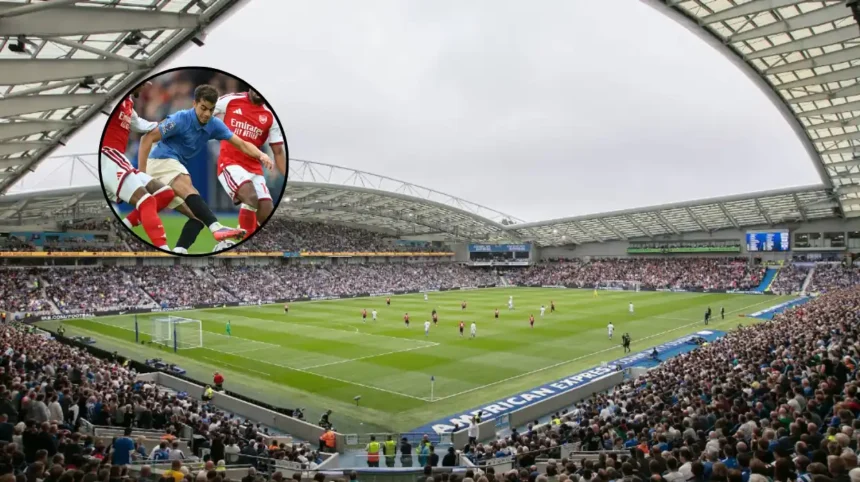
- 3-0 Tactical Defeat: Brighton & Hove Albion defeated defending Premier League champions Arsenal 3-0 at the Amex Stadium, marking Arsenal’s first league defeat of the season.
- The “Rugby” Long-Ball Strategy: Brighton manager Fabian Hürzeler employed a direct kicking tactic reminiscent of rugby territory play, utilising goalkeeper Bart Verbruggen to bypass Arsenal’s initial pressing line.
- Statistical Impact: Data published by The Sun and analyzed across sports outlets confirmed Verbruggen completed 22 accurate passes, with 25 out of his 40 total attempted passes (62.5%) being long direct balls.
- Targeting Arsenal’s Left Flank: The Seagulls consistently launched aerial deliveries towards Arsenal’s left side, overloading the area with right-back Ferdi Kadıoğlu to secure second-phase loose balls.
- Goalscorers: Pascal Groß opened the scoring in the 31st minute, Charalampos Kostoulas doubled the lead in the 45th minute, and Chema Andrés sealed the win with a 57th-minute header.
- Arteta’s Admission: Arsenal manager Mikel Arteta conceded post-match to Sky Sports that his team was “extremely poor technically” in their own half and lost basic duels across the pitch.
Arsenal (North London News) September 22, 2026 – Brighton & Hove Albion produced a dominant 3-0 victory over reigning Premier League champions Arsenal at the Amex Stadium, ending the Gunners’ unbeaten start to the 2026–27 campaign through a calculated long-ball tactical framework. As reported by BCE Football News, Brighton deliberately drew inspiration from rugby union territory kicks, repeatedly launching high, direct balls into touch or deep target zones to force physical duels inside Arsenal’s defensive third rather than relying on short build-up play from the back.
As detailed by statistics published by The Sun and reported by Goal, 24-year-old Dutch goalkeeper Bart Verbruggen functioned as the primary catalyst for the approach. Verbruggen, who was previously linked with a potential move to Bayern Munich, repeatedly stood with his foot on the ball during build-up phases to invite Arsenal’s high press before launching long aerial passes over the pressing block.
Out of 40 total passes attempted by Verbruggen during the 90 minutes, 25 were long passes (62.5%), as reported by tactical analyst Fahd Ahmed on Medium. Rather than attempting risky short combinations against Arsenal’s aggressive frontline, Verbruggen targeted the space occupied by Arsenal’s central defenders Gabriel and Ezri Konsa, as well as the left-back area, forcing them into repeated aerial contests.
Why did Mikel Arteta’s side struggle against Fabian Hürzeler’s direct strategy?
The tactical setup designed by Brighton head coach Fabian Hürzeler targeted Arsenal’s defensive structure by establishing numerical overloads around second-ball landing zones. As noted in match analysis by Read Arsenal, Brighton matched Arsenal man-for-man across the pitch when defending, while pushing right-back Ferdi Kadıoğlu into advanced positions whenever Verbruggen went long. This enabled Brighton to construct 3v3 and 4v3 overloads on the right flank, ensuring that even when Arsenal won the initial aerial header, Brighton’s outfield players were positioned to gather the secondary loose ball.
As reported by BCE Football News, Brighton recovered possession from Arsenal 10 times inside the final third of the pitch during the match. In statements provided to Sky Sports following the match, Arsenal manager Mikel Arteta acknowledged the structural issues that plagued his side throughout the contest:
“They were always first in the first duel, in the second actions, second balls,” Arteta stated, as quoted by Read Arsenal. “We were extremely poor technically in our own half against a team that pressed man to man.”
The opening goal in the 31st minute demonstrated the effectiveness of the routine. After recycling play back to Verbruggen, the Dutch international launched a direct ball to the right wing, leading to a thrown-in high up the pitch that ultimately allowed midfielder Pascal Groß to strike from distance past Arsenal goalkeeper David Raya.
Brighton doubled their lead in the 45th minute on the verge of half-time. Moments after Bukayo Saka saw a rare Arsenal chance saved by Verbruggen, the goalkeeper rapidly distributed the ball to spring a counter-attack, allowing 20-year-old forward Charalampos Kostoulas to drive forward and finish from 25 yards. Brighton added a third goal before the hour mark when Chema Andrés headed home a corner at the far post in the 57th minute.
Background of the particular development
The tactical confrontation between Mikel Arteta and Fabian Hürzeler comes against the backdrop of an evolving rivalry that began during the 2024–25 Premier League season, marked by high-profile touchline exchanges and contrasting tactical philosophies. Arsenal entered the 2026–27 season as defending Premier League champions, having established one of the most dominant defensive records and set-piece structures in European football.
Brighton’s recruitment strategy under owner Tony Bloom has consistently prioritized high-performance goalkeepers capable of executing specialized passing ranges. The signing of Dutch international Bart Verbruggen from Anderlecht in 2023 was tailored around build-up flexibility. While Brighton previously gained a reputation under Graham Potter and Roberto De Zerbi for strict, short-passing build-up play inside their own penalty area, Hürzeler’s appointment introduced greater physical dynamism and directness.
Prior to the match on September 19, 2026, Arsenal had successfully managed deep-block opponents, but had rarely encountered teams willing to combine a strict man-to-man high press with intentional rugby-style long-ball restarts designed to bypass midfield progression entirely.
Prediction: How this development can affect Premier League opposition and Arsenal’s tactical approach
This tactical development is likely to have immediate ramifications for both Arsenal’s defensive preparation and the wider tactical landscape of the Premier League:
- Copycat Tactics from Opposition Managers: Opposing coaches facing Arsenal will closely analyze Hürzeler’s blueprint. Teams possessing physical wide players and goalkeepers with long-range kicking accuracy may abandon short build-up play against Arsenal’s high press, choosing instead to target Arsenal’s full-backs with direct aerial passes to contest second balls in high areas.
- Adjustments to Arsenal’s Defensive Press: Mikel Arteta and his coaching staff will be forced to modify their high-pressing triggers. If teams consistently bypass Arsenal’s initial press by playing over it, Arsenal may drop their defensive line deeper or reallocate midfield players to shield the drop zones rather than committing four or five players to press the opponent’s 18-yard box.
- Personnel Re-evaluations in Arsenal’s Backline: Arsenal’s physical dominance in individual aerial duels has been a cornerstone of their league success. Defeats of this nature could prompt Arteta to alter his full-back selections, favoring greater height and aerial capability over inverted mid-field qualities when facing opponents known for direct long-ball execution.
- Validation of Brighton’s European Ambitions: For Brighton, successfully disrupting the reigning champions with a distinct tactical blueprint provides a major confidence boost. It confirms that Hürzeler’s side can flex between possession-based football and high-intensity, direct territorial play, positioning them as serious contenders for European qualification berths this season.