Key Points
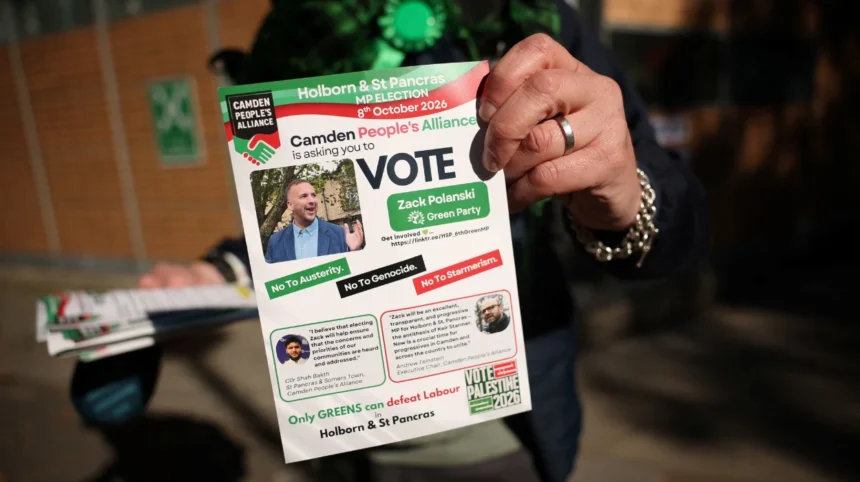
- Labour’s Sagal Abdi-Wali secured victory in the Holborn and St Pancras by-election with 12,292 votes (45.17%), retaining the north London seat following the resignation of former Prime Minister Sir Keir Starmer. Yeni Şafak
- Green Party leader Zack Polanski finished second with 8,928 votes (32.8%), securing a 13% swing to the Greens, but falling short of overturning Labour’s stronghold by over 3,000 votes. ITVX
- Polanski confirmed he will remain Green Party leader, describing the result as an “amazing opportunity to build to the next election,” despite mounting internal criticism. ITVX
- Controversy surrounded the Green campaign following the passage of a contentious “Zionism is racism” motion at the party conference, which prominent Greens admitted caused “genuine damage”. The Guardian
- Prominent Green figures, including former leader Caroline Lucas and MP Siân Berry, expressed strong concern regarding party procedures and internal policy fallout. The Guardian
- Voter turnout fell significantly to 38.6%, representing the lowest turnout for an English parliamentary by-election during the current parliament. NewsCord
Camden (North London News) October 9, 2026 — A little more than half an hour before Sagal Abdi-Wali was declared the winner of the Holborn and St Pancras by-election on Friday, Zack Polanski’s Green Party admitted that they would not win.
- Key Points
- How did the final election results pan out in Holborn and St Pancras?
- Did the controversial conference motion on Zionism damage Green prospects?
- What was the campaign strategy and why did local activists criticize it?
- Background of the Holborn and St Pancras Development
- Prediction: How will this development affect the Green Party and its electoral audience?
The declaration at Camden’s King’s Cross office complex concluded a high-stakes campaign to fill the parliamentary seat vacated by former Prime Minister Sir Keir Starmer. Abdi-Wali, who serves as the leader of Camden Council, achieved 12,292 votes (45.17%), maintaining Labour’s historic grip on the constituency. Polanski achieved second place with 8,928 votes (32.8%), adding over 22 percentage points to the party’s previous baseline in the area. However, local activists and party figures have voiced frustration regarding campaign strategy and a damaging policy controversy that emerged in the final days of campaigning.
How did the final election results pan out in Holborn and St Pancras?
The by-election was triggered by Sir Keir Starmer’s formal departure from Parliament. Labour’s Sagal Abdi-Wali successfully defended the seat with a majority of 3,364 votes over Polanski.
As reported by Peter Walker of The Guardian, total voter turnout dropped to 38.6%, marking a decrease of 15.4 percentage points compared to the 2024 general election and representing the lowest turnout for an English parliamentary by-election in the current legislative period.
Addressing supporters and journalists shortly after 03:00 BST at Camden Council’s King’s Cross headquarters, Abdi-Wali framed the outcome as a triumph for community cohesion.
“We cannot allow that work, built over generations, to be casually undone by those who seek to divide us,” Abdi-Wali stated. “We have a responsibility to defend what we’ve built, and pass it on. Hope is not naive. People need to believe that politics can make their lives better… Winning not by making people afraid of each other, but by bringing people together.”
Did the controversial conference motion on Zionism damage Green prospects?
The final week of Polanski’s campaign was dominated by controversy after Green Party members voted at their annual conference to pass a motion defining Zionism as a form of racism and calling for the abolition of the Israeli state.
As reported by The Guardian, Green MP Siân Berry stated that opponents of the motion were “persuaded” not to publicly fight the text before the vote to avoid disrupting Polanski’s campaign. Berry subsequently acknowledged that the passage of the motion inflicted “genuine damage” on the party’s reputation and offered an apology for not working harder to defeat it.
Former Green Party leader Caroline Lucas strongly criticised the handling of the policy in an article for the New Statesman. Lucas wrote that passing the motion crossed “a very significant red line” and argued that the Green Party was “woefully exposed” to entryism, urging an immediate overhaul of internal policy-making rules.
Furthermore, Vivien Lichtenstein, Chair of Jewish Greens, publicly called for Polanski to resign as party leader, citing a lack of leadership after Polanski missed the debate and vote at the conference.
When questioned on the doorstep and during campaign stops, Labour candidate Abdi-Wali noted that voters expressed genuine concern over the motion. Polanski subsequently described the “Zionism is racism” motion as “imperfect,” stating he would have preferred an amended text and confirming he wished to revise the policy “at the earliest opportunity.”
As reported by The Guardian, Polanski also confirmed that the party is investigating a member involved in proposing the motion following court document references regarding links to a convicted individual.
What was the campaign strategy and why did local activists criticize it?
Local grassroots activists and council members expressed frustration with the direction of the Green campaign, with one prominent voice labelling the effort as overly “Whitehall-coded.” Critics argued that the national leadership focused too heavily on national media narratives and Westminster positioning rather than addressing specific local Camden concerns.
Polanski defended the campaign strategy and insisted that his position as leader remains secure despite the defeat.
Speaking to the BBC immediately following the declaration, Polanski stated:
“Of course I can carry on as leader of the Green Party. We’re a party of 220,000 members. I’ve taken a loss tonight but our movement is so much bigger than one election or one motion and we’re going to grow.”
Speaking later to ITV News, Polanski rejected claims that he had lost control of internal party machinery:
“I don’t think that’s true at all. I’ve got a party that was 55,000, 60,000 members when I was running for leader, it’s now 220,000. Any member is entitled to their opinion. We’re a democratic grassroots party.”
Polanski maintained that achieving second place with a 13% swing demonstrated that the Greens pose “more of a threat” to Labour than in previous years. However, polling experts, including Professor Sir John Curtice, noted that claiming a simple 22% vote share growth was somewhat misleading given the unique context and lower turnout of parliamentary by-elections.
Background of the Holborn and St Pancras Development
Holborn and St Pancras has historically served as a central redoubt for the Labour Party in inner London. The constituency was represented by Sir Keir Starmer from 2015 until his resignation in September 2026. Following Labour’s national general election victory and subsequent cabinet developments, Starmer vacated the seat, prompting the October by-election.
The Green Party identified the constituency as a prime target to challenge Labour from the left, building on urban parliamentary gains made in recent years. The by-election became a testing ground for whether the Greens could consolidate left-leaning voters dissatisfied with Labour’s governmental record. However, the contest coincided directly with internal structural challenges within the Green Party, culminating in high-profile platform disputes over foreign policy resolutions at their annual conference.
Prediction: How will this development affect the Green Party and its electoral audience?
The outcome in Holborn and St Pancras will likely have immediate consequences for both the Green Party’s internal governance and its appeal to urban electorate bases.
For the Green Party membership and core supporters:
- Internal Reform Pressure: Pressure from senior figures such as Caroline Lucas and Siân Berry will likely force the party to reform its conference voting procedures to prevent future policy disruptions. The Guardian
- Leadership Scrutiny: Although Zack Polanski has pledged to remain leader, failure to win the seat alongside internal pushback from groups such as the Jewish Greens may lead to prolonged debate regarding his leadership style and political judgment. Yeni Şafak
- Electoral Strategy Reassessment: The result highlights the potential limitations of relying on national media profile over localized community campaigning. Future target-seat strategies may shift focus back toward local municipal issues to avoid alienating core progressive voters sensitive to party infighting.