Key Points
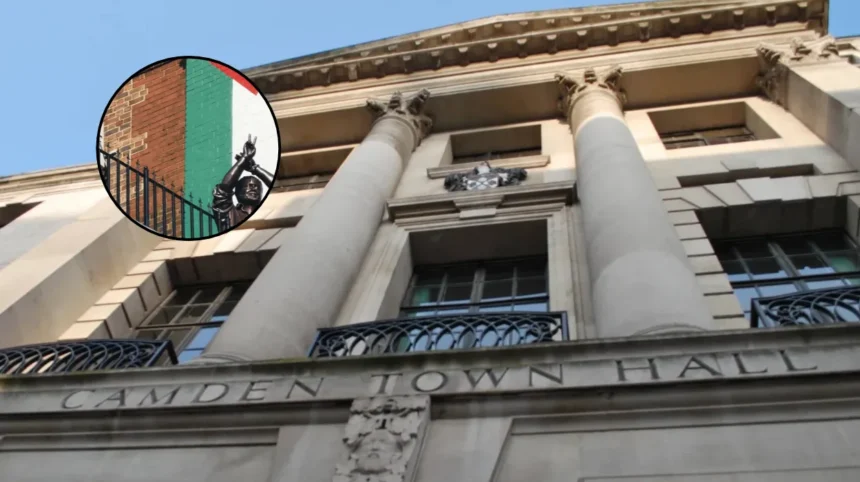
- Council Investigation: Camden Council has launched an official probe into the unauthorised installation of a statue depicting Marwan Barghouti on the roof of a Palestinian organisation in Bloomsbury, North London.
- Legal and Planning Concerns: The statue was erected without planning permission or local authority consent, triggering a review by local council enforcement officers.
- Conviction Details: Barghouti is currently serving five life sentences plus an additional 40 years in an Israeli prison following his conviction for his role in terrorist attacks and the murder of five people during the Second Intifada.
- Symbol of Resistance vs. Convicted Terrorist: Whilst supporters and political activists campaign for his release and view him as a prominent figurehead of Palestinian resistance, critics and community representatives have expressed alarm over the public display.
- Attribution & Enquiries: Council officials have confirmed that statutory planning control rules apply and that an assessment is underway to determine appropriate enforcement action.
Bloomsbury (North London News) October 28, 2026 – Camden Council has launched a formal investigation into the unauthorised erection of a statue depicting Marwan Barghouti on the roof of a Palestinian centre in Bloomsbury, Central London.
As reported by local media and municipal observers, local authority officials were alerted to the visual installation after it was erected on the roof section of the premises without prior planning application or statutory consent. Camden Council has confirmed that its planning enforcement division is actively reviewing the site to ascertain whether planning regulations have been breached and to decide what corrective measures, including potential removal orders, may be issued.
Marwan Barghouti, a high-profile Palestinian political figure, is currently serving five consecutive life sentences alongside an additional 40-year sentence in an Israeli prison. He was convicted by an Israeli civilian court in 2004 on multiple counts of murder and attempted murder linked to his leadership role within the Al-Aqsa Martyrs’ Brigades during the Second Intifada, an armed Palestinian uprising against Israel in the early 2000s. The court held him responsible for attacks that resulted in the deaths of five people.
Despite his convictions, Barghouti remains an influential and controversial figure in Middle Eastern politics. Supporters, international advocacy groups, and Palestinian factions frequently campaign for his release, portraying him as a unifying national symbol of Palestinian self-determination and political resistance. Conversely, victim groups, Israeli authorities, and anti-terrorism campaign organisations designate him strictly as a convicted terrorist whose public commemoration causes severe distress to victims’ families and surrounding communities.
The presence of the statue on the Bloomsbury rooftop has drawn immediate attention due to the building’s location within a high-density, culturally sensitive area of the London Borough of Camden. Under UK planning legislation, visible alterations to structural exteriors, rooflines, and public-facing elements typically necessitate explicit consent from the local planning authority—particularly within designated conservation areas or on listed structures.
A spokesperson for Camden Council indicated that enforcement procedures are underway to determine the ownership of the installation, the structural safety of the roof display, and compliance with local town planning legislation. Further statements are expected once enforcement officers conclude their technical inspection of the site.
What Is the Background to the Marwan Barghouti Statue Controversy in Camden?
The controversy surrounding Marwan Barghouti stems from his decades-long prominence in Palestinian political and militant structures, as well as his ongoing detention in Israel.
Born in 1959 in the West Bank village of Kobar, Barghouti joined the Fatah movement during his youth and subsequently rose to become the secretary-general of Fatah in the West Bank. During the First Intifada (1987–1993) and the Second Intifada (2000–2005), he emerged as a leading orator and political organiser. Following the onset of the Second Intifada, Israeli authorities accused Barghouti of founding and directing the Al-Aqsa Martyrs’ Brigades, an armed offshoot of Fatah responsible for numerous fatal shooting attacks and suicide bombings targeting Israeli soldiers and civilians.
In April 2002, Israeli forces arrested Barghouti in Ramallah. He refused to present a formal defence during his trial, challenging the legal jurisdiction and authority of the Israeli judiciary to try a Palestinian political figure. In 2004, the Tel Aviv District Court convicted him of murder, attempted murder, and membership in a terrorist organisation.
Throughout his imprisonment, Barghouti has remained a central candidate in discussions surrounding Palestinian leadership and potential prisoner exchanges. Public displays or memorials dedicated to Barghouti in international capitals frequently trigger intense debate regarding the boundaries of political expression, urban planning laws, and community cohesion within multicultural boroughs.
How Could This Development Affect Local Residents and Wider Community Relations?
The ongoing investigation by Camden Council carries specific implications for local residents, community organisations, and municipal authorities in London:
- Local Planning and Regulatory Precedents: Should Camden Council enforce the removal of the statue under town planning regulations, it reinforces the strict statutory controls governing external displays, artwork, and structural additions across commercial and non-residential properties in the borough.
- Community Cohesion and Public Relations: The display of monuments representing polarizing international political figures can heighten local tensions between opposing campaign groups. Local residents, civic associations, and faith communities in Bloomsbury may experience increased protest activity or heightened security sensitivity around the site.
- Diplomatic and Political Scrutiny: Matters involving Middle Eastern political history routinely draw attention from national media outlets, foreign diplomats, and advocacy bodies. Camden Council’s decision-making process will remain under careful public scrutiny regarding how neutral planning enforcement laws are applied to politically sensitive subject matter.