Key Points
- Community Pushback: Residents and business owners gathered at an independent community meeting in Mildmay ward to express deep-seated grievances over Islington Council’s Liveable Neighbourhood scheme.
- Democracy and Consultation Concerns: Attendees argued that the local authority’s original consultation process was “biased” and “censored”, noting that a 2023 survey drew only 506 responses from a population of 14,000.
- Class and Economic Divide: Local campaigners and Mayville estate residents highlighted socioeconomic disparities, pointing out that traffic is often displaced from affluent streets onto busier working-class roads like Matthias Road.
- Safety and Accessibility Impacts: Disabled residents reported severe mobility restrictions, while empty filtered streets have sparked fears among women walking home alone at night.
- Severe Business Loss: Independent business owners, including the operator of Kingfisher Cafe, reported revenue drops of up to 40 per cent, warning of imminent closures if further road restrictions take effect.
- Council Stance: Executive Member for Environment, Air Quality and Transport Councillor Rowena Champion defended the schemes as crucial for reducing carbon emissions, while acknowledging that other contentious schemes like Barnsbury and Laycock were recently abandoned following public opposition.
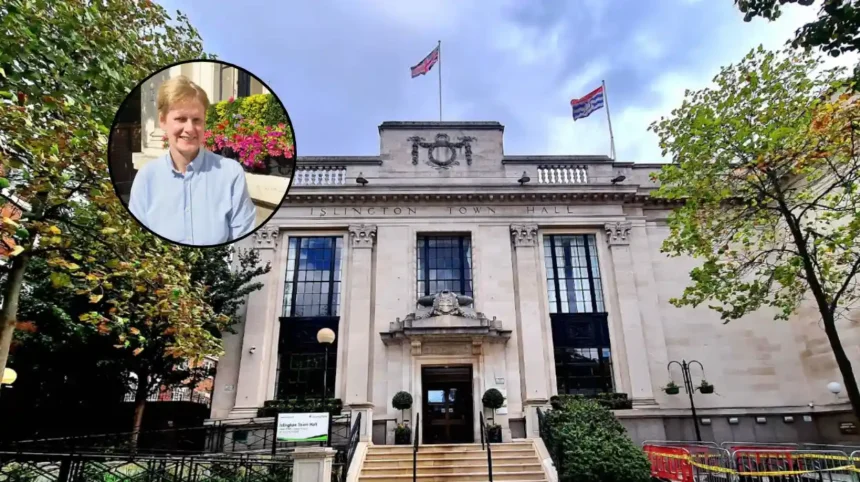
Islington (North London News) November 9, 2026 – The persistent friction surrounding low-traffic neighbourhood (LTN) initiatives flared up once again on Wednesday evening as councillors, town hall staff, and local citizens convened in the Mildmay ward to debate the future of the area’s Liveable Neighbourhood scheme. Designed to curtail vehicular traffic, boost cycle usage, and lower urban air pollution, the traffic-calming filters have instead exposed sharp ideological and socioeconomic fractures across the north London borough. Attending the session to address an array of sharp questions from the floor were Islington Council’s environment chief, Councillor Rowena Champion, alongside Mildmay ward councillors Jackson Caines and Sophia Brown.
- Key Points
- Why Are Mildmay Residents Questioning the Council’s Consultation Process?
- Is the LTN Policy Creating a Class Divide and Traffic Displacement?
- How Is Islington Council Balancing Climate Goals Against Public Pushback?
- How Are Local Independent Businesses Surviving the Traffic Restrictions?
- Background of the Particular Development
- Prediction: How This Development Can Affect Residents and Local Businesses
Why Are Mildmay Residents Questioning the Council’s Consultation Process?
According to an event organiser who spoke on the condition of anonymity, the independent assembly was explicitly arranged to give community members a neutral space to voice their experiences. The organiser stated that many local people felt Islington Council’s official initial consultation was inherently “biased” and that negative feedback was routinely “censored” from public records.
Friction over public engagement is further evidenced by official attendance figures: a 2023 council survey regarding the Mildmay scheme—which was first introduced in 2020—managed to capture just 506 responses across a total ward population of roughly 14,000 residents. During the proceedings, one attendee declared that the entire execution had actively eroded democratic trust. Another resident pointed to permanent physical alterations, arguing that because bricks had already been laid to expand pedestrian footpaths, the ongoing assessment process appeared cosmetic, giving the impression that council decisions were a foregone conclusion and unlikely to be reversed.
Additional operational flaws were raised by attendees, including a noted absence of consultation literature printed in non-English languages to cater to the ward’s multicultural population. Disabled residents highlighted how vehicle filters have severely curtailed their personal mobility and access. Furthermore, women in attendance raised safety alarms, stating that deserted, traffic-starved residential streets have left them feeling vulnerable to street crime while walking home during the late hours of the night or early hours of the morning.
Is the LTN Policy Creating a Class Divide and Traffic Displacement?
The division in the room was underscored when an organiser requested that participants select tables reflecting whether they held negative, mixed, or positive stances regarding the Liveable Neighbourhood implementation. Over 20 people sat at the anti-LTN table, approximately eight chose the neutral option, and four sat at the pro-LTN table.
When reporting on the performance of the traffic filters, the contrasting views of the participants became clear:
- Pro-LTN Table: Praised local ward councillors for their perceived adaptability to public feedback and commended the measurable improvements in localized air quality.
- Anti-LTN Table: Reported opposing experiences. Residents of the Mayville estate described a noticeable influx of displaced vehicular traffic and accompanying exhaust emissions diverted directly onto bordering arterial roads such as Matthias Road.
Unannounced upcoming proposals to convert neighboring Boleyn Road into a one-way street also caught several attendees off guard, despite details being posted on the council’s online portal. The debate highlighted not only tensions between motorists and cyclists, but also a rift between residents living on quiet, blocked-off streets and those residing on boundary roads absorbing the rerouted vehicles. At Wednesday’s meeting, this gap in sentiment between affluent property owners and social housing tenants was laid bare.
While academic research into traffic-calming measures often indicates that LTNs do not disproportionately penalize specific socioeconomic groups, local residents insisted the lived reality on the ground tells a different story. As reported by the Islington Tribune, prominent anti-LTN campaigner and local resident Rebekah Kelly stated:
“We have eyes. You can see and feel the change. The council doesn’t acknowledge people’s lived experience of issues and say it’s anecdotal.”
Ms Kelly, who attended the gathering, noted that while elements of the Liveable Neighbourhood scheme are undeniably beneficial—such as greening initiatives and relocating school access points away from busy thoroughfares like Matthias Road—the negative impact of street blockades dominates public debate. As reported by the Islington Tribune, Ms Kelly added:
“It’s got to be fairer. We have to do something to reduce traffic and pollution, but not all experiments work. There’s no shame in saying, ‘okay, we tried that, that didn’t work.’ It’s not about driving – I don’t have a driving licence. It is absolutely a class issue. During COVID, it wasn’t people who work from home being impacted, it was working-class people using the roads.”
How Is Islington Council Balancing Climate Goals Against Public Pushback?
Addressing the criticisms, Councillor Rowena Champion reasserted the local authority’s statutory obligation to tackle climate change and urban pollution. As reported by the Islington Tribune, Cllr Champion stated:
“We remain committed to reducing carbon emissions by as much as possible, as quickly as possible and in as fair a way as possible. Like any council with ambitious climate targets, our efforts are impacted by the national picture.”
Cllr Champion further explained: “As our new corporate plan sets out, Liveable Neighbourhoods remain a key part of our approach and something that we will continue. We have already delivered a number of fantastic schemes including Mildmay, Highbury and The Cally as well as recent improvements in St John Street and Clerkenwell Green.”
Despite the council’s commitment, the political landscape surrounding traffic filters remains volatile. The Islington Tribune previously reported that during a recent full council session, Cllr Champion confirmed that the proposed Barnsbury and Laycock traffic filtering scheme had been formally abandoned following intense sustained pushback from local residents.
How Are Local Independent Businesses Surviving the Traffic Restrictions?
The economic toll of the traffic filtering measures extends beyond residential frustration into the commercial sector. As reported by journalist Amy Reid of the Islington Tribune, Selma Cicekci, owner of the Kingfisher Cafe situated on the Mildmay-Dalston border along Kingsland High Street, revealed that her business has suffered a devastating 40 per cent decline in revenue since Islington Council introduced its local low-traffic neighbourhood measures in November 2024.
Ms Cicekci, who inherited the enterprise from her parents, warned that the family business is nearing insolvency after more than two decades of operation. As reported by Amy Reid of the Islington Tribune, Ms Cicekci stated:
“At the moment we’re just making ends meet. But if all these road closures come in, we’ll be locking up shop.”
Background of the Particular Development
Low-Traffic Neighbourhoods (LTNs) were accelerated across key London boroughs during 2020 under emergency active travel guidance issued during the COVID-19 pandemic. Using modal filters—such as bollards, planter boxes, and automatic number plate recognition (ANPR) cameras—the initiatives aim to stop motor vehicles from using residential side streets as shortcuts (“rat-runs”), thereby encouraging walking, wheeling, and cycling.
In the London Borough of Islington, the implementation of LTNs and Liveable Neighbourhood schemes has emerged as one of the most contentious municipal policy issues of recent years. While environmental advocacy groups and the council highlight reductions in overall traffic volume, lower carbon emissions, and improved road safety within filtered zones, critics—including trader associations, disability advocates, and taxi operators—argue that LTNs merely displace congestion and air pollution onto surrounding boundary roads. These boundary thoroughfares often feature higher concentrations of social housing estates, leading to accusations of environmental inequity.
The public pushback has already reshaped municipal planning in the borough; the explicit cancellation of the planned Barnsbury and Laycock scheme demonstrated that sustained local opposition can force local authorities to roll back or amend proposed traffic interventions.
Prediction: How This Development Can Affect Residents and Local Businesses
The continuing dispute over Mildmay’s Liveable Neighbourhood scheme signals a critical juncture for both local residents and small businesses across Islington and surrounding boroughs:
- For Local Businesses: Independent traders operating along border corridors like Kingsland High Street face an immediate risk of commercial decline. If customer footfall and delivery accessibility drop further due to combined restrictions from Islington and neighboring Hackney Council, small independent businesses may face closure. This could lead to an increase in vacant storefronts and alter the retail character of local high streets.
- For Working-Class and Boundary-Road Residents: As traffic filters remain active on interior residential roads, boundary routes such as Matthias Road are likely to continue carrying redirected traffic. Residents along these corridors—predominantly living in social housing estates like Mayville—may experience persistent air quality degradation and heightened noise pollution unless systemic changes are made to broader transit networks.
- For Local Governance and Future LTN Schemes: The political sensitivity around LTN implementations will likely force Islington Council to adopt more rigorous, multi-lingual, and transparent consultation protocols for future projects. Following the withdrawal of the Barnsbury and Laycock proposal, the town hall faces mounting political pressure to modify existing spatial layouts, introduce wider exemptions for blue-badge holders, or risk further public opposition and legal challenges from organized community action groups.