Key Points
- Eighth London Borough: Barnet Town Hall has become the eighth local authority in London to engage in discussions with HM Government to seek special dispensation to raise council tax above the standard national 5% cap.
- £200 Million Shortfall: The local authority is grappling with a severe financial shortfall, facing an estimated budget deficit of £200 million over its multi-year medium-term financial strategy.
- Exceptional Financial Support: The request follows previous applications for Exceptional Financial Support (EFS) to manage mounting pressures, particularly across statutory adult social care, children’s services, and temporary accommodation.
- Statutory Thresholds: Under current English local government legislation, local authorities must hold a binding local referendum if they intend to increase general council tax by 3% or more, plus a 2% precept for adult social care (total 5%), unless central ministers grant explicit exemption.
- Broader Capital Crisis: Barnet joins a growing list of London boroughs—including Birmingham, Slough, Croydon, and Thurrock in recent financial years—seeking central intervention or tax headroom to avoid issuing Section 114 notices.
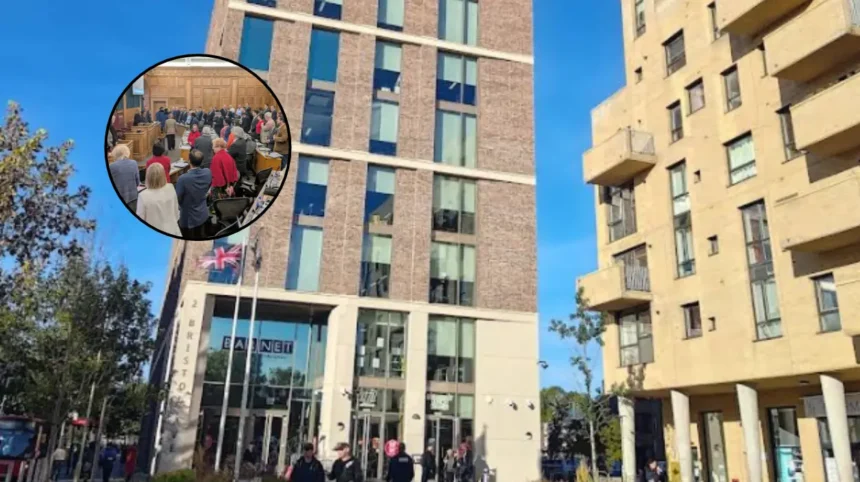
Barnet (North London News) October 16, 2026 — Barnet Council has entered formal discussions with central Government ministers to obtain explicit legal permission to breach the standard 5% annual cap on council tax increases, as the local authority struggles to bridge an extraordinary £200 million budget deficit.
- Key Points
- Why Is Barnet Council Seeking Permission To Exceed The 5% Limit On Council Tax?
- Which Other London Boroughs Have Approached Central Government For Similar Tax Relief?
- How Are Local Authority Services Contributing To Barnet’s £200 Million Black Hole?
- What Impact Has Adult Social Care And Children’s Services Had On Town Hall Finances?
- How Is The Housing And Homelessness Crisis Exacerbating The Deficit?
- What Opposition Views And Political Debates Have Emerged Over The Proposed Tax Hike?
- Background Of The Financial Crisis In Barnet Council
- Prediction: How This Development Can Affect Barnet Rate-Payers And Local Service Users
Why Is Barnet Council Seeking Permission To Exceed The 5% Limit On Council Tax?
As reported by local authority correspondents across capital media outlets, Barnet Town Hall has joined seven other London local authorities in approaching the Department for Levelling Up, Housing and Communities (DLUHC) to request statutory flexibility above the standard local government precept limits. Under existing regulations, councils in England are restricted from raising general council tax by more than 2.99% alongside a 2% adult social care precept—amounting to a total maximum increase of 4.99%—without conducting a costly borough-wide referendum.
The local administration has warned that skyrocketing operational demands have created an unsustainable structural deficit. As detailed in local authority financial reports and reported by David Floyd for the Barnet Post, the town hall is managing a total multi-year financial shortfall approaching £200 million, driven predominantly by acute demands in statutory social care, temporary housing for homeless families, and inflation-fuelled service delivery costs.
In a official budget briefing statement detailing local government pressures, Councillor Barry Rawlings, Leader of Barnet Council, stated:
“Setting a budget has been extremely difficult as we have faced very tough choices. We are facing an unprecedented crisis in financing our services, driven by a perfect storm of a decade of funding cuts from central government, high interest rates making services more expensive to deliver, and ever-increasing demand.”
Councillor Rawlings further noted:
“The exceptional financial support we have received is just a temporary solution. We still have some difficult decisions in the months ahead and we will be regularly engaging with residents to understand what is most important to you, so we can reshape services to focus on those things and deliver them even more cost-effectively.”
Which Other London Boroughs Have Approached Central Government For Similar Tax Relief?
Barnet is the eighth London borough forced to enter discussions with central government over special financial measures or dispensation to lift statutory taxation caps. Across London and the wider south-east, local authorities facing severe fiscal stress have increasingly turned to central ministers for Exceptional Financial Support (EFS) or council tax headroom.
As reported in regional coverage by GB News and the BBC, several UK local authorities—including Croydon Council, Slough Borough Council, and Birmingham City Council—were previously granted ministerially approved council tax increases ranging between 7.5% and 15% in response to major financial failures or structural insolvency. Within London, councils such as Newham have also examined significant precept adjustments as social care burdens escalate rapidly across the capital.
Local government analysts note that local authorities are legally required to deliver a balanced budget each financial year under the Local Government Finance Act 1992. If a council cannot demonstrate a balanced budget or sufficient reserves to cover anticipated liabilities, its Chief Finance Officer (Section 151 officer) is legally bound to issue a Section 114 notice, effectively declaring the authority bankrupt and halting all non-statutory spending.
How Are Local Authority Services Contributing To Barnet’s £200 Million Black Hole?
The primary drivers of Barnet’s financial crisis stem from non-discretionary statutory responsibilities that town halls are legally obligated to provide regardless of budget constraints.
What Impact Has Adult Social Care And Children’s Services Had On Town Hall Finances?
Expenditure on vulnerable adults and children’s residential care represents the largest single sector of growth in Barnet’s operational budget. Due to an ageing demographic within the borough—which holds one of the largest elderly populations in Greater London—the cost of supporting high-needs individuals has increased well beyond initial inflationary forecasts.
How Is The Housing And Homelessness Crisis Exacerbating The Deficit?
The acute shortage of affordable local housing across North London has forced Barnet Council to spend unprecedented sums on temporary accommodation for vulnerable and unhoused families. With emergency hotel and private-sector nightly-paid accommodation charges reaching record highs, temporary housing expenditure has become one of the quickest-growing liabilities on the town hall’s balance sheet.
What Opposition Views And Political Debates Have Emerged Over The Proposed Tax Hike?
The prospect of exceeding the 5% council tax threshold has sparked intense political debate within Hendon Town Hall.
As reported by David Floyd in the Barnet Post, opposition Conservative councillors have labelled the ongoing fiscal situation a “jaw-dropping crisis,” claiming that substantial tax hikes reflect local fiscal mismanagement alongside systemic pressures. In response, the Labour administration maintains that spending remains under control despite “very challenging” financial headwinds, pointing out that Barnet had previously maintained general council tax rates lower than many neighbouring North London boroughs.
Addressing the parliamentary and local policy context, local government policy experts have noted that relying on property-based council tax increases to fund national crisis sectors—such as adult social care—places an unfair burden on local rate-payers while failing to fix underlying structural underfunding.
Background Of The Financial Crisis In Barnet Council
The underlying financial strain on Barnet Council has been building over more than a decade, shaped by changes in local government financing, demographic shifts, and severe macroeconomic shocks.
Following the implementation of central government austerity measures in 2010, local authorities across England experienced substantial net reductions in core grant funding from White Hall. To compensate, town halls were encouraged to rely more heavily on locally retained business rates and council tax receipts. However, Barnet’s population growth—becoming the second largest population of any London borough—outpaced the growth of its commercial tax base.
In early 2025, Barnet Council successfully applied to central government for £55.7 million in Exceptional Financial Support (EFS). This mechanism allowed the council to borrow funds or sell public assets to cover day-to-day operational running costs—a practice normally strictly prohibited under standard UK public accounting rules. Despite securing EFS borrowing authorisations and identifying over £23 million in internal efficiency savings, the structural deficit continued to widen toward the £200 million mark due to persistent high inflation, elevated interest rates, and spiralling social care placement costs.
Furthermore, attempts to adjust the local Council Tax Support Scheme—which assists lower-income households—highlighted the severe trade-offs facing the council. While adjustments saved millions in local authority expenditure, they reduced relief for hundreds of working-age residents during a broader cost-of-living squeeze.
Prediction: How This Development Can Affect Barnet Rate-Payers And Local Service Users
If central government grants Barnet Council explicit authorization to breach the 5% limit without holding a local referendum, the decision will directly impact households, vulnerable residents, and local businesses across the borough.
Financial Impact On Households
For average Band D council tax payers in Barnet, an increase above the standard 5% cap will mean an immediate, significant rise in annual household bills. On top of standard Greater London Authority (GLA) precept increases, residents could face annual council tax bill increases well exceeding £100–£200 per household depending on the final percentage approved by ministers. For working-age families who are already navigating elevated living costs, mortgage payments, and private rents, this additional tax levy will place substantial pressure on disposable household incomes.
Impact On Local Public Services
Even with an above-cap council tax increase, tax revenue alone will be insufficient to fully close a £200 million budget gap without concurrent reductions in municipal expenditure. Consequently, residents are likely to experience:
- Discretionary Service Cuts: Reductions in non-statutory services such as street cleaning frequency, park maintenance, library opening hours, community grants, and leisure center subsidies.
- Increased User Charges: Higher fees for local services, including parking permits, green waste collection, pest control, and planning applications.
- Targeted Care Provision: Stricter eligibility thresholds for social care support, focusing public funds strictly on acute statutory cases while reducing preventative community programs.