Key Points
- Historical Tie: The local elections in the London Borough of Barnet resulted in an unprecedented dead-heat, with both the Labour Party and the Conservative Party securing exactly 31 seats each in the 63-seat chamber.
- Green Balance of Power: Councillor Charli Thompson, the borough’s first-ever Green Party representative, was elected to the single remaining seat, holding the absolute balance of power.
- Labour Leader Reappointed: Councillor Barry Rawlings, the leader of the previous majority Labour administration, was successfully reappointed to lead a new minority administration.
- Strategic Tory Abstention: All 31 Conservative councillors abstained during the leadership vote for Rawlings, deliberately allowing him to win 31–1 over the opposition of the lone Green councillor.
- Bipartisan Stability Agreement: Labour and Conservative leadership hammered out a cross-party administrative agreement to prevent institutional chaos, granting the opposition enhanced scrutiny powers and cabinet discussion access.
- Isolation of the Green Party: Both major parties actively avoided negotiating with Councillor Thompson, citing institutional stability and deep-seated political and community sensitivities within the borough.
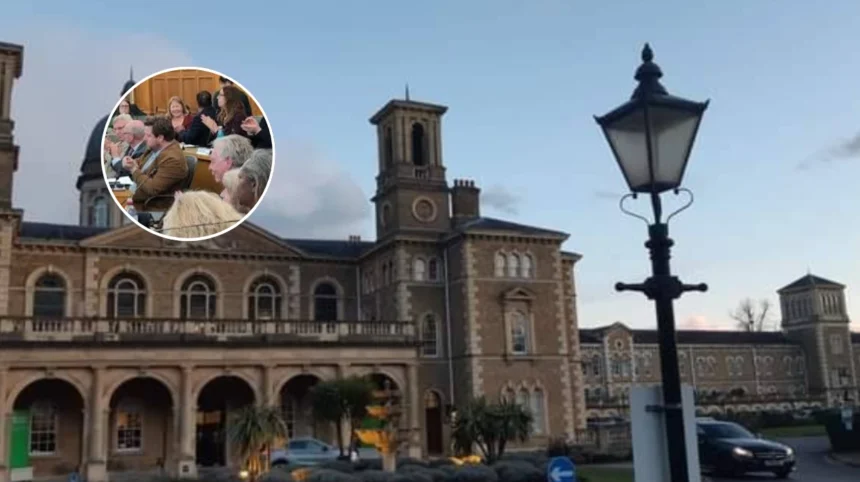
Hendon (North London News) 22 May 2026 — In one of the most mathematically extraordinary and politically pragmatic developments in modern London local government, Labour Councillor Barry Rawlings has been reappointed as the leader of Barnet Council despite his party failing to win a majority in the recent local elections. The appointment was secured during a high-stakes Annual Meeting at Hendon Town Hall on Tuesday evening, made possible by a tactical bloc abstention by the 31-member Conservative opposition group.
- Key Points
- How Did the High-Stakes Leadership Voting Unfold at Hendon Town Hall?
- Why Did the Barnet Conservatives Choose to Induce a Labour Victory?
- What Are the Specific Details of the Secret Labour-Tory Administrative Agreement?
- Why Did Green Councillor Charli Thompson Condemn the Major Parties?
- What Underlies the Deeper Disquiet Surrounding the Green Party in Barnet?
- Background of the Barnet Electoral Shift
- Prediction: How Will This Cross-Party Coexistence Affect Barnet Residents?
The recent local elections left the 63-seat chamber perfectly deadlocked, with the Labour Party winning 31 seats and the Conservative Party—which had historically controlled the borough for the vast majority of its existence—also securing 31 seats. The single remaining seat was won by Councillor Charli Thompson, making her the first-ever Green Party representative in the history of Barnet. With the two major parties locked in a tie, Thompson wielded the absolute balance of power, creating a scenario that threatened to plunge the local authority into a prolonged constitutional impasse.
However, rather than allowing the single Green councillor to dictate the future of the borough’s governance, the Labour and Conservative leadership groups orchestrated a rare administrative understanding. By choosing to abstain during the crucial vote, the Tories effectively cleared the path for Rawlings to continue at the helm of a minority administration, choosing mainstream political stability over minor-party leverage.
How Did the High-Stakes Leadership Voting Unfold at Hendon Town Hall?
The process for electing a council leader in Barnet dictates that nominees are voted on individually, one at a time, via a simple majority. If the first nominee fails to secure a majority of votes from the councillors present, the chamber moves to vote on the next contender.
At Tuesday’s Annual Meeting, presided over by the incumbent civic mayor, Labour Councillor Danny Rich, nominations were made directly from the floor.
As a result of pre-meeting negotiations between party managers, the Conservative nominee, Group Leader Peter Zinkin, was placed first on the voting agenda.
During the first round of voting, all 31 Conservative councillors voted in favour of Zinkin. However, all 31 Labour councillors, alongside the lone Green councillor, Charli Thompson, voted against his appointment. This resulted in a 32 to 31 vote rejecting Zinkin’s leadership bid.
Because a clear majority had voted against the Conservative candidate, Mayor Rich was not required to exercise his tie-breaking casting vote.
The chamber then moved to consider the nomination of Labour’s Barry Rawlings. All 31 Labour councillors cast their votes in his favour, while Thompson cast her single vote against him. In a calculated procedural move, all 31 Conservative councillors abstained from voting.
This left Rawlings with a clear statutory victory of 31 votes in favour to one against, officially confirming his reappointment as leader of Barnet Council.
Why Did the Barnet Conservatives Choose to Induce a Labour Victory?
The decision by the Conservative group to intentionally step aside and permit their primary political rivals to form an administration surprised outer observers, but it reflected a calculated strategy to protect the council from institutional disruption.
According to statements delivered on the floor of the town hall, both Labour and Tory frontbenchers felt a structural obligation to mitigate the risks of extreme political volatility. As reported by local government correspondents covering the meeting, Labour Councillor Ross Houston, who formally proposed Rawlings for the leadership, emphasized that he had
“always supported collaborative working when it’s possible.”
Houston further noted that a core guiding principle behind the civic mayor’s casting vote in deadlocked scenarios is to ensure the absolute continuity of essential council business.
Responding for the opposition, Conservative Councillor Richard Cornelius openly referenced the cross-party discussions, describing the creation of an
“administrative agreement in order to deal with what has happened.”
Cornelius remarked that such deep “collaborative working… will be very new for Barnet,” calling the rapid formulation of the governance pact “quite something.”
In an official media statement released immediately following the conclusion of the Annual Meeting, the Barnet Conservatives explicitly clarified that their strategy was designed to marginalize the Green Party’s influence. The group stated:
“We were not prepared to enter any arrangement that would hand the single Green councillor disproportionate influence over the borough’s future and leave the administration of the borough in complete chaos.”
What Are the Specific Details of the Secret Labour-Tory Administrative Agreement?
To secure the compliance of the Conservative group, Labour negotiators conceded significant institutional concessions that grant the Tory opposition unprecedented access to the executive branch of the local authority.
The finalized administrative agreement includes several core structural pillars:
- Cabinet Access: The unsuccessful Conservative leadership candidate, Peter Zinkin, will be permitted to formally attend all leader’s cabinet meetings.
- Policy Input: The opposition leader will possess a direct seat at the executive table to offer real-time input and critique during high-level policy discussions.
- Enhanced Scrutiny: The Conservative opposition group will be granted expanded structural opportunities to rigorously scrutinize and review major administrative decisions before they are formally executed by the cabinet.
Political analysts note that the sequence of the votes was a crucial component of this cross-party deal. The Conservatives had strongly insisted that the vote on Zinkin occur first. This sequencing ensured that the Tories could formally put forward their case for a Conservative-led administration within the chamber without appearing to have abandoned their electorate.
Had the vote on Rawlings been called first, he likely would have secured the leadership immediately—either through an outright vote from Thompson or via the casting vote of the Labour mayor in the event of a 31–31 tie. By voting on Zinkin first and establishing his defeat via the Green-Labour alignment, the Conservatives justified their subsequent abstention as the only viable mechanism to prevent an ongoing leadership vacuum.
Why Did Green Councillor Charli Thompson Condemn the Major Parties?
The strategy deployed by the two dominant parties drew fierce condemnation from Councillor Charli Thompson, who used her address from the floor of Hendon Town Hall to accuse the political establishment of actively subverting the democratic will of voters who sought alternative representation.
Thompson argued that the sudden alliance between Labour and the Conservatives served to protect entrenched interests rather than addressing systemic local issues. In her speech, Thompson stated:
“Across Barnet, residents feel deeply disconnected from how decisions are made and increasingly frustrated by a political culture that too often manages the status quo rather than confronting the scale of the challenges we face.”
Thompson further alleged that she had reached out to both major party groups “constructively and in good faith to discuss how we might work differently in a council with no overall control,” but claimed her overtures were entirely rebuffed.
She characterized the administrative agreement as a case of Labour and the Tories “teaming up” specifically to shut out third-party oversight and limit public participation in local democracy. Thompson concluded by warning that impending constitutional changes within the borough’s committee frameworks would further isolate independent and minority voices from formal scrutiny processes.
What Underlies the Deeper Disquiet Surrounding the Green Party in Barnet?
Beyond the immediate desire for administrative stability, journalists reporting on the Barnet deadlock have highlighted a much deeper, highly sensitive communal backdrop that explained the mutual reluctance of Labour and Tory leadership to collaborate with the Green representative.
The London Borough of Barnet contains the largest Jewish population of any local authority area in England and Wales. It also features a substantial Iranian community. Consequently, issues regarding community safety, international relations, and antisemitism carry immense weight in municipal politics.
At the opening of Tuesday’s proceedings, traditional prayers were delivered by a local rabbi. Following this, Mayor Danny Rich—who is himself a practicing rabbi—addressed the chamber regarding a recent escalation in antisemitic incidents within the borough, reminding councillors that
“all of us need to maintain our vigilance against hate in all its forms.”
Councillor Houston also noted during his remarks that a recent antisemitic attack had directly occurred within his own electoral ward, while Zinkin represents Golders Green, an area with a dense Jewish population that has been a frequent target for such incidents.
Against this backdrop, the political history of the lone Green representative became an unstated but significant factor in her isolation.
As extensively documented by journalists at the Jewish News, Thompson previously held membership within the Labour Party and has publicly acknowledged being a strong admirer of former Labour leader Jeremy Corbyn. Corbyn’s tenure led to a severe collapse of Labour support across Barnet’s Jewish communities due to intense controversies surrounding antisemitism within the party and his geopolitical positions.
Furthermore, the broader Green Party in London has faced intense scrutiny over community relations. Prior to the recent local elections, two Green Party candidates in the borough of Lambeth were arrested by the Metropolitan Police on suspicion of spreading antisemitic material, leading to their formal suspension from the party.
While Thompson herself has not been linked to illegal activities, municipal reporters emphasize that the wider political associations of the Green Party created a profound barrier to entry within Barnet’s unique political landscape.
Background of the Barnet Electoral Shift
To understand the extraordinary nature of Tuesday’s deadlocked Annual Meeting, one must look to the long-term political evolution of the London Borough of Barnet, which was historically regarded as an unshakeable bastion of suburban conservatism.
From the creation of the modern borough in 1965 until the early 2020s, the Conservative Party maintained almost uninterrupted control over Barnet London Borough Council.
The borough’s demographic profile—characterized by high rates of homeownership, leafy residential enclaves like Totteridge and Mill Hill, and large, traditional faith communities—made it a reliable base for blue-ribbon municipal politics.
The only brief historical exception occurred between 1994 and 2002, when the council operated under No Overall Control (NOC) via a fragile formal coalition between Labour and the Liberal Democrats.
A major structural shift occurred during the May 2022 local elections. Capitalizing on widespread national dissatisfaction with the central Conservative government and shifting demographics in the multi-ethnic south of the borough, the Labour Party achieved a historic breakthrough.
Led by Barry Rawlings, Labour won a clear majority of 41 seats, taking absolute operational control of Barnet Town Hall for the first first time in the borough’s history. The Conservatives were reduced to 22 seats, marking an unprecedented low point for the local party.
The local elections of May 2026, however, saw a sharp reversal of fortunes. The local Conservative group, re-energized under the leadership of Peter Zinkin, mounted a highly disciplined campaign focused heavily on local council tax rates, outer-London motoring compliance costs, and development planning disputes. The Tories successfully recaptured nine seats from Labour, pulling off a remarkable electoral comeback to split the chamber exactly down the middle at 31 seats each.
Prediction: How Will This Cross-Party Coexistence Affect Barnet Residents?
The unheralded governance pact between Labour and the Conservatives will profoundly shape the day-to-day administrative reality for the residents and taxpayers of Barnet over the coming council term.
For the average citizen, the immediate benefit of this cross-party arrangement is institutional predictability. Because the two dominant factions have agreed to prioritize stability, core municipal services—such as domestic waste collection, highway maintenance, social care allocation, and public park upkeep—are highly unlikely to suffer from the bureaucratic paralysis that routinely plagues deadlocked councils. Residents will not face the sudden freezing of local services or emergency budgetary interventions that occur when a local authority cannot successfully elect executive leadership.
However, the specific mechanics of local governance will look vastly different than they did under the previous majority Labour administration. Because Leader Barry Rawlings must maintain the passive compliance of the 31 Conservative councillors to pass annual budgets and structural policies, the council’s legislative output will naturally skew toward centrist, compromised governance. Contentious, ideologically driven progressive policies are effectively off the table.
Any proposed increases in municipal council tax will face intense downward pressure from the emboldened Conservative opposition, who now possess the formal committee access to block or stall executive financial plans. Similarly, large-scale urban regeneration projects and controversial traffic management schemes will undergo far more rigorous, adversarial vetting procedures before receiving approval, potentially slowing down the implementation of local infrastructure upgrades.