Key Points
- Identified Primary Source: Cooking within restaurants, hotels, pubs, and takeaways is the biggest individual source of PM2.5 air pollutants in the London Borough of Camden.
- Health Hazard: The heated food industry accounts for more than 28 per cent of PM2.5 air pollution in Camden, which is known to cause nearly seven per cent of mortality in the area.
- Changed Pollution Dynamics: Business and commercial establishments have taken over motor vehicles as the primary source of air pollution in the area, mainly because of their cooking processes and heating systems.
- Reducing Impact of Motor Vehicles: Vehicle emissions will keep on declining because of clean engine technologies, the rise in use of electric vehicles, and development of cycling and walking facilities.
- Anti-Idling Efforts: Camden Council aims at toughening legal efforts and increasing fines for illegal idling of motor vehicle engines, especially near schools and health facilities.
- Strategy for 2027–2030: A 105-page draft of Clean Air Action Plan suggests tougher planning regulations, more stringent licensing requirements, and strict application of Building Regulations and Environmental Health Act.
Camden (North London News) September 7, 2026 – Commercial cooking operations across restaurants, hotels, pubs, and takeaways have officially been identified as the leading source of fine particulate matter (PM2.5) air pollution within the London Borough of Camden. According to official findings detailed by local authority officers in Camden Council’s newly published draft Clean Air Action Plan, the commercial hot food industry is responsible for more than 28 per cent of the borough’s total PM2.5 emissions. Fine particulate pollution represents a major public health hazard, contributing to approximately seven per cent of all recorded deaths within the local authority area each year. The newly released figures underline a significant structural shift in urban pollution sources, with commercial building operations—comprising kitchen emissions and heating systems—now outstripping road transport as the primary source of dangerous urban atmospheric pollutants.
- Key Points
- What Has Caused Commercial Premises to Overtake Vehicles as Camden’s Top Polluter?
- How Will Camden Council Address Illegal Vehicle Engine Idling Near Vulnerable Areas?
- What Strategic Changes Are Outlined in the 2027–2030 Clean Air Action Plan?
- Background of the Particular Development
- Prediction: How This Development Can Affect Hospitality Businesses and Local Residents
What Has Caused Commercial Premises to Overtake Vehicles as Camden’s Top Polluter?
As reported by administrative officers in Camden Council’s official Clean Air Action Plan, premises occupied by local businesses “are now the largest source of air pollution, both from the way they are heated and also from kitchens.” While historical transport data consistently designated road traffic as the primary environmental health threat across Inner London, municipal measures and vehicle fleet modernisations have fundamentally altered the local emissions profile.
As documented by council policy analysts in the public consultation document, motor vehicles remain a substantial contributor to atmospheric degradation in Camden, “but the combination of cleaner engines, electric vehicles, and better cycling and walking infrastructure means the total amount of pollution from vehicles has reduced.” Consequently, while tailpipe emissions have experienced a steady downward trajectory due to zero-emission adoption and urban spatial redesign, stationary commercial sources—specifically solid-fuel and high-temperature commercial cooking apparatuses—have expanded their relative share of total particulate matter.
How Will Camden Council Address Illegal Vehicle Engine Idling Near Vulnerable Areas?
Despite the overall reduction in vehicle emissions, municipal authorities have confirmed that road transport continues to demand strict oversight. As highlighted by municipal compliance teams within Camden Council’s public release, local authorities intend to step up direct enforcement action and strengthen the “deterrent for vehicle engine idling in Camden.”
Vehicle engine idling remains illegal under national traffic legislation and directly contravenes the Highway Code. As stated by environmental health specialists in the council’s statutory report, idling actively harms the immediate health of drivers, passengers, and nearby pedestrians. Council officers emphasised that “in places with heavy engine idling, such as schools, health centres, and high streets, this poses a long-term health risk,” prompting targeted operational interventions across designated zero-tolerance zones.
What Strategic Changes Are Outlined in the 2027–2030 Clean Air Action Plan?
The policy framework is set out within a comprehensive 105-page document detailing municipal air quality and public health objectives running from 2027 through 2030. As reported by environmental policy officers in Camden Council’s draft framework, the updated scheme introduces a multi-pronged approach to environmental governance.
The draft clean air action plan includes a new focus on “being better prepared for pollution incidents,” alongside “a greater focus on indoor air quality.” Furthermore, local authorities have expanded the regulatory scope to focus on “tackling a wider range of pollution sources (e.g. street food markets, filming, public events),” while simultaneously “better linking clean air and climate action” across all municipal operations.
To curtail emissions generated by the commercial hospitality sector and business operations, municipal officers confirmed that Camden Council will actively explore “tighter planning and licensing controls, and more robust enforcement of Building Regulations and Environmental Health legislation.”
Background of the Particular Development
The emergence of commercial cooking as the dominant contributor to fine particulate matter reflects broader urban environmental trends across Inner London over the past decade. PM2.5 refers to fine particulate matter measuring 2.5 micrometres or less in diameter—roughly one-thirtieth the width of a human hair. Due to its microscopic size, PM2.5 penetrates deep into the human respiratory system and cardiovascular network, causing chronic systemic inflammation, exacerbating respiratory diseases such as asthma, and directly contributing to cardiovascular illnesses.
Historically, London’s air quality strategies focused almost exclusively on road transport, leading to the establishment of targeted low-emission policies, Ultra Low Emission Zone (ULEZ) expansions, and extensive cycling infrastructure investments across Camden and neighboring boroughs. While these measures successfully drove down nitrogen oxides ($\text{NO}_x$) and heavy tailpipe particulates, non-transport emissions received comparatively less statutory oversight.
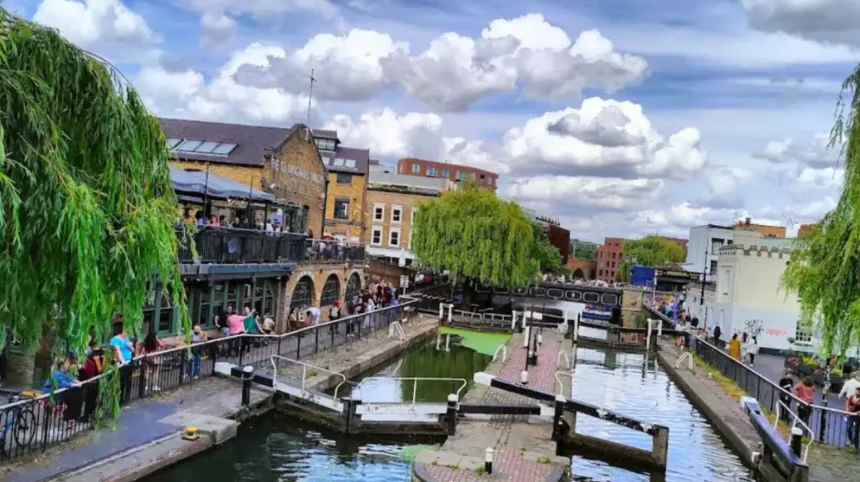
Commercial food preparation—particularly high-temperature frying, charcoal grilling, wood-fired ovens, and open-flame cooking—releases concentrated quantities of volatile organic compounds (VOCs) and solid carbonaceous particulates. As Camden hosts one of London’s most concentrated hospitality sectors, including major culinary hubs such as Covent Garden, Camden Market, and King’s Cross, the cumulative volume of commercial kitchen emissions has scaled rapidly. The publication of the 105-page Clean Air Action Plan marks a formal policy shift, moving municipal oversight from traditional vehicle-centric frameworks toward comprehensive commercial regulation.
Explore More Camden News
Camden Approves £1.7M Fitzjohn’s Avenue Traffic Scheme Hampstead 2026
Kentish Town Road Flooding After Burst Water Main Explosion 2026
Prediction: How This Development Can Affect Hospitality Businesses and Local Residents
The statutory measures proposed in the 2027–2030 Clean Air Action Plan are expected to significantly transform operations for commercial business owners while altering health outcomes for local residents across the London Borough of Camden.
Impact on Hospitality Businesses and Commercial Operators
Commercial kitchens, food market vendors, pubs, and hotel operators face heightened regulatory compliance costs and administrative oversight. The implementation of “tighter planning and licensing controls” means new and existing food establishments will likely be required to install advanced, high-efficiency particulate filtration and electrostatic precipitator (ESP) grease extraction systems as a mandatory condition of their operating licences. Furthermore, stricter enforcement of Environmental Health legislation and Building Regulations could lead to increased routine inspections, mandatory maintenance logs for ventilation units, and potential fines or operating restrictions for businesses utilizing solid fuels like charcoal or wood. Street market vendors and temporary event caterers will also need to transition to cleaner electric cooking appliances to align with new municipal market standards.
Impact on Local Residents and Vulnerable Communities
For local residents, particularly children, elderly citizens, and individuals with pre-existing cardiovascular or respiratory conditions, the targeted reduction of PM2.5 emissions offers direct long-term health benefits. A reduction in fine particulate concentration across high streets and residential streets situated near dense commercial clusters is anticipated to lower the borough’s seven per cent mortality rate attributed to air pollution. Additionally, heightened anti-idling enforcement around sensitive zones—such as primary schools, medical clinics, and community facilities—will create cleaner immediate micro-environments for pedestrians, reducing acute spikes in localized toxic exhaust exposure during peak drop-off and travel hours.