Key Points
- A highly dilapidated two-bedroom end-of-terrace property located at 75 Camden Mews, London, was listed for auction with a guide price of £925,000.
- The property is described as uninhabitable, featuring collapsed ceilings, interiors filled with debris, and an overgrown garden.
- An abandoned vehicle remains on the off-road driveway, obscured by vegetation.
- Despite its condition, Auction House London suggested the property’s prime location holds significant potential for redevelopment.
- The house had been under the same family ownership for over 35 years before being brought to auction.
- The property ultimately sold at auction for £976,000.
Camden (North London News) April 28, 2026 — A severely derelict end-of-terrace house in the heart of Camden Mews, North London, has captured public attention after being listed for auction with a guide price of £925,000, despite requiring extensive renovation to be deemed habitable.
Why is a derelict house priced so high?
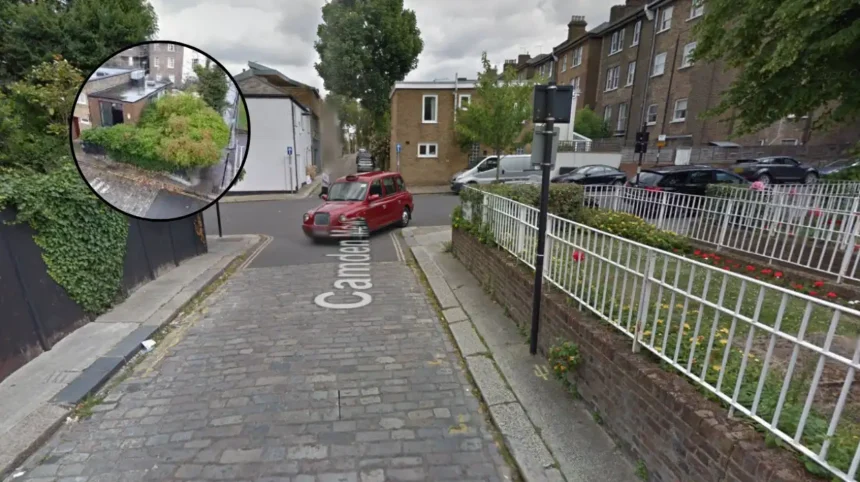
The property, situated at 75 Camden Mews, gained notoriety due to its stark contrast between its outward appearance and its internal state of disrepair.
As reported by journalists at The Sun, the building’s exterior is “completely engulfed in vegetation,” appearing as though it has been reclaimed by nature after years of neglect.
Photos provided in the auction listing revealed a home filled with piles of rubbish reaching toward the ceilings, with structural issues including collapsed ceilings.
According to reports from the Evening Standard, the property was described as being in a state of advanced disrepair, with an abandoned vehicle left on the driveway.
Despite these significant challenges, the auctioneers, Auction House London, maintained that the location and the nature of the plot meant that even the most “unappealing and unattractive” properties possess “true potential” for the right buyer.
What is the history of this property?
The house had reportedly been under the same family ownership for more than 35 years. As detailed by the Evening Standard, the property was once the home of the seller, who had initially intended to carry out renovation work.
However, these plans were put on indefinite hold, and over the subsequent decades, the residence fell into its current state of extreme disrepair.
The project serves as an example of how long-term abandonment can lead to a property becoming entirely uninhabitable, necessitating a complete structural overhaul for any future use.
Did the auction result meet expectations?
While guide prices at auctions are often set to entice potential bidders, they do not necessarily reflect the final sale price. Following the initial listing, the property attracted significant interest from developers and architects, who saw value in the site’s location in a prestigious part of London.
Reports confirm that the property ultimately sold at auction for £976,000, surpassing its guide price of £925,000.
This outcome highlights the competitive nature of the London property market, where the value of the land often supersedes the current physical condition of the existing structure.
What is the background of this development?
The development reflects a wider trend in the UK property market where “fixer-upper” homes, or even complete structural ruins, are sold at auction to developers or private buyers looking for redevelopment opportunities in prime locations.
In areas like Camden, where land is scarce, and property values remain consistently high, the intrinsic value of the plot frequently drives pricing, even when the building itself is effectively non-functional. Auction houses often highlight these properties as “golden eggs” for investors, though experts advise that prospective buyers must account for the substantial costs of clearance, structural repairs, and modernization.
The case of 75 Camden Mews serves as a clear illustration of how location-based demand can sustain high price points despite visible signs of decay.
How can this development affect local residents and property seekers?
For local residents, the sale and eventual redevelopment of such a long-neglected site represent a positive change, as the property had become an eyesore that signaled years of residential decline. The transformation of a derelict, rubbish-filled lot into a renovated home or a new housing development typically improves the visual appeal of the street and can positively influence nearby property valuations.
For property seekers and potential investors, this sale demonstrates that high-value entry points in prime London locations may require significant capital beyond the purchase price. Prospective buyers should be aware that guide prices are often starting points rather than estimates of final value, and competition for “promising” plots remains fierce. This development serves as a reminder to conduct rigorous due diligence, as the costs associated with clearing and renovating a severely neglected property are often substantial and can complicate the actual return on investment for developers.