Key Points
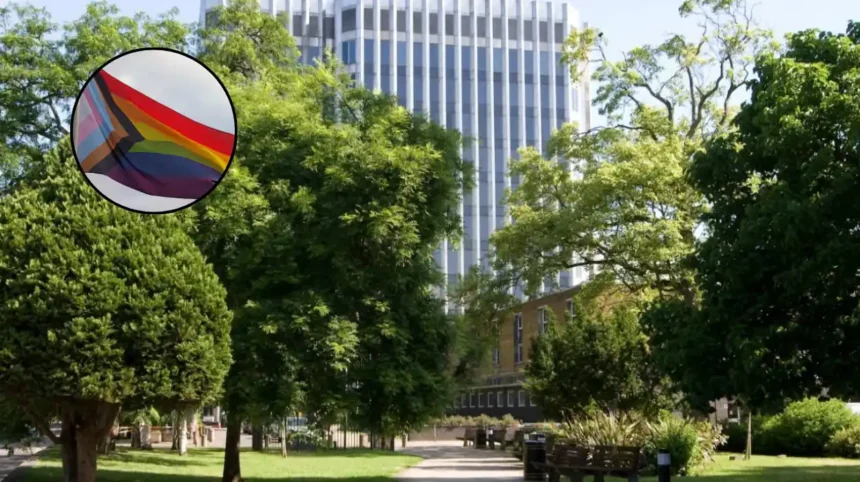
- Flag Policy Shift: The newly elected Conservative administration at Enfield Council has implemented a policy to restrict the flags flown outside the Enfield Civic Centre primarily to the Union Flag, the Flag of St George, and the Enfield Beast flag.
- Civic Pride vs. Inclusion: Council Leader Alessandro Georgiou defended the policy as a measure to restore “traditional civic pride” through “clarity and consistency,” while opposition Labour councillors labelled the move a “slap in the face” to the local LGBTQ+ community.
- Armed Forces Day Exception: While the Pride flag was omitted during June’s Pride Month, the council chose to fly the Armed Forces Day flag over the weekend of 27 June, sparking accusations of inconsistency from critics.
- Historical Precedent: Under the previous Labour administration, the Pride flag was routinely raised outside the local government headquarters to mark the global month of LGBTQ+ advocacy and commemoration.
Enfield (North London News) June 30, 2026 – The leader of a north London local authority has publicly defended the decision to withhold the Pride flag from the area’s primary municipal building during global Pride Month, citing a commitment to operational “clarity and consistency.”
The Enfield Council Conservative administration, which secured power as a minority leadership in late May 2026, had previously outlined a distinct civic protocol within its local election manifesto.
This manifesto pledged to limit the flags displayed outside the Enfield Civic Centre to three specific banners: the Union Flag, the Flag of St George, and the Enfield Beast flag.
According to party literature, this directive was explicitly designed to “restore a sense of traditional civic pride” across the borough.
However, the political transition has drawn immediate scrutiny and local protest. Critics highlighted that despite the strict manifesto guidelines, the administration opted to fly the Armed Forces Day flag outside the Civic Centre over the final weekend of June.
The decision to accommodate one commemorative banner while omitting the Pride flag has intensified the local debate regarding municipal representation and diversity.
What Are the Differing Political Perspectives on the Decision?
The policy shift has created a sharp division within the chambers of the north London authority, drawing formal condemnation from political opponents.
As reported by journalists covering local government affairs for the BBC, members of Enfield Labour formally described the decision to bypass the Pride flag as “a slap in the face” to the local LGBTQ+ community, pointing out that the borough has historically used its civic platforms to signal solidarity with minority groups.
Pride Month is observed internationally every June to advocate for LGBTQ+ rights and to commemorate the 1969 Stonewall riots in New York. Under the borough’s previous Labour administration, the Pride flag was routinely and prominently displayed outside the council headquarters throughout the month.
In response to the growing public and political criticism, the Conservative leadership sought to clarify the operational distinction between the permitted banners.
In a video statement published across official social media channels, Conservative Council Leader Alessandro Georgiou stated that the three core flags detailed in the manifesto were intended to remain as “permanent” fixtures.
Conversely, Councillor Georgiou explained that the Armed Forces Day flag represented a strictly temporary addition to the civic masts, hoisted specifically to celebrate and acknowledge the contributions of British service personnel. Armed Forces Day was observed nationally on Saturday 27 June 2026.
Background of the Civic Flag-Flying Policy in Enfield
The dispute in Enfield reflects broader, ongoing discussions across various United Kingdom local authorities regarding the use of civic spaces for cultural and political expression.
For several years, local councils nationwide have frequently flown a variety of flags—including the Pride rainbow flag, the Transgender Pride flag, and various international banners—to mark specific cultural months, heritage weeks, or global human rights campaigns.
In Enfield, the transition of power in late May 2026 brought an end to consecutive years of Labour control, introducing a minority Conservative executive with an explicit focus on traditional civic branding.
The Enfield Beast flag, which features the mythological creature from the borough’s historic coat of arms (combining the head of a greyhound, the body of a lion, and the tail of a rooster), has been championed by the new administration as a unifying symbol of local heritage, alongside the national flags of England and the United Kingdom.
The restriction of municipal flag masts to traditional or statutory designs aligns with policies adopted by a number of other conservative-led authorities in recent years, who argue that state and local government buildings should remain strictly neutral or focused exclusively on foundational national identity symbols. Opponents, meanwhile, view the removal of identity-specific flags as an intentional rollback of visible state support for marginalized communities.
Explore More Enfield Council News
Enfield Council Flooded With Major Residential Planning Applications: Enfield 2026
Enfield Council Settles Mitchells & Butlers Toby Carvery Tree Dispute: Enfield 2026
Prediction: How Will This Development Affect Local Residents and Community Groups?
The enforcement of this flag-flying policy is expected to influence local community dynamics, municipal relations, and the visible environment for residents within the borough of Enfield in several distinct ways.
For LGBTQ+ residents and supportive advocacy networks within Enfield, the absence of the Pride flag from the Civic Centre will likely diminish the perceived sense of institutional validation and safety.
Local community groups may interpret the policy change as an indicator that the current administration places a lower priority on diversity initiatives, potentially leading to reduced engagement between these grassroots organisations and local authority departments on civic projects.
Impact on Civil Society and Heritage Groups
Conversely, segments of the local population that favor traditional civic protocols or felt alienated by the proliferation of cause-specific banners may view the change as a fulfillment of democratic promises.
The permanent display of the Enfield Beast flag alongside national symbols is intended by the administration to foster a broader, non-political sense of shared historic identity among residents who prioritize traditional local heritage over modern cultural campaigns.
Expected Political and Administrative Developments
Administratively, the decision is likely to result in sustained political friction within the council itself. With the Conservatives operating as a minority administration, opposition parties are expected to use future council sessions to challenge the definition of “consistency” applied to civic flags.
The precedent set by hosting the Armed Forces Day flag suggests that the administration will face ongoing petitions from various local cultural, religious, and charitable groups requesting temporary exceptions for their own commemorative days, ensuring that the usage of the Civic Centre masts remains a point of local political debate.