Key Points
- Personalised Bays Introduced: Enfield Council has published formal traffic management orders to designate specific, personalised disabled parking spaces assigned strictly to individual permit holders.
- Borough-Wide Impact: The scheme affects multiple residential streets across Enfield, including areas in Edmonton, Palmers Green, Southgate, Enfield Lock, and Winchmore Hill.
- Removal of Obsolete Spaces: Parallel proposals involve revoking several existing disabled parking bays that are no longer required by local residents.
- Statutory Consultation Period: Formal public notice was published on 4 November, opening a consultation period where residents can submit support or formal objections until 25 November.
- Enforcement & Exclusivity: Only vehicles displaying a valid, council-issued permit specific to that precise bay will be legally allowed to park in the newly designated spaces.
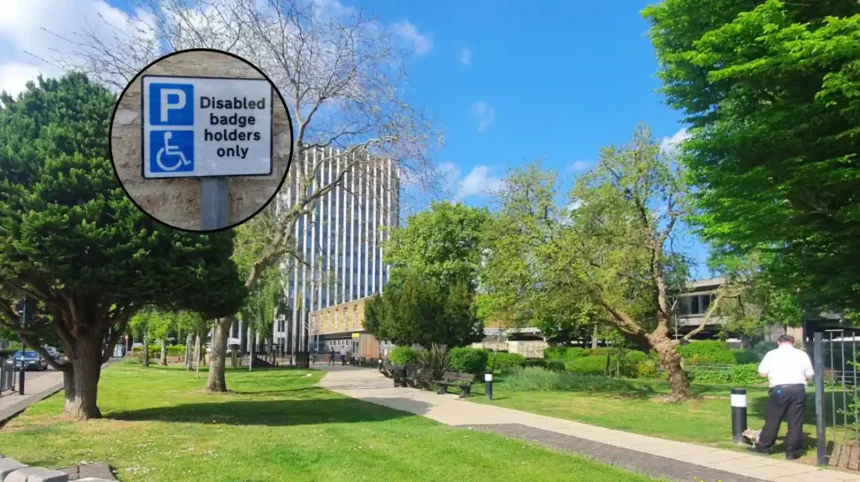
Enfield Council (North London News) November — Enfield Council has formally announced plans to modify the allocation and management of disabled parking spaces across the borough by introducing personalized disabled parking bays. Under the new proposals published in official public notices on 4 November, the local authority intends to designate designated parking spaces on public highways that are tailored specifically for individual residents holding a valid, council-issued permit. Unlike standard Blue Badge bays—which can be used by any vehicle displaying a valid Blue Badge—these personalized spaces will be legally restricted to the specific permit holder assigned to that location.
- Key Points
- Which Locations Will Be Affected by the New Personalised Spaces?
- How Will the Personalised Permit System Be Enforced?
- How Can Residents Submit Objections or Support by 25 November?
- Background to Disabled Parking Space Allocation in Enfield
- Predictions: How Will This Development Affect Local Residents and Blue Badge Holders?
As reported by local news reporting on the official traffic notices published by Enfield Council, the local authority is simultaneously moving to remove several existing disabled parking bays that have been identified as redundant or no longer required by local residents. The dual measure forms part of the council’s ongoing management of highway space to ensure accessible parking is positioned directly where qualified residents need it most, whilst returning unused spaces back to general residential parking availability.
The published orders cover a significant number of residential streets across Enfield. Members of the public, local motoring groups, and residents affected by the proposed installations or removals have been given until 25 November to lodge formal comments, support, or objections with the council’s traffic engineering team.
Which Locations Will Be Affected by the New Personalised Spaces?
According to the official statutory traffic notices issued by Enfield Council, the proposed introduction of personalized disabled parking bays covers a comprehensive list of addresses across the borough’s key electoral wards and residential districts.
The council has outlined specific locations where new personalized disabled parking bays are scheduled for installation, subject to the outcome of the public consultation:
- Edmonton & South Edmonton: Proposed installations include designated highway locations along major residential thoroughfares to assist residents with severe mobility impairments.
- Palmers Green & Winchmore Hill: Selected streets will see dedicated curb side spaces marked and signed exclusively for individual permit holders.
- Enfield Lock & Highway: Key residential streets near housing estates will receive tailored bays to ensure direct access from doorstep to vehicle.
- Southgate & Cockfosters: Individual addresses have been identified following formal mobility assessments by council traffic officers.
Simultaneously, the council’s order details the removal of legacy disabled bays that are no longer in active use. By revoking the traffic orders on these obsolete bays, the council aims to relieve localized parking pressure by converting the spaces back into unreserved kerbside parking for all local residents and visitors.
How Will the Personalised Permit System Be Enforced?
As detailed in the public consultation documentation released by Enfield Council, the operational legal structure of personalized disabled parking bays differs significantly from traditional municipal disabled bays:
| Feature | Standard Blue Badge Space | Personalised Disabled Space |
| Eligibility | Any valid Blue Badge holder nationwide | Specified resident with approved council permit |
| Signage | Standard Traffic Signs Regulations (TSRGD) disabled bay sign | Tailored sign displaying specific permit identifier |
| Enforcement | Civil Enforcement Officers check windscreen Blue Badge | Civil Enforcement Officers verify permit registration number |
| Penalty | Penalty Charge Notice (PCN) issued to non-badge holders | Penalty Charge Notice (PCN) issued to any non-permitted vehicle |
Civil Enforcement Officers (CEOs) employed by or contracted to Enfield Council will be empowered to patrol these locations. Any vehicle parked in a personalized space without displaying the corresponding council-issued permit matching that specific bay will be subject to an immediate Penalty Charge Notice (PCN) and potential vehicle removal, regardless of whether the driver holds a generic national Blue Badge.
How Can Residents Submit Objections or Support by 25 November?
As outlined in the statutory public notices published by Enfield Council, a strict 21-day public consultation window is now active. Members of the community who wish to object to, support, or comment on any of the proposed installations or removals must submit their representations in writing before the deadline of 25 November.
To ensure objections are legally valid and considered during the decision-making process, residents must follow the official statutory procedure:
- Written Format: All objections must be submitted in writing, either via the council’s official online traffic representation portal or via post to the Head of Traffic and Transportation.
- Reference Requirement: Submissions must explicitly state the specific traffic order reference code printed on the public notice relevant to their street.
- Grounds for Objection: Objectors must clearly set out the specific grounds upon which their objection is based, such as sight-line concerns, impact on available residential parking, or accessibility access.
Once the consultation window closes on 25 November, council traffic officers will collate all responses and submit a formal report to the cabinet member or delegated officer to determine whether the traffic orders will be confirmed, modified, or withdrawn.
Background to Disabled Parking Space Allocation in Enfield
Over recent years, outer London boroughs including Enfield have faced mounting challenges in balancing highway capacity with accessibility needs. Standard Blue Badge parking bays, while beneficial for general accessibility, do not guarantee that a disabled resident will find a parking space near their own home. In high-density residential streets where off-street parking or driveways are absent, Blue Badge holders frequently face situations where shared disabled bays are occupied by visiting motorists displaying Blue Badges from outside the immediate area.
To resolve this localized barrier, several London local authorities have transitioned toward personalized disabled bays. Under this framework, an applicant must satisfy strict criteria established by the council’s mobility and transport teams—typically demonstrating both a high-level disability benefit entitlement (such as the Higher Rate Mobility Component of Disability Living Allowance or Personal Independence Payment) and evidence that no suitable off-street parking is available.
Enfield Council periodically reviews its Traffic Management Orders (TMOs) to update street infrastructure. The continuous process of issuing new orders while revoking outdated ones allows the local authority to maintain an accurate database of active mobility needs, preventing kerbside space from being tied up by historic designations after a resident moves away or no longer requires the space.
Predictions: How Will This Development Affect Local Residents and Blue Badge Holders?
The introduction of personalized disabled parking spaces in Enfield is anticipated to have distinct, tangible impacts on various segments of the local community across the borough.
For Disabled Residents with Personalised Bays
For the individual permit holders receiving personalized bays, the development represents a significant improvement in daily independence and quality of life. By legally reserving a kerbside space directly outside or adjacent to their residence, the council eliminates the physical strain and uncertainty of searching for parking. This directly reduces the distance mobility-impaired residents must walk or wheel between their vehicle and their home, enhancing safety during severe weather or dark winter hours.
For General Blue Badge Holders
Conversely, general Blue Badge holders visiting or passing through these residential streets will experience a marginal reduction in available public disabled parking. Vehicles displaying standard national Blue Badges will no longer be permitted to utilize these personalized bays. Drivers relying on general accessibility spaces will need to exercise greater caution to read kerbside signage carefully to avoid incurring fines for parking in dedicated personalized spaces.
For the Wider Residential Community
For non-disabled residents, the outcome of the proposed traffic management orders will vary by street:
- In locations where new personalized bays are designated, available unreserved parking for general households will be reduced by one car length per bay, potentially increasing kerbside competition on streets already subject to heavy parking pressure.
- In areas where obsolete bays are revoked, the return of kerbside space to general use will offer relief to local households seeking parking close to their properties.
Overall, the proposed measures signal Enfield Council’s continued shift toward individualised highway management, prioritizing dedicated access for residents with severe mobility challenges while attempting to rationalise limited kerbside space across the borough.