

Key Points
- The future of the Euston Area Plan (EAP), designed to regenerate Euston Station and its surrounding neighbourhoods, will be decided by the Planning Inspectorate following extensive local debate and modifications.
- Camden Council projects that the final scheme will deliver 2,000 new homes, create 17,000 jobs, and strengthen the area’s position within London’s Knowledge Quarter.
- Over 40 local residents, alongside heritage bodies such as Historic England, have raised objections regarding the demolition of historic sites and the loss of green spaces.
- Environmental campaigners argue that the extensive construction and demolition works will release significant greenhouse gas emissions, worsening the climate emergency.
- Delays and adjustments to the project have persisted since 2015 due to government pauses on High Speed 2 (HS2) works and the abandonment of previous interchange designs deemed unfeasible.
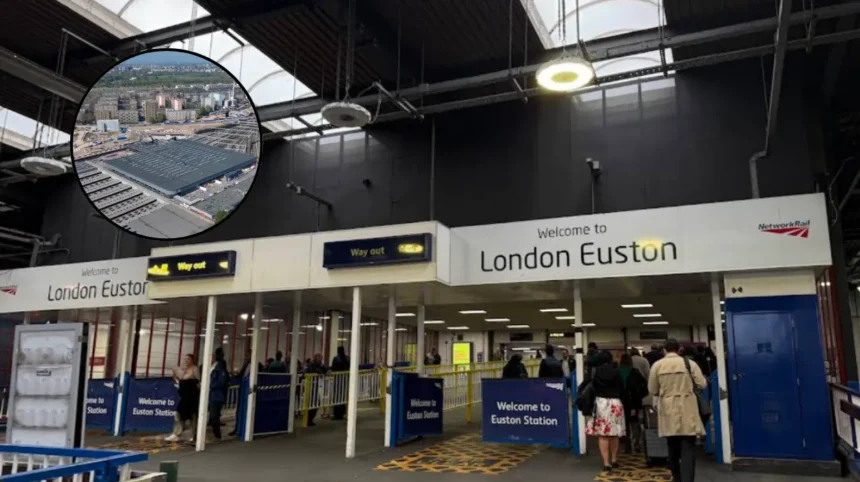
Euston (North London News) September 12, 2026 – A major redevelopment scheme intended to modernise Euston Station and transform the surrounding area is set to be formally decided by the Planning Inspectorate, following years of delays, design revisions, and intense public pushback from local residents and heritage guardians. Originally conceived under the Euston Area Plan (EAP) to overhaul one of London’s primary transport hubs, the project has become a focal point of debate between municipal leaders seeking economic growth and community members warning of irreversible environmental and structural damage. Camden Council maintains that the finished scheme will secure thousands of employment opportunities and provide much-needed residential capacity, but local opposition remains steadfast against the scale of proposed demolitions and green space loss.
What Are the Core Proposals in the Euston Area Plan?
The Euston Area Plan represents a comprehensive strategic framework intended to guide the long-term development of Euston Station and its immediate vicinity. Since its initial inception in 2015, the masterplan has aimed to integrate national rail infrastructure—including the long-planned High Speed 2 (HS2) terminal—with new public spaces, commercial facilities, and residential housing.
According to Camden Council, the completed regeneration scheme is projected to deliver 2,000 new homes alongside 17,000 jobs. Municipal planners argue that the infrastructure upgrades are essential to cement the area’s role as a primary gateway within London’s Knowledge Quarter, a cluster of academic, scientific, and cultural institutions surrounding Euston, Bloomsbury, and King’s Cross.
However, the vision for the transport hub has been repeatedly disrupted by broader infrastructure challenges. Changes in federal transport policy, government-mandated pauses on HS2 construction phases, and the discarding of earlier station interchange designs after planners deemed them unfeasible have led to a prolonged cycle of reviews and updates.
Why Are Local Residents and Heritage Bodies Objecting to the Scheme?
Despite municipal revisions submitted in an updated plan in January, opposition to the scheme has mounted. Camden Council altered several proposals following formal objections submitted by at least 40 local residents, as well as official representations from Historic England.
Opponents have voiced sustained concerns over the impact that large-scale demolitions will have on the character of the neighborhood, particularly regarding the future of historic public squares and established mature green spaces. Although Camden Council has attempted to reassure community members that the long-term benefits will outweigh the temporary disruption, critics argue that the project represents an unnecessary over-development that compromises local heritage.
Specific criticisms were raised during a Town Hall cabinet meeting on Tuesday (September 8). As reported by local media sources, Alice Brown, an architect and former Green Party candidate, told councillors directly that the EAP would exacerbate the climate emergency due to the substantial greenhouse gas (GHG) emissions generated by extensive demolition and construction works.
Ms Brown further questioned the underlying financial rationale of the project. As reported by local news outlets, Alice Brown stated that the council was primarily pursuing the scheme to boost “inward investment,” which she argued was unnecessary because Euston had already received £1bn in recent years as a result of HS2 funding and “doesn’t need more.”
Background of the Euston Area Plan Development
The debate over Euston’s future is rooted in more than a decade of shifting infrastructure planning, policy changes, and national budget adjustments:
- 2015: The original Euston Area Plan (EAP) was established jointly by Camden Council, Greater London Authority (GLA), and Transport for London (TfL) to prepare the district for the arrival of HS2 and to revitalize outdated station facilities.
- 2017–2020: Initial site preparations and property acquisitions began around Euston, leading to the clearance of historic buildings, mature trees, and public parks such as St James’s Gardens. The initial demolitions sparked widespread community protests regarding loss of public green space.
- 2023: The UK central government announced a series of pauses and cost-cutting measures on the HS2 project, specifically halting work on the main Euston HS2 terminal and instructing teams to redesign the station layout to lower costs and integrate private investment models.
- January 2026: Camden Council submitted an updated, adapted version of the Euston Area Plan aimed at aligning local housing and commercial objectives with the modified national rail plans.
- September 2026: Following sustained formal objections from Historic England and local community groups, the scheme moves toward formal determination by the Planning Inspectorate, taking final oversight out of purely local hands.
Prediction: How Will This Decision Affect the Local Community and Key Stakeholders?
The forthcoming determination by the Planning Inspectorate will carry significant consequences for several key demographics across the region:
Local Residents and Community Groups
If the Planning Inspectorate approves the scheme in its current form, local residents face a prolonged decade of active construction, localized noise, traffic diversions, and elevated dust emissions. The potential loss or altering of historic public squares will permanently alter the urban landscape of Euston. Conversely, if the inspector demands significant reductions in density or halts specific build phases, residents may retain local green spaces but could face prolonged uncertainty over half-demolished infrastructure sites left behind by stalled HS2 works.
Homeowners and Jobseekers
Approval of the plan would unlock 2,000 new housing units—a critical addition given London’s ongoing housing supply shortages—along with 17,000 projected long-term jobs in commercial, technology, and research sectors linked to the Knowledge Quarter. However, if the project is substantially scaled back, these economic opportunities and residential units will be delayed or lost, potentially dampening long-term commercial investment in North London.
Climate and Planning Precedents
A decision prioritizing the carbon footprint of structural demolition could set a notable legal and planning precedent for future major infrastructure projects across the United Kingdom. If the Inspectorate cites embodied carbon emissions as a key factor in constraining the scheme, local authorities nationwide may be forced to re-evaluate large-scale urban renewal projects in favour of retrofitting existing building stock.


