Key Points
- Policy U-turn: Hackney Council has officially abandoned its opposition to the £1.5 billion Edmonton EcoPark waste incinerator reconstruction project following a comprehensive internal review.
- Manifesto Commitment: The decision directly contrasts with the Hackney Green Party’s 2026 local election manifesto pledge to explore every available avenue to cancel the plant’s rebuilding.
- Financial Risk: Abandoning the scheme at this stage would cause severe financial damage, exacerbating the borough’s projected budget deficit over the next three years.
- Environmental Impact: Cancelling the project would worsen operational and environmental outcomes, requiring the authority to transport waste to lower-performing regional incinerators.
- Borough Scale: The Edmonton EcoPark serves seven north London local authorities, all of which face severe operational and financial disruption if the rebuild is halted.
Hackney (North London News) November 2, 2026 – Hackney Council has officially withdrawn its opposition to the £1.5 billion Edmonton rubbish incinerator redevelopment, revealing that halting the construction would trigger severe financial losses and worsen regional environmental outcomes.
The strategic reversal marks a significant pivot for the administration following political commitments made earlier in the year. Although work on the modernised facility commenced in 2022, the long-term project has generated sustained political and environmental debate across north London regarding municipal waste strategy, local air quality standards, and carbon reduction targets.
Why has Hackney Council reversed its position on the £1.5bn incinerator?
As reported by Noah Vickers of the Local Democracy Reporting Service, Councillor Jacob Cable, Hackney Council’s Cabinet Member for Climate, confirmation came after an extensive technical and financial review of the capital project. Cable, who also serves as the Chair of the North London Waste Authority (NLWA), stated that it was “clear” that failing to complete the project would be “devastating both financially for the seven constituent boroughs” reliant on the site.
The decision represents a direct shift from the political platform established ahead of the 2026 local elections. In its campaign manifesto, the Hackney Green Party formally pledged to “explore every option to cancel” the reconstruction of the aging rubbish incinerator. However, after taking control of the local authority in May, executive leadership commissioned a formal review into the precise operational costs and contractual risks associated with terminating the active infrastructure contract.
Following the analysis of the review’s findings, Cable explained to the Local Democracy Reporting Service that withdrawing from the project would yield counterproductive ecological consequences. He stated that cancelling the rebuild would “also massively worsen environmental and operational outcomes, as we would have to pay to transport our waste to lower performing incinerators than that which is being built”.
How does the decision impact Hackney’s rising budget deficit?
The policy U-turn arrives as total capital costs for the Edmonton rebuild continue to rise, directly increasing the projected municipal budget deficit facing the authority over the next three-year financial plan. The project is managed under the umbrella of the NLWA, which processes municipal waste on behalf of seven London boroughs: Barnet, Camden, Enfield, Haringey, Harrow, Islington, and Hackney.
According to financial figures published by the NLWA, total capital expenditure for the broader Edmonton EcoPark energy recovery project has escalated to an estimated £1.5 billion. Because municipal waste levies are distributed across the participating constituent councils based on waste volume and capital contributions, any contractual default or exit penalty would fall directly upon the member authorities’ revenues.
What is the historical background of the Edmonton EcoPark waste incinerator?
Background of the Edmonton EcoPark project
The original Edmonton waste incinerator, located in the London Borough of Enfield, was constructed in the late 1960s and became operational in 1971. For over five decades, the facility has served as the central processing hub for residual household rubbish generated across north London that cannot be recycled or composted.
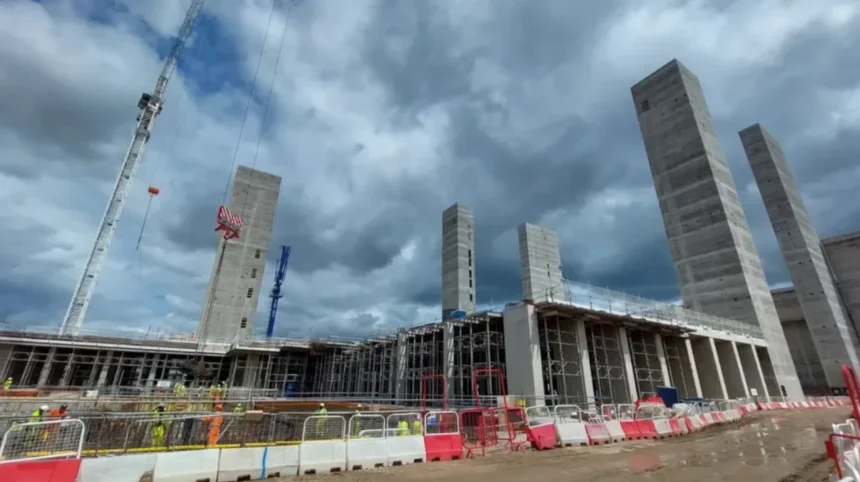
Plans to replace the aging plant were initiated by the North London Waste Authority to modernise regional waste management infrastructure. Development consent for the new Edmonton EcoPark scheme—featuring an Energy Recovery Facility (ERF), a resource recovery centre, and a public reuse centre—was granted by the Secretary of State for Energy and Climate Change in November 2017. Initial site preparation began shortly thereafter, with main construction work on the central incinerator structure officially starting in 2022.
Throughout its multi-decade operational history and the subsequent planning phases for its replacement, the facility has attracted continuous criticism from local community groups, public health advocates, and environmental organisations. Opponents have consistently raised concerns regarding long-term carbon dioxide emissions, heavy vehicle traffic, and the potential impact of particulate emissions on local air quality in surrounding communities across Enfield, Haringey, and Waltham Forest. Conversely, the NLWA has consistently maintained that the advanced energy-from-waste technology will divert non-recyclable waste from landfill while generating electricity and low-carbon district heating for thousands of local homes.
What does this development mean for local taxpayers and environmental policy?
Prediction: Financial and political implications for north London residents
The decision to continue funding and supporting the Edmonton incinerator project carries distinct practical consequences for local residents, tax-paying households, and environmental campaigners across north London.
- Impact on Local Taxpayers: By avoiding the contractual termination fees, legal penalties, and logistics costs associated with cancelling a major infrastructure scheme mid-construction, Hackney Council and its six partner boroughs avert immediate fiscal shocks. However, because overall project costs have expanded to £1.5 billion, constituent councils will still need to allocate higher portions of their annual budgets toward the waste levy over the coming three-year window. This upward pressure on local authority finances may constrain municipal spending in other non-statutory public services or contribute to future adjustments in local council tax rates across the participating boroughs.
- Impact on Environmental Groups and Campaigners: Local community networks and environmental advocates who campaigned on the Green Party’s initial manifesto commitment face a significant political setback. The affirmation of the Edmonton facility ensures that thermal treatment (incineration) will remain the central pillar of north London’s residual waste strategy for decades to come. Anti-incineration groups are expected to redirect their efforts toward monitoring atmospheric emissions compliance, pressing for enhanced waste diversion and recycling targets, and auditing the implementation of promised carbon-capture technologies at the Edmonton site.