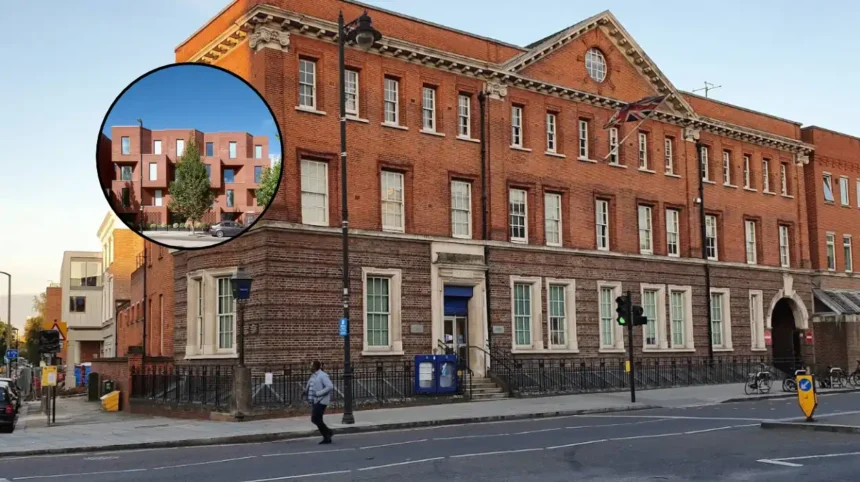
- Regeneration Completed: North London architectural practice Archanaeum has completed the residential transformation of the historic 19th-century Hornsey Police Station in Haringey.
- Residential Units: The scheme provides a total of 29 new homes, combining the restored Victorian structure with two new contemporary blocks.
- Communal Landscape: A central Japanese-style garden designed by renowned landscape artist Takeshi Nagasaki forms the heart of the new layout.
- Architectural Concept: Designed around a philosophy termed “weaving the past and the present”, establishing a architectural narrative with Victorian heritage without resorting to historic imitation.
- Material Approach: The contemporary extensions draw inspiration from the intricate decorative brickwork of the original police station building.
Haringey (North London News) November 10, 2026 – Finchley-based architectural practice Archanaeum has officially completed the residential regeneration of the former Hornsey Police Station in the London Borough of Haringey, converting the late 19th-century municipal structure into a 29-home residential complex centered around a Japanese-inspired communal garden.
As reported by Thomas Lane of Building Design, the scheme re-establishes a unified sense of place for the isolated Victorian asset by surrounding the refurbished historical building with two contemporary blocks arranged around a courtyard designed by landscape artist Takeshi Nagasaki. The police station originally operated as part of a civic precinct alongside a municipal fire station and public library; however, those adjacent structures were demolished during the 1960s to construct a surface car park, leaving the police facility isolated for decades prior to its closure in 2021.
What is the design concept behind the Hornsey Police Station regeneration?
According to statements released by Archanaeum and reported by Building Design, the design strategy for the Hornsey site was anchored by a core concept defined as “weaving the past and the present”. The practice explored methods to enable modern architectural interventions to establish a meaningful dialogue with the existing Victorian context, explicitly avoiding direct historical imitation.
As detailed in the project documentation by Archanaeum’s project team, the decorative brickwork of the original 19th-century building was analyzed to inform the material palette and elevational treatment of the new additions. This approach resulted in a contemporary interpretation of traditional Victorian masonry craftsmanship, linking the new structure visually to the retained historical facade.
How has the site layout been reconfigured for residential use?
As documented by Building Design, the completed project comprises three distinct buildings arranged around the central Japanese-style garden created by Takeshi Nagasaki. The retainment and restoration of the main police station building form the anchor of the composition.
As outlined in engineering and construction project records from Create Consulting Engineers and Dida Construction, the overall scheme incorporates a mix of refurbished structures and newly constructed elements. The original police station building was converted to house terraced residential units and apartments. To reinstate visual density on the site previously occupied by the 1960s surface car park, two additional contemporary blocks were constructed, completing the tripartite architectural grouping.
Background of the particular development
The Hornsey Police Station, located on Tottenham Lane in Haringey, was originally constructed in the late 19th century to form the core of a municipal civic complex. The complex initially housed civic facilities including a local fire station and a public library. During urban reconfigurations in the 1960s, the surrounding civic buildings were pulled down to create ground-level parking spaces, stripping the police station of its urban context.
The station officially ceased operational policing duties in 2021 as part of broader estate rationalisation across London. Following its closure, the site was acquired for redevelopment, leading to the appointment of Finchley-based practice Archanaeum to design a residential scheme that would re-integrate the site into the surrounding streetscape. Planning permissions were secured to convert the site into high-density residential housing while preserving key heritage features of the main building facade.
Prediction: How this development will affect urban planners, heritage bodies, and local housing supply
The completion of the Hornsey Police Station regeneration provides a practical model for local authority planning departments, heritage organisations, and residential developers managing redundant civic infrastructure across the United Kingdom.
For urban planners and municipal authorities, the project demonstrates how brownfield site infill can successfully eliminate former surface car parks while restoring urban density around heritage assets. The integration of 29 housing units on a restricted footprint offers a template for local councils seeking to fulfill regional housing targets without sacrificing local character.
For heritage groups and conservation specialists, Archanaeum’s approach provides a case study in avoiding stylistic pastiche. By adapting the material essence of Victorian brickcraft into modern elevational designs rather than copying historic detailing, the project highlights how historic buildings can be preserved alongside contemporary infill.
For the local property market and North London residents, the re-introduction of residential units to a long-closed municipal site increases local housing availability. The inclusion of communal green space designed by a landscape artist establishes an environmental benchmark for future high-density residential conversions within urban conservation settings.