Key Points
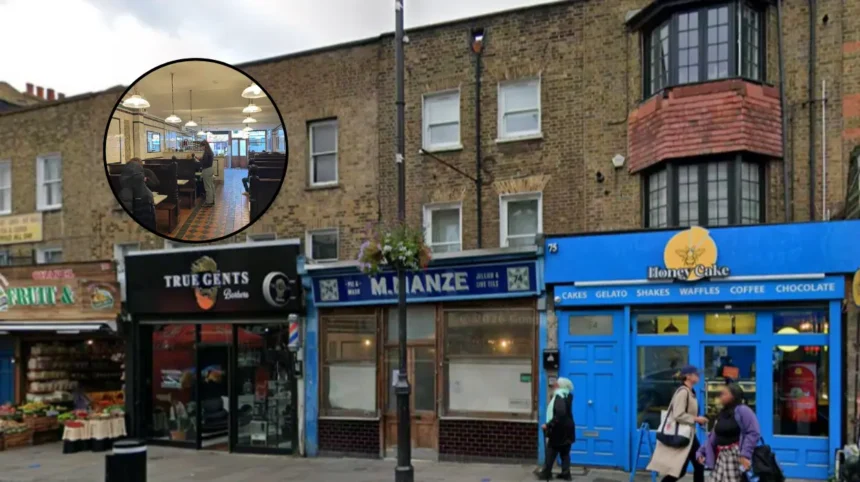
- M Manze in Chapel Market, Islington, briefly reopened as 74 Chapel Market before appearing to close again within weeks.
- The new operators said they could no longer keep trading because of “issues out of our control”.
- The closure has been described by local reporters and traders as another blow to Chapel Market and its long-standing character.
- The site has a long heritage: M Manze served pie and mash there for more than 100 years before closing in 2019 due to rising rents and business rates.
- North London has lost many pie and mash shops over time, although a small number still remain open.
- The wider story is not just about one restaurant, but about gentrification, high overheads and the survival of traditional London food culture.
Islington (North London News) July 23, 2026 — As reported by the Islington Gazette and MyLondon, the former M Manze site at 74 Chapel Market has once again fallen quiet after a short-lived revival as 74 Chapel Market.
The restaurant had been brought back to life by Martin Savage and business partner John Gordon, prompting excitement among locals who wanted the historic pie and mash tradition to continue.
However, according to a statement quoted by MyLondon, the business said: “Unfortunately, due to some issues out of our control, we are no longer able to keep on trading.”
The Islington Tribune reported the closure under the headline “Pie and mash shop lasts just weeks”, underlining how quickly the revival ended after reopening.
The loss has been particularly significant because the site was not a short-lived food trend outlet, but a location with more than a century of pie and mash history.
Why does the closure matter?
The Chapel Market shop had symbolic value far beyond the plate itself.
As reported by the Islington Tribune, traders said the closure would be “another nail in the coffin” of the market, with concerns that rising rents and business rates are speeding up gentrification.
One trader told the paper that the loss would not be good for the market and described the shop as the last traditional pie and mash shop in Islington.
That concern is not new: earlier reporting on M Manze’s original closure in 2017 pointed to steep business rates as a major pressure on the business.
In other words, the latest shutdown is being read locally as part of a longer pattern affecting small, heritage-led food businesses in expensive parts of London.
How long had M Manze been there?
M Manze had been trading at Chapel Market since 1911, serving traditional pies, mash and liquor to generations of customers.
The shop became one of the best-known names in London’s pie and mash scene, and its white tiles, marble counters and old fittings were part of its appeal.
It closed in 2019 after pressures including rising rents and business rates, according to later reporting.
The site then became Beefsteaks, which later shut permanently in 2023, before the 2026 revival reopened the old address under a new name.
That sequence shows how difficult it has been to maintain continuity at the location, even when there is public affection for the brand and the food.
What do other reports say?
MyLondon reported that locals were “baffled” when the reimagined pie and mash shop announced its closure just a month after opening.
The same report said the reopening had initially generated excitement because the historic M Manze unit was being restored by Martin Savage and John Gordon.
The Islington Gazette said the shop appeared to have closed again just weeks after reopening, reflecting the speed of the turnaround.
The Islington Tribune focused more on the market-wide impact, quoting traders who feared the closure would worsen the sense that Chapel Market is losing its traditional character.
Together, the reports paint a consistent picture: local disappointment, uncertainty about the immediate cause, and wider anxiety about the future of the market.
Explore More Islington News
Islington Council Face Backlash Over £131k Zebra Crossing: Finsbury Park 2026
Islington Pension Fund Members Back Divestment Proposals Islington 2026
Which pie and mash shops are still open?
North London has lost most of its pie and mash shops over time, according to the Ham & High, although a few continue to trade.
The paper framed the story as a historic look back at the decline of an old London food tradition in the north of the city.
The wider London pie and mash scene still exists, but it is much smaller than it once was, and many of its remaining sites are treated as local institutions.
That is why closures such as Chapel Market attract more than just food interest; they also tap into debates about affordability, identity and the survival of working-class traditions in central London.
For readers, the important point is that the Chapel Market closure is part of a shrinking landscape rather than an isolated incident.
What is the background?
Pie and mash is closely associated with London’s East End, but it also spread beyond that area and became part of the wider city’s food culture.
The dish developed as an affordable meal for working-class communities, combining meat pies, mashed potato and liquor.
M Manze became one of the better-known names in that tradition, and its Chapel Market branch stood out because of its long run in Islington rather than east London.
Over time, however, shops like this have faced the same pressures as many independent businesses: rising property costs, business rates and changing customer habits.
That background helps explain why reopening a heritage venue can still be difficult even when there is strong public goodwill.
What is the likely effect?
For local residents and market traders, the immediate effect is another loss of a well-known traditional business and another reminder of how fragile independent shops can be.
For supporters of London’s food heritage, the closure reduces the number of places where pie and mash is still being served in a historically recognisable setting.
For Chapel Market itself, the development may strengthen concerns that the area is shifting away from the mix of character businesses that once defined it.
The likely longer-term effect is not a sudden end to pie and mash in London, but a further narrowing of where and how the tradition survives.
That means the audience most affected will be local shoppers, regular diners, and anyone who sees these shops as part of London’s living heritage.