Key Points
- Evolution of Newington Green: Long regarded as an unremarkable transit corridor between Hackney and Islington, Newington Green has transformed into a major culinary and social hub.
- Community-Led Growth: Despite rapid commercial development, local business owners and residents maintain that a close-knit community atmosphere remains the area’s primary foundation.
- Local Business Insights: Daniel Murphy, proprietor of the fishmonger and restaurant Oeno Maris, highlights the shift from a quiet district best known for a demolished petrol station to a vibrant destination.
- Geographic Identity: Situated directly on the border of the London Borough of Islington and the London Borough of Hackney, the locality draws unique cultural influences from both areas.
Newington Green (North London News) September 21, 2026 – For longstanding residents of Hackney and Islington, Newington Green—situated precisely on the border of the two prominent North London boroughs—was historically viewed as a transit enclave rather than a destination in its own right, perhaps best known locally for its long-demolished petrol station. Decades on, and to the surprise of long-time locals, a vibrant food and drink scene has exploded from this former quiet corner, drawing substantial weekend crowds.
As reported by broadsheet reporter subtle profiles for MyLondon, local business owner Daniel Murphy provided insight into the area’s evolving commercial appeal. Cutting into a salmon fillet behind the seafood-stacked counter of Oeno Maris, the 42-year-old trade venue operator stated,
“I think it’s super sexy down here.”
Murphy opened the acclaimed fishmonger-cum-restaurant four years ago, following extended professional stints in Brixton and Broadway Market. Having lived locally since 2011, Murphy noted that the neighborhood’s commercial trajectory has changed markedly over the past decade, shifting from quiet residential streets into a flourishing network of independent eateries, coffee shops, and specialized retail establishments.
How Do Local Business Owners View The Cultural Shift In The Area?
According to reporting by MyLondon, the appeal of Newington Green extends beyond its commercial success, leaning heavily on the social cohesion amongst store owners and residents. While adjacent districts such as Angel or Shoreditch have experienced large-scale commercialisation, Newington Green has largely retained a distinct, village-like atmosphere driven by independent traders.
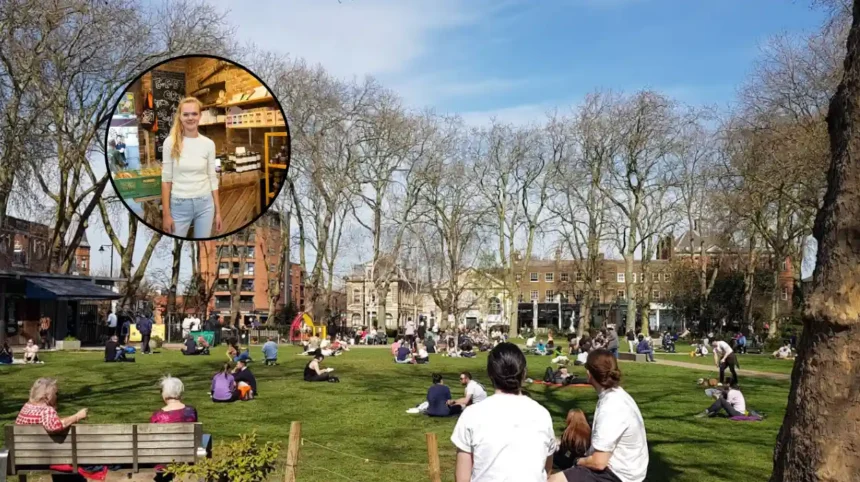
Local proprietors note that the influx of visitors during weekends has provided vital footfall for independent businesses amidst broader economic challenges across the capital’s retail sector. The district’s reputation as a “groovy village” has been reinforced by its compact central green surrounded by historic buildings and modern independent fronts.
Despite the rapid expansion of hospitality venues, community members interviewed by local press emphasize that the neighborhood retains its core identity, sustained by long-term residents alongside newer business operators who collaborate rather than strictly compete.
Background: What Is The Historical Context Of Newington Green’s Development?
Historically, Newington Green holds a notable position in London’s civic and political history. Dating back to the 16th century, the area was a rural settlement that later became a well-known haven for English Dissenters—religious and political reformers who lived outside the established Church of England.
In the 18th century, Newington Green was home to pioneering feminist writer Mary Wollstonecraft, who established a school for girls near the green in 1784. The Newington Green Unitarian Church, built in 1708, remains the oldest nonconformist place of worship in continuous use in London, serving as an intellectual epicenter for historic figures including Richard Price and Benjamin Franklin.
During the mid-to-late 20th century, the area transitioned into an affordable residential space bridging Islington and Hackney. The central traffic gyrate surrounding the green dominated the immediate urban landscape for decades. Comprehensive urban regeneration efforts initiated in the early 2000s renovated the central park space, improved pedestrian access, and paved the way for the current influx of independent hospitality businesses.
Prediction: How Will This Ongoing Transformation Affect Local Residents And Businesses?
The continued recognition of Newington Green as one of London’s prominent cultural and culinary hot spots is anticipated to bring both financial opportunities and structural challenges for the local demographic:
Impact on Independent Business Owners
Continued positive media coverage and increased footfall will likely benefit local traders, hospitality venues, and specialty shops. However, elevated profile levels often trigger commercial rent increases during lease renewals, which may place pressure on smaller, long-standing independent establishments unable to match corporate yield expectations.
Impact on Housing and Local Residents
For homeowners, the area’s growing reputation as a desirable village center is likely to sustain property values and drive housing demand. Conversely, private renters and lower-income residents may face heightened risks of price displacement as residential rents track the neighborhood’s rising profile.
Preservation of Community Character
The key operational test for Newington Green over the coming years will be balancing its expanding popular appeal with the maintenance of its historical community roots. If local planning authorities in Hackney and Islington prioritize independent business protection, Newington Green can retain its distinctive village character while sustaining its current economic momentum.