Key Points
- Location and Incident: A retail store inside CF Masonville Place, a major shopping centre located in north London, Ontario, was targeted in an afternoon robbery where a chemical irritant was weaponised.
- Casualties Reported: At least two retail store employees sustained minor injuries during the confrontation and received treatment at the scene from emergency medical services.
- Evacuation Orders: Security protocols led to a swift partial evacuation of the shopping complex, primarily impacting retail shops located near the facility’s third and fourth entrances.
- Emergency Response: First responders arrived at the scene around 1:25 p.m., with paramedics providing immediate care and facilities personnel deploying industrial exhaust fans to ventilate trapped airborne irritants.
- Suspect Descriptions: Eyewitness testimony described the perpetrators as adolescent youths, estimated to be between 13 and 14 years old, who fled the shopping centre carrying stolen merchandise.
- Investigation Underway: The London Police Service has launched an active investigation into the incident, treating it as an armed robbery involving a dangerous chemical agent.
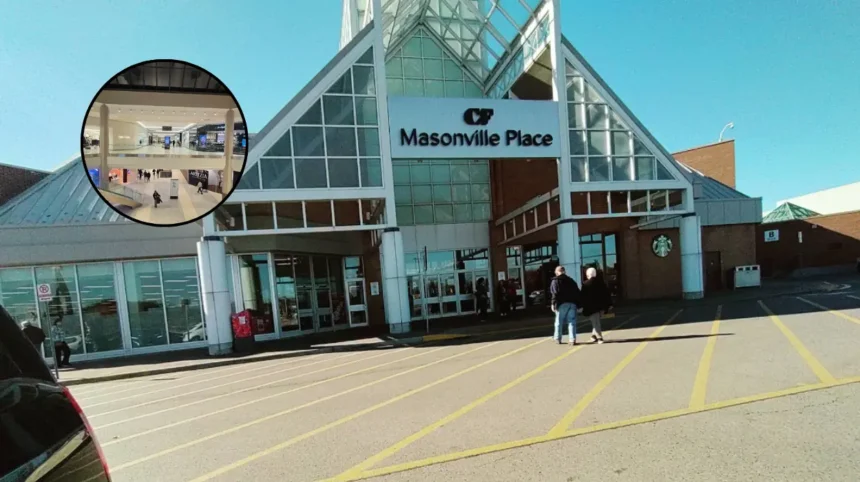
CF Masonville Place (North London News) June 11, 2026 – A mid-day robbery involving the deployment of a suspected chemical irritant triggered an emergency response and a partial evacuation at CF Masonville Place shopping mall in north London, Ontario, leaving two retail employees injured on Wednesday afternoon. First responders converged on the commercial complex at approximately 1:25 p.m. following reports that multiple suspects had released a noxious substance inside a retail establishment before fleeing the premises with stolen inventory. Emergency management personnel and mall security cleared a multi-store radius near the building’s northern entrances, forcing dozens of retail workers and shoppers to wait outside for nearly an hour while tactical and environmental safety measures were implemented.
- Key Points
- What Happened During the CF Masonville Place Robbery?
- What Type of Noxious Substance Was Used inside the Store?
- How Extensively Were the Victims Injured During the Attack?
- How Did Mall Management and Authorities Contain the Chaos?
- Background of the Particular Development
- Prediction: How This Development Can Affect Front-Line Retail Workers and Consumers
The emergency response involved specialized units from the London Police Service and tactical paramedics from the Middlesex-London Paramedic Services, who focused initial efforts on securing the perimeter and assessing victims showing signs of acute respiratory distress. Local police officials confirmed that the active phase of the robbery concluded prior to their arrival, transitioning the operation immediately into a search-and-containment effort across the surrounding commercial district.
While the targeted retail brand has not been formally declared by corporate offices, independent witness accounts pinpointed the location as a prominent athletic apparel store operating within the secondary corridor of the shopping centre.
What Happened During the CF Masonville Place Robbery?
As documented by journalist Ashley Hyshka of CTV News, the targeted mid-day assault saw suspects deliberately introduce a chemical deterrent into an enclosed retail environment to incapacitate staff and shoppers.
According to formal updates published by local authorities, the perpetrators weaponised the chemical agent directly within the sales floor area to create an environmental barrier, ensuring an uninterrupted escape route after collecting high-value store goods.
Eyewitness accounts from inside the shopping center provided vital data regarding the sequence of events and the estimated demographics of those involved. In a field interview conducted by reporter Lauren Stallone of CTV News London, mall employee Sean Ashworgh stated:
“I was working when teenagers about ages, I want to say around 14, 13 [years old], went into the camps, were doing whatever. I didn’t see what happened. I only heard the commotion, and I saw the two of them run out with a bunch of stuff in hand, and then run down that way towards the shoppers and the youth before everyone started coughing around the area.”
The physical effects of the chemical cloud spread quickly beyond the immediate storefront, forcing nearby operators to pull down security gates to prevent the aerosolized mist from filtering into their respective spaces. Customers inside the immediate concourse reported a sudden burning sensation in their throats and eyes, leading to localized panic before security personnel established an organized evacuation line.
What Type of Noxious Substance Was Used inside the Store?
In a comprehensive report compiled by reporter Isha Bhargava of CBC News, detailed technical descriptions of the environmental cleanup showed that the specific agent used by the youth shoplifters was pepper spray. While initial police dispatches utilized the broader legal classification of a “noxious substance,” retail staff working adjacent to the targeted area confirmed that the residual scent and severe physical side-effects were completely consistent with defensive oleoresin capsicum spray.
To systematically combat the lingering atmospheric hazard, mall operations teams worked alongside emergency personnel to initiate localized ventilation procedures.
According to on-scene reporting by CBC News, heavy-duty industrial exhaust fans had to be positioned directly at Entrance 4 and immediately outside individual store thresholds to purge the concentrated chemical fumes out of the commercial corridors and into the open air.
How Extensively Were the Victims Injured During the Attack?
Medical data released by the responding emergency units indicated that the human toll was restricted to non-life-threatening injuries, though the psychological distress among front-line retail workers remains high.
As reported by CBC News, at least two employees stationed inside the targeted retail establishment bore the brunt of the close-range chemical discharge.
Providing the official operational brief on the status of those affected at the scene, London Police Service Constable Gavin Dell issued a public statement:
“At least two employees sustained minor injuries. Members of the Middlesex-London Paramedic Services attended to assist police at the scene.”
Field paramedics evaluated both employees on-site for direct topical exposure and respiratory inflammation caused by the gas. Following targeted eye-flushing protocols and monitored oxygen delivery inside staging ambulances, both victims were cleared without requiring secondary transfer to local emergency hospital facilities.
How Did Mall Management and Authorities Contain the Chaos?
The logistical coordination between public safety agencies and private mall security allowed the shopping complex to avoid a complete commercial shutdown. Media updates from CBC News indicated that retail operations inside the impacted wings of entrances 3 and 4 were ground to a halt for approximately 45 minutes as customers and non-essential personnel were directed to assembly points outside the exterior parking structures.
Following the successful deployment of air-scrubbing equipment and a thorough sweep by police units to ensure no secondary hazards remained, the evacuation order was lifted. Representatives from CBC News confirmed that all affected stores inside the mall have since reopened for standard business operations, with individual merchant syndicates returning to their regular shifts by late Wednesday evening.
Corporate administrators from CF Masonville Place were reached by regional newsrooms for independent comment on the breach of security, but the management group chose to defer all investigative queries directly to the primary law enforcement agency.
Background of the Particular Development
This chemical weapon assault is not an isolated disruption for the north London retail hub, but rather part of a documented escalation in commercial property crimes and public disturbances involving youthful offenders at the site.
In March 2026, a violent group altercation occurred within the CF Masonville Place food court, where multiple individuals engaged in a physical brawl that resulted in minor injuries to a female bystander and subsequent criminal charges against three people.
Journalist Reta Ismail of CTV News London reported on that previous incident, securing a formal policy statement from Sandra Lorentiu, the General Manager of Retail Operations for CF Masonville Place:
“The safety and security of our guests and personnel remain our highest priority and we are fully cooperating with LPS as they conduct their ongoing investigation. Cadillac Fairview is committed to community safety and is engaged in discussions with local police departments and government partners to find effective ways to work together.”
To directly address this persistent rise in retail crime and teenage vagrancy, the London Police Service finalized a strategic partnership with Cadillac Fairview to build a permanent, dedicated storefront Community Engagement Centre directly within the interior of CF Masonville Place.
Scheduled to open in the autumn of 2026, this infrastructure development aims to place uniformed police personnel directly inside the high-traffic shopping destination to deter organized retail theft rings and youth-led swarming incidents before they escalate into dangerous encounters.
Explore More Local North London News
Doctors’ Strike Hits Deficit-Ridden NHS Trust: North London 2026
North London Acting School Launches Feature Film Led by Students: London 2026
Prediction: How This Development Can Affect Front-Line Retail Workers and Consumers
The integration of chemical irritants into casual shoplifting offenses represents a dangerous tactical shift that will fundamentally alter the operational environment for retail workers, commercial developers, and everyday shoppers across the region. For front-line retail employees—a demographic largely comprised of young adults and students—this incident strips away the traditional assumption of physical safety on the sales floor.
Corporate loss-prevention policies will likely undergo immediate restructuring, shifting from passive observation toward zero-engagement mandates to protect staff from unpredictable chemical threats, potentially leading to increased insurance premiums and specialized safety training for mall workers.
For the general consuming public, the reality of encountering aerosolized hazards like pepper spray during a standard shopping trip will inevitably change foot-traffic patterns and consumer comfort levels.
To preserve public confidence and maintain retail real estate values, major asset managers like Cadillac Fairview will be forced to accelerate their investments in visible counter-measures. Shoppers can expect to see an immediate uptick in private security patrols, more stringent surveillance systems, and the implementation of advanced environmental monitoring tools designed to isolate HVAC networks during airborne emergencies.