Key Points
- Conor Erskine told Belfast Coroner’s Court he felt terrified after repeated threats from Fionntán McGarvey.
- Mr Erskine accepted striking the 18-year-old outside the Devenish Complex in Belfast on December 27, 2021.
- Mr McGarvey suffered a fractured skull and later died in hospital, 24 days after the altercation.
- Police said they could not establish why tension developed or obtain railway-halt CCTV footage.
- The inquest remains ongoing.
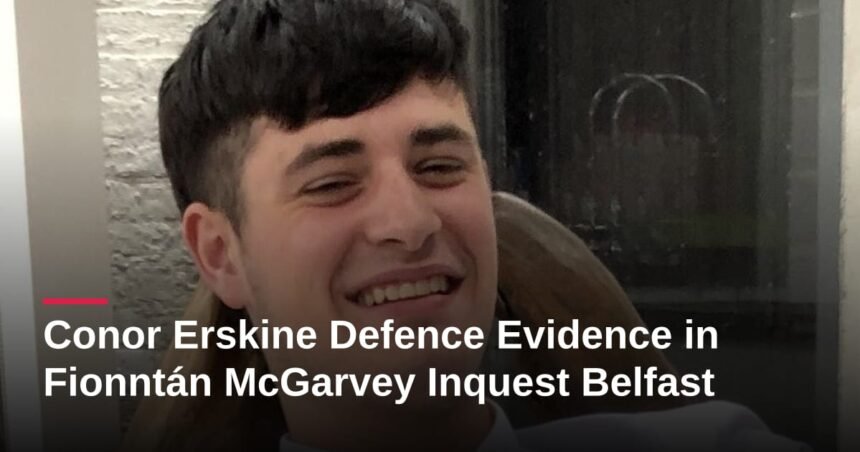
Belfast (North London News) November 18, 2026 – Conor Erskine told Belfast Coroner’s Court that he had “no other option” but to defend himself when Fionntán McGarvey repeatedly threatened him outside the Devenish Complex in the Finaghy Road North area in the early hours of December 27, 2021. Mr Erskine, giving evidence by videolink from Australia, accepted that he struck Mr McGarvey, but said he reacted instinctively after seeing what he believed was an incoming threat.
What did Conor Erskine tell the inquest?
As reported by The Belfast Telegraph, Mr Erskine said he had been drinking after attending Down Royal Races before going to the Devenish. He said there had been no argument before Mr McGarvey approached him aggressively at the entrance.
Mr Erskine told counsel to the coroner, Ian Skelt KC, that Mr McGarvey repeatedly said he was going to kill him and threatened to assault him. He said he tried to calm Mr McGarvey by saying they were friends and were not going to fight.
Mr Erskine said he offered to move away from the crowd to defuse the situation. He described removing his jacket and waistcoat because he was panicking, sweating and frightened.
“I saw an incoming threat, and with the threats made before, I was fearful for my life, so instinctively I reacted and threw my arm up,” Mr Erskine told the inquest.
He described the action as an upward, semi-open-handed swipe rather than a punch. Mr Erskine said he did not believe the blow had enough force to cause serious injury and believed Mr McGarvey’s head struck the concrete when he fell.
What happened to Fionntán McGarvey?
Mr McGarvey, an 18-year-old Queen’s University student and talented sportsman, sustained a fractured skull and a blood clot on the surface of his brain. He was discharged from hospital eight days after the incident but suffered a further brain bleed one week later.
His condition deteriorated rapidly and he died in hospital 24 days after the altercation. Earlier in the inquest, pathologist Dr James Lyness said it was possible that the later bleed was connected to the original injuries, although he said this could not be stated categorically from the post-mortem examination alone.
Counsel to the coroner said the medical treatment Mr McGarvey received appeared to have been appropriate. Witness Michelle Craig previously described a panicked scene after Mr McGarvey fell, with blood visible near his ear and on the ground.
What did police tell the coroner?
A detective chief inspector who initially led the investigation said police had been unable to obtain CCTV footage from Translink covering the nearby railway halt. Officers interviewed witnesses who offered several theories about the tension between the two men, but investigators were unable to confirm the reason.
Mr Erskine told the inquest he knew Mr McGarvey from school and through mutual friends, but had never previously had a negative interaction with him. He denied losing control and said he believed he was protecting himself.
At the close of the hearing, coroner Louisa Fee acknowledged the “dignity and courage” shown by Mr McGarvey’s parents during what she described as an extraordinarily difficult day. The inquest continues.
What is the background to the Belfast inquest?
The incident occurred outside the Devenish Complex in Belfast during the early hours of December 27, 2021. Mr McGarvey died more than three weeks after being struck and falling to the ground.
The inquest opened at Belfast Coroner’s Court after witnesses were called about the verbal exchange and events outside the venue. CCTV footage shown to the court depicted the two men walking away from the entrance with other people following.
The hearing is examining the circumstances of the injury, the subsequent medical deterioration and the events surrounding Mr McGarvey’s death. No final conclusion has been reported while proceedings remain in progress.
The Belfast Telegraph and CrimeWorld reported that evidence included Mr Erskine’s account, witness descriptions and medical testimony concerning the head injuries.
How could the inquest affect the people involved?
The continuing inquest may provide Mr McGarvey’s family with a formal account of the circumstances leading to his death, while allowing the coroner to assess the medical and factual evidence. It may also clarify the sequence of the confrontation and the significance of the fall.
For Mr Erskine, the proceedings place his account of repeated threats and self-defence alongside witness evidence, police findings and medical testimony. Any conclusions will depend on the evidence heard and the coroner’s eventual determination.