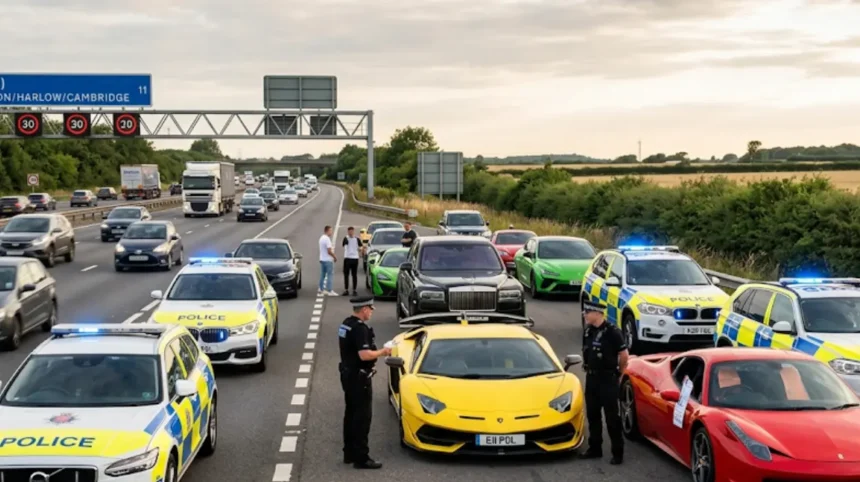
The M11 motorway supercar convoy refers to organised gatherings of high-performance luxury vehicles that assemble to drive together along the M11 route between London and Cambridge, often attracting police intervention due to dangerous driving behaviours. These events typically involve Lamborghinis, Ferraris, Rolls-Royces, and other exotic automobiles that congregate at service stations or junctions before proceeding in formation. Recent incidents in July 2026 resulted in Essex Police seizing thirteen vehicles after drivers engaged in reckless manoeuvres during peak rush hour traffic.
- What Is the M11 Motorway Supercar Convoy Phenomenon?
- Why Do Supercar Enthusiasts Choose the M11 for Convoy Events?
- What Legal Consequences Do M11 Convoy Participants Face?
- How Have Authorities Responded to M11 Convoy Incidents?
- What Environmental and Community Impacts Do M11 Convoys Generate?
- Where Can Tourists and Travellers Experience M11 Culture Responsibly?
- How Does the M11 Motorway’s Historical Development Shape Current Usage Patterns?
- What Future Measures Will Prevent M11 Convoy Recurrence?
What Is the M11 Motorway Supercar Convoy Phenomenon?
The M11 motorway supercar convoy describes spontaneous or pre-arranged gatherings of luxury and high-performance vehicles that travel together along the M11 corridor, frequently disrupting normal traffic flow and prompting law enforcement action. These convoys emerged as a social phenomenon within the UK’s supercar enthusiast community, with participants using the motorway’s direct London-to-Cambridge route as a scenic and practical thoroughfare for group driving experiences.
The M11 motorway spans 55 miles (89 kilometres) from the North Circular Road (A406) at South Woodford in north London to the A14 at Girton, northwest of Cambridge. Construction occurred between 1975 and 1980, with the motorway opening in stages: junctions 7 to 8 opened in June 1975, junctions 4 to 7 in 1977, junctions 8 to 9 in 1979, and the full length became operational in February 1980. The route passes through Essex and Cambridgeshire, serving as the primary road connection to East Anglia and Stansted Airport.
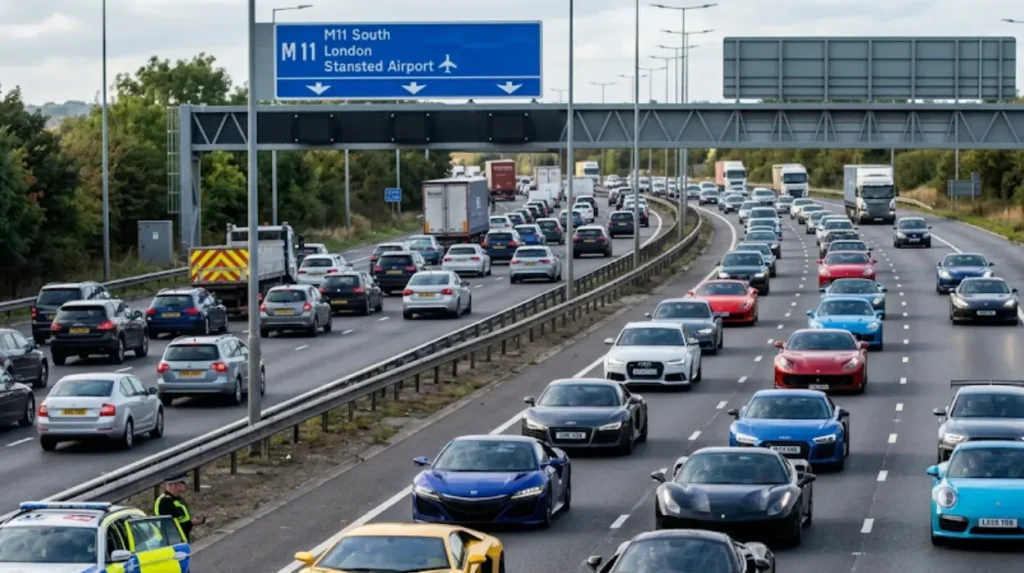
Supercar convoys on the M11 typically assemble at service areas such as Birchanger Green (Junction 8), which sits adjacent to Stansted Airport and offers extensive parking facilities suitable for high-value vehicles. Participants often coordinate through social media platforms or private messaging groups, arranging meet-up times and locations before embarking on group journeys. The phenomenon gained significant media attention following high-profile incidents where drivers engaged in dangerous behaviours including excessive speeding, abrupt braking, lane-blocking, and hard-shoulder overtaking.
Essex Police have characterised these gatherings as presenting serious safety risks, particularly when they occur during peak travel periods when the motorway experiences maximum traffic density. Sergeant Will Willsher from the roads policing unit stated that reported behaviour was not only anti-social but potentially placed other road users at serious risk, especially on busy motorways during peak travel times. The police response has included vehicle seizures, anti-social driving warnings, and ongoing investigations into suspected offences ranging from dangerous driving to causing public nuisance.
Why Do Supercar Enthusiasts Choose the M11 for Convoy Events?
Supercar enthusiasts select the M11 motorway for convoy events due to its direct route from central London to Cambridge, proximity to Stansted Airport, and relatively straight stretches that facilitate group driving formations. The motorway’s infrastructure, including well-maintained service stations and multiple junctions, provides convenient assembly points and escape routes should law enforcement intervention occur.
The M11’s geographical positioning makes it particularly attractive for London-based supercar owners seeking to escape urban congestion while remaining within reasonable driving distance of the capital. The route connects directly to the North Circular Road (A406) at Junction 4, providing straightforward access from north and east London boroughs where many high-net-worth individuals reside. The motorway’s 55-mile length offers sufficient distance for an extended driving experience without requiring excessive fuel consumption or journey time.
Stansted Airport’s proximity to the M11 at Junction 8A creates an additional draw for supercar enthusiasts, as the airport serves as a major hub for private aviation and international travel. Many supercar owners combine airport visits with convoy events, using the Birchanger Green services as a natural meeting point. The services facility includes extensive parking, fuel stations, and food outlets that accommodate large groups of vehicles and their occupants.
The motorway’s design characteristics also contribute to its appeal. The M11 features relatively gentle gradients and long, straight sections particularly between junctions 6 and 9, which facilitate comfortable high-speed cruising when traffic conditions permit. Unlike more congested motorways such as the M25 or M1, the M11 historically experiences lower traffic volumes outside peak hours, though this has changed as the supercar convoy phenomenon has gained notoriety. The route’s passage through rural Essex and Cambridgeshire countryside provides scenic views that enhance the driving experience compared to purely urban motorway sections.
Social dynamics within the supercar community further reinforce the M11’s popularity. As convoys became regular occurrences, the route developed a reputation as the designated corridor for group driving events, creating a self-perpetuating cycle where new participants naturally gravitated toward the established location. Online forums and social media groups dedicated to exotic car ownership frequently reference the M11 when discussing convoy routes, cementing its status within the community’s collective consciousness.
What Legal Consequences Do M11 Convoy Participants Face?
Participants in M11 supercar convoys face severe legal consequences including vehicle seizure, driving bans, criminal prosecution for dangerous driving, and potential imprisonment if their actions cause injury or death. Essex Police and other law enforcement agencies have adopted increasingly stringent enforcement measures in response to the public safety risks posed by these gatherings.
The Road Traffic Act 1988 provides the primary legal framework for prosecuting dangerous driving behaviours associated with supercar convoys. Section 2 of the Act defines dangerous driving as driving that falls far below what would be expected of a competent and careful driver, and where it would be obvious to such a driver that driving in that way would be dangerous. Convictions for dangerous driving can result in unlimited fines, mandatory driving bans of at least 12 months, and imprisonment for up to two years. If the dangerous driving causes death, the maximum sentence increases to 14 years imprisonment under the Criminal Justice Act 2003.
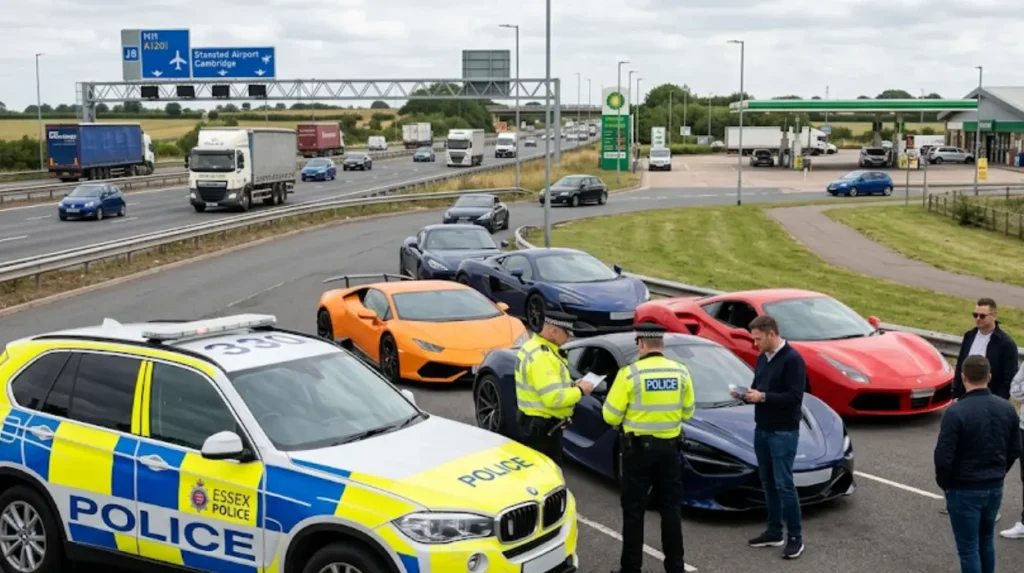
Police forces employ Section 59 of the Police Reform Act 2002 to seize vehicles used in anti-social driving behaviours. This legislation authorises officers to confiscate motor vehicles where the driver has been warned about careless or inconsiderate driving, and the officer reasonably believes the vehicle will be used again in a manner causing alarm, distress, or annoyance to members of the public. During the July 2026 incident, Essex Police issued thirteen anti-social driving warnings and seized all participating vehicles at Birchanger Green services near Bishop’s Stortford.
Additional charges commonly brought against convoy participants include causing public nuisance under common law, which carries a maximum sentence of life imprisonment for the most serious cases, though typical sentences range from community orders to several years’ custody depending on the severity of disruption caused. The Highways Act 1980 also provides offences for wilful obstruction of the highway, which can apply when convoys deliberately block lanes or use hazard lights to impede traffic flow.
Essex Police have publicly stated their commitment to pursuing all available legal remedies against convoy participants. Sergeant Will Willsher emphasised that officers acted quickly to locate vehicles and take appropriate enforcement action, with ongoing inquiries identifying multiple suspected offences. The force actively appeals for witnesses, dashcam footage, and video recordings from members of the public who observe convoy activity, using this evidence to support prosecutions and identify additional participants who may have escaped initial enforcement action.
Insurance implications also present significant long-term consequences for convicted drivers. Motor insurance policies typically exclude coverage for damage arising from illegal activities including dangerous driving and participation in organised racing events. Drivers found guilty of convoy-related offences face dramatically increased premiums, policy cancellations, and potential difficulty obtaining future coverage. The motor insurance industry maintains databases of high-risk drivers, and convoy participants are categorised alongside other serious traffic offenders.
How Have Authorities Responded to M11 Convoy Incidents?
Authorities have responded to M11 convoy incidents through coordinated multi-agency enforcement operations, increased patrol presence, public awareness campaigns, and legislative advocacy for enhanced penalties. Essex Police, National Highways, and local councils have implemented comprehensive strategies to deter future gatherings and prosecute existing offenders.
Essex Police established dedicated roads policing units with specialised training in high-speed vehicle interception and convoy disruption tactics. These units employ advanced surveillance technologies including aerial drones, automatic number plate recognition (ANPR) systems, and coordinated patrol vehicles positioned at strategic points along the M11 corridor. During the July 2026 incident, officers tracked the convoy from its entry point onto the M11 from London at approximately 4:20 PM BST, monitoring its progress until reaching Junction 8 services where enforcement action commenced.
National Highways, the government body responsible for England’s strategic road network, has worked with police forces to identify and secure vulnerable sections of the M11 where convoys frequently assemble or engage in dangerous manoeuvres. The agency has installed additional signage warning drivers of anti-social driving enforcement zones and increased the frequency of traffic officer patrols during peak convoy periods, typically weekday evenings and weekend afternoons.
Local authorities in Essex and Cambridgeshire have implemented supplementary measures including temporary traffic management orders that restrict large vehicle gatherings at service stations and junctions. Uttlesford District Council and East Hertfordshire Council, which administer areas adjacent to the M11, have coordinated with police to share intelligence about planned convoy events and expedite the processing of enforcement actions.
The Crown Prosecution Service (CPS) has issued guidance to prosecutors handling convoy-related cases, emphasising the seriousness with which these offences should be treated and encouraging the pursuit of maximum available penalties. The CPS’s approach reflects broader governmental concerns about anti-social driving behaviours and their impact on public safety and community wellbeing. Government ministers have publicly condemned supercar convoy activities, with transport officials describing them as unacceptable endangerment of innocent road users.
Public awareness campaigns have complemented enforcement efforts, with police forces using social media and traditional news outlets to publicise successful prosecutions and warn potential participants of consequences. Essex Police regularly publish details of seized vehicles and sentencing outcomes, creating deterrent effects through visibility of enforcement actions. The force maintains dedicated reporting channels for members of the public to submit information about convoy activities, including anonymous tip-offs and online evidence submission portals.
What Environmental and Community Impacts Do M11 Convoys Generate?
M11 supercar convoys generate significant environmental and community impacts including noise pollution, increased carbon emissions, disruption to local residents, and degradation of the motorway’s surrounding natural habitats. These effects extend beyond immediate traffic safety concerns to affect the quality of life for communities living adjacent to the M11 corridor.
Noise pollution represents the most immediate and tangible impact of supercar convoys on local communities. High-performance vehicles produce substantially higher decibel levels than conventional automobiles, with exhaust systems often modified to amplify engine sound. The M11 passes through residential areas particularly near junctions 4 through 8, where convoys assembling at service stations or accelerating from junction slip roads generate noise levels that exceed acceptable thresholds established under the Environmental Noise Regulations 2006. Residents in villages such as Loughton, Epping, and Bishop’s Stortford have reported sleep disturbance, reduced property values, and diminished enjoyment of outdoor spaces due to convoy-related noise.
Air quality degradation occurs through increased emissions of nitrogen dioxide (NO2) and particulate matter from high-performance engines operating at elevated RPMs during convoy events. The M11 already contributes to Air Quality Management Areas (AQMAs) where annual mean NO2 concentrations exceed national standards, particularly at junctions with the A14 and M25. Supercar convoys exacerbate these problems through concentrated bursts of acceleration and idling at assembly points, adding to the cumulative pollution burden affecting nearby communities.
Habitat disruption affects the M11’s surrounding conservation areas and protected species corridors. The motorway traverses ecologically sensitive landscapes including the Epping Forest Conservation Area and various Sites of Special Scientific Interest (SSSIs) in Essex and Cambridgeshire. Environmental impact assessments for M11 improvements have documented the presence of protected species including bats, badgers, and nesting birds that utilise underpasses and hedgerows adjacent to the motorway. The disturbance caused by large gatherings of vehicles and associated human activity can disrupt wildlife movement patterns and breeding behaviours.
Community cohesion suffers as residents perceive convoys as symptomatic of broader anti-social behaviour and law enforcement’s inability to maintain public order. Local councillors and community groups have expressed frustration at the frequency of convoy incidents and their impact on area reputation. The perception that wealthy individuals can treat public roads as private racetracks generates resentment and erodes trust in regulatory institutions.
Economic impacts extend to local businesses that experience reduced customer access during convoy disruptions and increased operational costs from vehicle damage caused by road debris or collision risks. Service station operators face challenges managing large groups of high-value vehicles while maintaining normal operations for other customers. Insurance costs for businesses located near frequent convoy assembly points have increased as risk assessments factor in the probability of property damage from associated incidents.
Where Can Tourists and Travellers Experience M11 Culture Responsibly?
Tourists and travellers can experience M11 culture responsibly by visiting designated car shows, motorsport events, and automotive museums that provide legal, safe environments for appreciating high-performance vehicles without engaging in dangerous road activities. These alternatives offer authentic supercar experiences while respecting legal boundaries and community safety.
The Essex and Cambridgeshire region hosts numerous legitimate automotive events throughout the year that cater to supercar enthusiasts. The Classic Car Show at Sandown Park, the London Motor Show at ExCeL, and various Cars and Coffee gatherings at stately homes throughout East Anglia provide opportunities to view exotic vehicles in controlled settings. These events feature vehicle displays, concours competitions, and driving experiences on closed circuits that satisfy enthusiasts’ desire to engage with high-performance automobiles without violating traffic laws.
Stansted Airport’s proximity to the M11 creates opportunities for aviation-focused tourism that complements automotive interests. The airport’s visitor centre offers observation decks where tourists can watch aircraft movements while appreciating the infrastructure that supports both commercial aviation and private supercar travel. Nearby attractions include the Imperial War Museum Duxford, accessible via Junction 10, which houses extensive vehicle collections including historic military automobiles that provide educational context for automotive development.
For those seeking driving experiences, several providers operate closed-circuit supercar driving programmes at venues such as Brands Hatch in Kent, Silverstone in Northamptonshire, and Bovingdon in Hertfordshire. These facilities offer professionally supervised sessions where participants can drive exotic vehicles at appropriate speeds on purpose-built tracks with comprehensive safety measures. Prices typically range from £100 to £500 depending on vehicle selection and session duration, providing legal alternatives to public road rallying.
Local councils and tourism boards promote responsible automotive tourism through designated heritage routes that highlight the region’s industrial and engineering history. The M11 corridor itself passes through areas significant to Britain’s automotive development, including former manufacturing sites and testing grounds. Guided tours and self-drive itineraries emphasise historical appreciation rather than performance driving, encouraging visitors to understand the cultural context of Britain’s relationship with the automobile.
Community engagement initiatives have emerged in response to convoy incidents, with local residents and responsible enthusiasts collaborating to promote positive automotive culture. Car clubs throughout Essex and Cambridgeshire organise charity drives, community service projects, and educational programmes that demonstrate the constructive contributions motor enthusiasts can make to society. These organisations provide entry points for tourists seeking authentic engagement with local car culture while supporting community wellbeing.
How Does the M11 Motorway’s Historical Development Shape Current Usage Patterns?
The M11 motorway’s historical development from 1975 to 1980 established the route’s current configuration, junction numbering, and service infrastructure, which directly influence contemporary usage patterns including supercar convoy assembly points and enforcement challenges. Understanding this historical context explains why certain locations became focal points for gatherings and why enforcement strategies target specific sections.
As you explore the modern site, you are crossing land with a deep heritage. Read about the full [M11 Motorway Construction and Opening History 1975-1980] to understand its origins. The motorway’s construction occurred in four distinct phases, with Contract 3 (junctions 7 to 8) commencing first and completing in 1975, followed by Contracts 1 and 2 (junctions 4 to 7) in 1977, Contract 4A and 4B (junctions 8 to 9) in 1979, and finally junctions 9 to 14 in 1980. This phased development created the current junction numbering system where junctions 1, 2, and 3 were reserved for an inner London section that was never constructed, leaving the motorway’s southern terminus at Junction 4.
The decision to locate Birchanger Green services at Junction 8 reflected 1970s planning assumptions about traffic volumes and traveller needs that have proven inadequate for contemporary supercar convoy phenomena. The services were designed to accommodate conventional family travellers and commercial vehicles, not large gatherings of high-value automobiles requiring extensive security and parking management. This infrastructural mismatch creates enforcement challenges as police must manage vehicles in facilities never intended for such purposes.
The M11’s alignment through Essex and Cambridgeshire followed historical trade routes and settlement patterns that predate the motorway by centuries. The route passes through areas with significant archaeological and historical importance, including Roman roads and medieval market towns. Environmental assessments for motorway improvements have documented numerous protected sites and species habitats that constrain expansion options and enforcement strategies.
Historical traffic patterns established the M11’s reputation as a relatively uncongested alternative to the M25 and M1, attracting drivers seeking efficient journeys between London and East Anglia. This characteristic made the route attractive for supercar enthusiasts when convoy culture emerged in the 2010s, as participants could achieve higher speeds with less interference from heavy goods vehicles and commuter traffic. However, as convoy incidents increased, the motorway’s traffic profile changed, with peak-hour congestion now exacerbated by enforcement activities and driver caution following widely publicised police operations.
The motorway’s integration with Stansted Airport, which expanded significantly from the 1980s onwards, created the economic and demographic conditions that enabled supercar convoy culture. The airport’s growth attracted high-net-worth residents to surrounding areas, established the infrastructure supporting private aviation, and created the social networks through which convoy events organise. Understanding this historical interconnection between aviation development and automotive culture explains why the M11, rather than other motorways, became the focal point for this phenomenon.
What Future Measures Will Prevent M11 Convoy Recurrence?
Future measures to prevent M11 convoy recurrence include legislative reforms enhancing police powers, technological innovations in vehicle monitoring, infrastructure modifications at service areas, and community-based prevention programmes that address underlying cultural drivers. These approaches combine immediate enforcement capabilities with long-term behavioural change strategies.
Legislative proposals under consideration by the Department for Transport include amendments to the Road Traffic Act that would create specific offences for organised convoy driving and provide enhanced penalties for participants in pre-arranged dangerous driving events. These reforms would address current legal gaps where prosecutors must rely on general dangerous driving provisions that may not fully capture the organised nature of convoy activities. Government consultations have indicated support for measures enabling vehicle confiscation without prior warnings for participants in identified convoy events.
Technological innovations promise enhanced detection and prevention capabilities. National Highways is piloting artificial intelligence-enabled ANPR systems that can identify convoy formations in real-time and alert patrol units before vehicles reach assembly points. These systems analyse vehicle movement patterns, speed differentials, and clustering behaviours to distinguish normal traffic from organised convoys, enabling proactive rather than reactive enforcement.
Infrastructure modifications at service areas include redesigning parking layouts to prevent large vehicle gatherings, installing physical barriers that limit congregation spaces, and implementing time-based access restrictions during peak convoy periods. Birchanger Green services is undergoing consultation on changes that would reduce its suitability as a convoy assembly point while maintaining functionality for legitimate users.
Community-based prevention programmes focus on engaging with responsible motor enthusiasts to isolate and marginalise individuals who engage in dangerous convoy activities. Police forces are developing partnerships with legitimate car clubs, driving schools, and automotive organisations to promote positive alternatives and create social pressure against anti-social behaviour. These initiatives recognise that sustainable prevention requires cultural change within the enthusiast community rather than solely relying on enforcement.
Educational campaigns targeting young drivers and newly wealthy individuals entering the supercar market aim to prevent recruitment into convoy culture by promoting responsible ownership and highlighting legal consequences. Schools, insurance companies, and vehicle manufacturers are collaborating on programmes that integrate safety messaging into the purchasing and licensing processes. These efforts seek to establish behavioural norms before dangerous patterns develop, addressing the root causes rather than symptoms of convoy phenomena.
The integration of these measures into a comprehensive strategy reflects lessons learned from previous enforcement cycles where isolated interventions produced only temporary reductions in convoy activity. Authorities recognise that sustainable prevention requires simultaneous action across legal, technological, infrastructural, and cultural dimensions, with continuous evaluation and adaptation as convoy organisers develop new tactics. The ultimate objective remains protecting public safety while preserving legitimate automotive enthusiasm within appropriate boundaries.