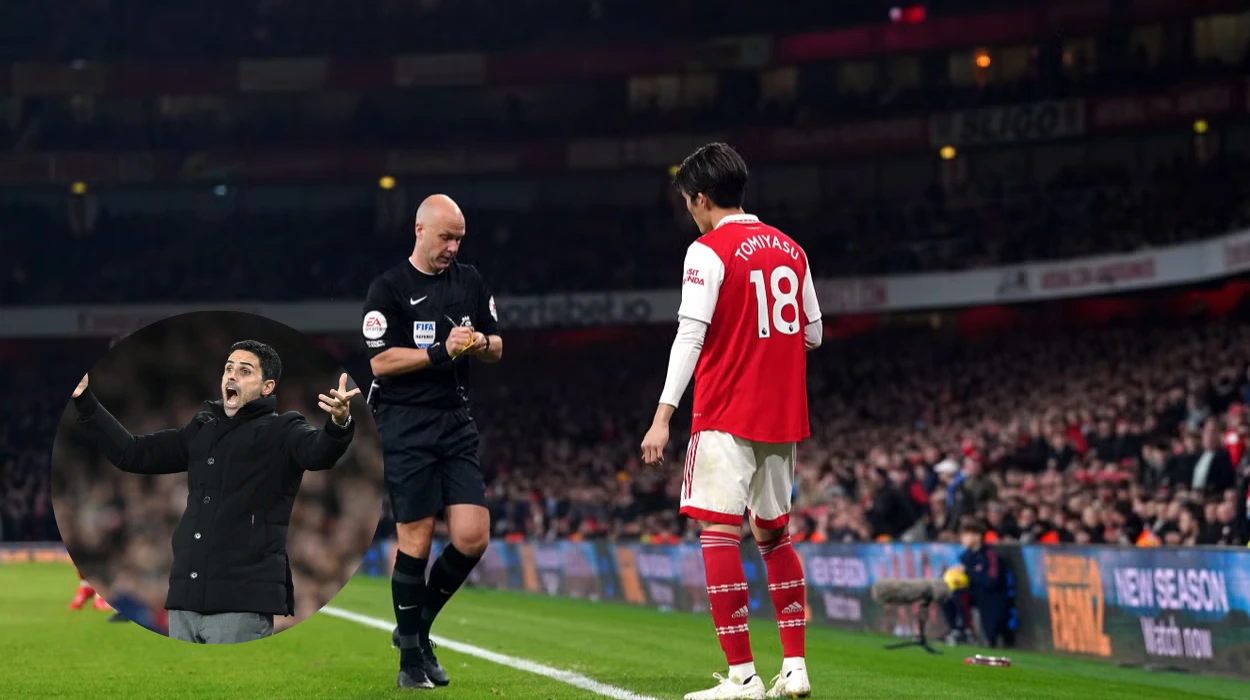
Key Points:
- Anthony Taylor has been appointed as the referee for the upcoming Premier League match between Fulham and Arsenal.
- Taylor previously oversaw a controversial 1-1 draw between Arsenal and Brighton in January 2025, where he awarded a penalty after William Saliba made head contact with Brighton’s Joao Pedro.
- Arsenal manager Mikel Arteta described the decision as “bizarre” and stated he had “never seen” such a call in his career, expressing strong dissatisfaction with the ruling.
- Arsenal fans reacted furiously to the decision, with widespread criticism directed at Taylor and the PGMOL, particularly due to the potential impact on Arsenal’s title challenge.
- The Professional Game Match Officials Limited (PGMOL) has confirmed Taylor’s appointment for the Fulham clash, reigniting concerns among Arsenal supporters about past officiating controversies.
- This will be Taylor’s second time refereeing Arsenal this season, having previously officiated their match against Manchester United in March 2025, where a miscalculation in wall distance during a free kick led to a goal by Bruno Fernandes.
- Stuart Attwell has been named as the Video Assistant Referee (VAR) for the Fulham-Arsenal fixture, with Craig Taylor serving as assistant VAR.
Inverted Pyramid
Anthony Taylor, the referee whose controversial penalty decision against Arsenal in January 2025 sparked fury from manager Mikel Arteta and fans alike, has been appointed to officiate the Gunners’ upcoming Premier League clash against Fulham. The announcement, confirmed via social media by journalist Korsuke Nari, has reignited debate over refereeing consistency and Arsenal’s perceived misfortunes under Taylor’s supervision.
- Key Points:
- Inverted Pyramid
- Why is Anthony Taylor’s appointment controversial?
- Has Taylor made other controversial calls this season?
- How has the PGMOL responded to past controversies?
- What do historical statistics say about Taylor’s record with Arsenal?
- How have other clubs reacted to Taylor’s appointments?
- What are the implications for Arsenal’s title campaign?
The decision to appoint Taylor comes amid heightened scrutiny of Premier League officiating, particularly following a series of contentious calls involving top-tier clubs. Arsenal’s last encounter under Taylor’s watch was a pivotal 1-1 draw with Brighton & Hove Albion, where a late penalty awarded to the Seagulls dramatically altered the course of the match. As reported by BBC Sport, Arteta branded the decision “bizarre,” stating in a post-match interview:
“Strange. It indicates that we may have never witnessed something like this before. I certainly haven’t in my career. It’s a first”.
Why is Anthony Taylor’s appointment controversial?
The controversy stems from a specific incident during Arsenal’s match against Brighton, where defender William Saliba made inadvertent head-to-head contact with striker Joao Pedro while contesting a high ball. Despite Saliba also making contact with the ball, Taylor judged the challenge to be a penalty under Law 12, which prohibits “careless, reckless or using excessive force” challenges, including those involving head contact.
As reported by Football.London, Arteta challenged the logic of the decision, arguing:
“We are extremely disheartened by the decision that led to the goal because I have never encountered anything like this in my life. He also makes contact with the ball. For me, it wasn’t a penalty, no”.
The penalty was converted, denying Arsenal a crucial victory in their title race with Liverpool.
Arsenal supporters took to social media to express outrage, with many accusing the PGMOL of systemic bias and inconsistency. The incident became a focal point in broader discussions about VAR protocols and the application of subjective rules in high-stakes matches.
Has Taylor made other controversial calls this season?
Yes. In March 2025, during Arsenal’s match against Manchester United at Old Trafford, Taylor was involved in another contentious moment, though not through a disciplinary decision. As detailed by Pain in the Arsenal, Taylor incorrectly measured the defensive wall during a free kick, placing it 11.2 yards from the ball instead of the mandated ten yards.
Bruno Fernandes capitalized on the error, curling a precise shot over the improperly positioned wall and into the net. While the goal stood, post-match analysis revealed the procedural flaw, leading to criticism that even minor officiating errors can have significant consequences. The incident underscored a growing narrative among Arsenal fans that marginal decisions consistently go against the club.
How has the PGMOL responded to past controversies?
The PGMOL has not issued a formal statement regarding Taylor’s appointment for the Fulham match. However, in a separate but related incident in August 2025, the referees’ body acknowledged an error in disallowing a Fulham goal against Chelsea, leading to the removal of VAR official Michael Salisbury from officiating duties for the following weekend.
As reported by BBC Sport, PGMOL admitted the VAR intervention was incorrect after Rodrigo Muniz was penalized for a minimal challenge on Trevoh Chalobah. Fulham manager Marco Silva called the decision “unbelievable,” while defender Antonee Robinson criticized the standard of officiating as “shocking” on social media.
Referees’ chief Howard Webb reportedly contacted Fulham to discuss the matter, signaling a willingness to engage with clubs over contentious decisions. However, no such outreach has been confirmed regarding the Brighton penalty decision involving Arsenal.
What do historical statistics say about Taylor’s record with Arsenal?
While comprehensive public data on Taylor’s officiating record is limited, anecdotal evidence suggests a pattern of unfavourable outcomes for Arsenal. This season alone, Taylor has overseen two matches involving the Gunners, both resulting in dropped points due to late or controversial decisions.
The appointment against Fulham marks Taylor’s third time officiating Arsenal in the 2025/26 campaign, making him one of the most frequently assigned referees for the club this season. Stuart Attwell, serving as VAR, has also been involved in previous contentious Arsenal fixtures, raising questions about official rotation and perceived neutrality.
How have other clubs reacted to Taylor’s appointments?
Taylor is no stranger to controversy across the league. In a 2024 match between Manchester City and Arsenal, he was involved in a dispute over Leandro Trossard’s red card for kicking the ball away, a decision Mikel Arteta described as “really, really worrying”. At the time, City’s Jeremy Doku had committed a similar act without sanction, amplifying perceptions of inconsistency.
Despite these incidents, Taylor remains one of the Premier League’s most experienced referees, often entrusted with high-profile fixtures. His appointment for the Fulham-Arsenal clash suggests the PGMOL maintains confidence in his capabilities, even as debate over subjective decision-making persists.
What are the implications for Arsenal’s title campaign?
With the Premier League title race tightening, every point is critical. Arsenal’s previous encounter with Taylor directly impacted their standings, and the psychological effect of facing the same official again cannot be underestimated. The club currently sits within the top four, but any slip against Fulham could open the door for rivals.
Arteta is expected to address the appointment in his pre-match press conference, though he is likely to tread carefully to avoid potential sanctions from the Football Association for public criticism of officials.
In conclusion, Anthony Taylor’s return to the whistle for Fulham versus Arsenal is more than a routine appointment—it is a flashpoint in an ongoing conversation about fairness, consistency, and trust in football officiating. As the Gunners prepare for another high-stakes fixture, the shadow of past decisions looms large.