Key Points
- Fan group Red Action is spearheading a major pre-match demonstration to welcome the Arsenal squad before their final home game of the season against Burnley.
- The event aims to replicate and exceed the intensity of the atmosphere created during the Champions League semi-final victory over Atletico Madrid.
- Supporters are encouraged to gather hours before kick-off with flags and flares to boost the team’s morale for the title run-in.
- The initiative follows a season of heightened fan engagement at the Emirates Stadium, which has been credited with transforming the home atmosphere.
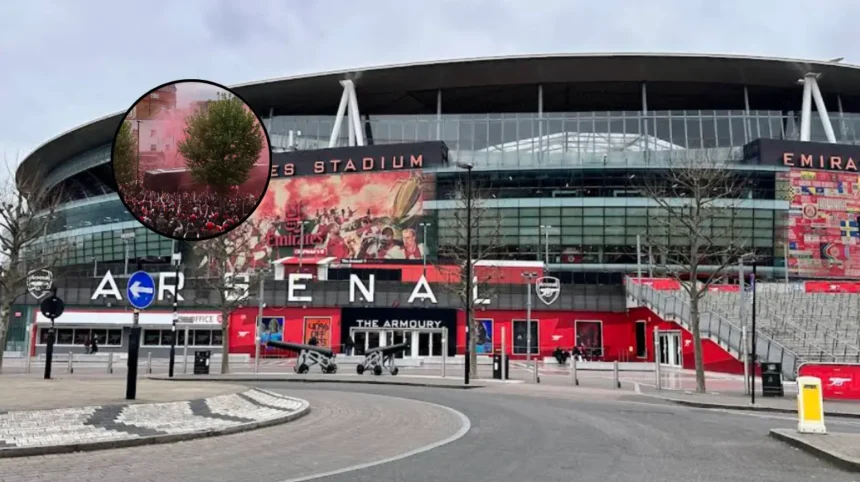
Arsenal (North London News) May 14, 2026 – Arsenal supporters are preparing to transform the streets of Highbury into a sea of red and white once more, as fan groups coordinate a massive “meet the bus” reception ahead of Monday’s final home fixture against Burnley. As reported by Sam Dean of The Telegraph, the North London club is looking to harness the “power of the 12th man” as they enter the final, decisive week of the Premier League title race. The initiative, led primarily by the influential fan group Red Action, seeks to provide the players with an emotional crescendo before they step onto the Emirates Stadium pitch for the last time this season.
- Key Points
- Why are Arsenal fans planning another ‘meet the bus’ event before the Burnley clash?
- How did the previous atmosphere against Atletico Madrid influence this decision?
- What are the specific plans for the Monday night reception?
- Who is coordinating the logistics for the Burnley pre-match display?
- What impact does this have on the players and the management?
- Background of the particular development
- Prediction: How this development can affect the fans and the club
Why are Arsenal fans planning another ‘meet the bus’ event before the Burnley clash?
The primary motivation behind the planned demonstration is to maintain the psychological momentum that has defined Arsenal’s home form this season. According to a spokesperson for Red Action, as cited by James Benge of CBS Sports, the goal is to “recreate and even surpass” the scenes witnessed during the recent Champions League semi-final win against Atletico Madrid.
During that evening, thousands of fans lined the approach to the stadium, creating a gauntlet of noise and pyrotechnics that many observers believe intimidated the opposition before a ball was even kicked.
As noted by Charles Watts, an Arsenal correspondent, the “meet the bus” phenomenon has evolved from a sporadic gesture into a strategic tool used by the fanbase to galvanize the squad. With the Premier League trophy within reach—the first such opportunity since 2004—the fans view this final home game as a pivotal moment to show unwavering support. Watts reported that the organisers are urging fans to arrive at the stadium at least two hours before the 20:00 BST kick-off to ensure the team bus is met by a capacity crowd on its arrival.
How did the previous atmosphere against Atletico Madrid influence this decision?
The success of the Atletico Madrid reception serves as the blueprint for Monday’s plans. Writing for The Athletic, Jordan Campbell detailed how the previous display was described by club insiders as “the loudest and most passionate” in the Emirates Stadium’s 20-year history.
The presence of flares, large-scale flags, and non-stop chanting provided a visual and auditory spectacle that was widely shared across social media, boosting the club’s global brand while simultaneously fostering a “siege mentality” within the dressing room.
As reported by Amy Lawrence of The Athletic, several Arsenal players have publicly stated how much these receptions affect their mindset.
Following the Atletico game, captain Martin Ødegaard reportedly told club media:
“Seeing the fans like that before we even get to the dressing room gives us an extra ten per cent. It reminds us who we are playing for.”
Consequently, fan groups are keen to ensure that the Burnley match, despite the opponent’s lower league standing, is treated with the same level of intensity.
Explore More Arsenal FC News
Arsenal’s First Summer Sale Confirmed; Rice at Risk (North London, 2026)
Arsenal Eye Roma’s Wesley Franca Right‑Back Move – North London 2026
What are the specific plans for the Monday night reception?
The logistics for the event involve a coordinated effort between several independent fan groups and local authorities.
According to a report by Kaya Kaynak of football.london, Red Action has been working to ensure the display is both safe and impactful. The group has used social media to instruct fans to congregate outside the North Bank and Clock End bridges, where the team bus typically enters the stadium perimeter.
As highlighted by Kaynak, the instructions involve:
- The Arrival: Fans are asked to be in position by 18:00 BST.
- Visuals: A call for everyone to wear red and bring club-issued or personal scarves and flags.
- Acoustics: Specific chants have been designated to be sung in unison as the bus slows down to enter the underground car park.
John Cross of the Daily Mirror noted that while the club officially remains neutral regarding the use of pyrotechnics due to safety regulations, there is an unspoken acknowledgement that the atmosphere created by these “fan-led welcomes” has been a vital component of the club’s resurgence under the current management.
Who is coordinating the logistics for the Burnley pre-match display?
While Red Action is the primary organiser, they are supported by a coalition of regular match-goers and the Arsenal Supporters’ Trust (AST). As reported by Sami Mokbel of the Daily Mail, the coordination involves ensuring that the crowds do not obstruct emergency access or cause significant delays to the matchday operations. Mokbel stated that
“The club has held informal talks with supporter representatives to ensure that the passion of the fans is channeled effectively without breaching Premier League safety protocols.”
The group Red Action has a long history of trying to improve the atmosphere at the Emirates. According to Nick Ames of The Guardian, this latest plan is part of a broader “culture shift” at the club.
For years, the Emirates was criticised for being “clinical” or “quiet,” but as Ames points out, the 2025/26 season has seen a radical departure from that reputation, with the “meet the bus” events becoming a symbol of a reunited fanbase.
What impact does this have on the players and the management?
The management’s perspective on these events is overwhelmingly positive. As reported by Art de Roché of The Athletic, manager Mikel Arteta has frequently praised the “synergy” between the stands and the pitch. In a recent press conference, Arteta stated,
“When the fans play their part outside the stadium, it translates into energy on the pitch. We feel it, the players feel it, and it makes the Emirates a very difficult place for anyone to come to.”
De Roché also noted that the club’s security teams have been briefed to allow the fans a certain degree of freedom during these arrivals, recognising that the “hostile but celebratory” environment is a key part of the matchday experience.
Background of the particular development
The “meet the bus” movement at Arsenal did not happen overnight. It is the result of several years of deliberate effort by fan groups to move away from the “prawn sandwich” culture often associated with modern, high-priced stadiums.
The trend began to gain significant traction during the 2021/22 and 2022/23 seasons, inspired by similar scenes in European football, particularly in the Bundesliga and among South American clubs.
Historically, Arsenal’s move from Highbury to the Emirates Stadium in 2006 was followed by a period of perceived “atmosphere stagnation.”
The larger stadium and increased corporate seating were often blamed for a lack of noise. However, under the current coaching regime, there has been a conscious effort to rebuild the connection between the team and the local community.
The “Ashburton Army” and “Red Action” have been at the forefront of this, introducing safe standing areas, coordinated Tifo displays, and the now-iconic pre-match bus welcomes.
These events have served to bridge the gap between the players and the supporters, creating a sense of collective purpose that was arguably missing for nearly two decades.
Prediction: How this development can affect the fans and the club
The continuation and escalation of these pre-match welcomes are likely to have a profound effect on both the matchday atmosphere and the club’s commercial appeal.
For the fans, these events provide a sense of agency and participation that goes beyond simply buying a ticket; it allows them to feel directly responsible for the team’s psychological state.
This is likely to lead to higher levels of fan retention and a more vibrant, youth-led supporter culture in North London.
For the Arsenal squad, particularly the younger players, this level of support acts as a massive confidence booster. However, there is a secondary effect: it sets a high bar for home performances.
The expectation of a “cauldron-like” atmosphere means that any drop in intensity on the pitch could lead to a more pronounced sense of disappointment if the results do not match the effort of the fans.
In the long term, if Arsenal continues to foster this environment, the Emirates Stadium will shed its former reputation for being a “library” and become one of the most intimidating venues in European football. This will not only aid the team in domestic and continental competitions but will also increase the club’s “theatre” value for global broadcasting, making the club a more attractive prospect for high-level sponsorships and commercial partnerships. Expect other Premier League clubs to attempt to replicate this “fan-led” model as a way to enhance their own home-field advantage.