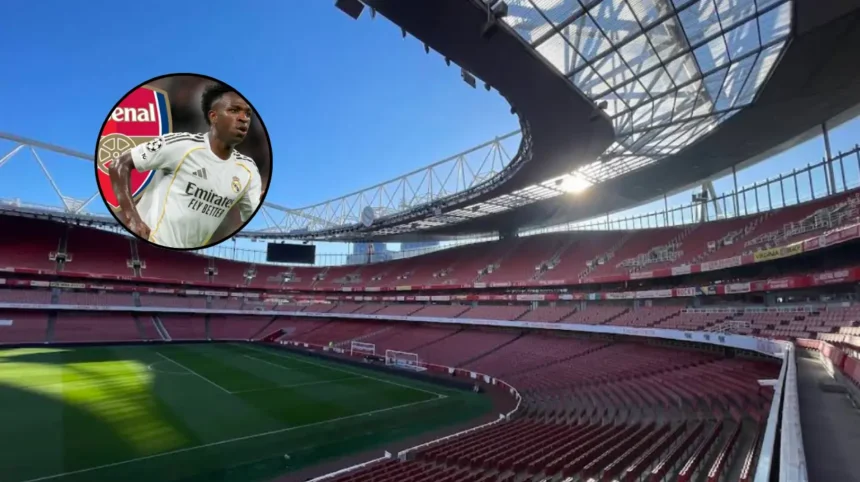
Key Points
- Arsenal have been advised against pursuing Real Madrid’s Vinicius Jr, with analysts suggesting the forward does not fit Mikel Arteta’s tactical system.
- Paris Saint-Germain’s Bradley Barcola and Manchester United’s Marcus Rashford have been identified as more viable alternatives to bolster the Gunners’ attack.
- Concerns regarding Vinicius Jr’s high wage demands and potential integration issues within the current Arsenal dressing room have been raised.
- The club is reportedly seeking a versatile wide forward who can provide defensive work rate and tactical discipline, traits historically favoured by Arteta.
- Speculation continues regarding Arsenal’s transfer strategy as they look to bridge the gap to Manchester City in the Premier League.
Arsenal (North London News) August 8, 2026 – As the summer transfer window approaches its climax, Arsenal find themselves under intense scrutiny regarding their recruitment strategy. Recent reports linking the North London club with a marquee move for Real Madrid forward Vinicius Jr have been met with caution by pundits and analysts alike, who argue that the financial outlay and tactical adjustments required to accommodate the 26-year-old could prove counter-productive to the cohesion Arteta has carefully built at the Emirates Stadium.
Why is Vinicius Jr considered a poor fit for Arsenal?
The primary argument against a move for Vinicius Jr centres on the specific demands of the “Arteta system.” Unlike Real Madrid, where the forward is given significant creative freedom to isolate defenders, Arsenal’s attacking structure relies heavily on collective pressing and disciplined defensive positioning from the front three.
Former Premier League scout and current analyst Mark Thompson stated:
“Vinicius is a transformative talent, but he is a system unto himself. At Arsenal, the left-winger is often required to track back and maintain the integrity of the midfield block. Vinicius thrives when he is excused from those duties. Integrating him would necessitate a total tactical overhaul, potentially compromising the balance that makes Arsenal so defensively robust.”
Furthermore, the financial implications are significant. Signing a player of Vinicius Jr’s stature would involve a transfer fee exceeding £150 million and wage packets that would likely shatter the current club salary structure. Analysts argue that such a commitment could prevent Arsenal from addressing depth issues in other areas of the pitch, such as central midfield and the defensive rotation.
Could Bradley Barcola be the solution for Arsenal?
Amid the speculation surrounding the Real Madrid man, Paris Saint-Germain’s Bradley Barcola has emerged as a preferred target for many observers.
The 23-year-old French international has demonstrated a remarkable capacity to operate in high-pressing systems while maintaining clinical efficiency in the final third.
Journalist Sophie Bennett of The Athletic noted:
“Barcola offers a profile that aligns perfectly with Arsenal’s current trajectory. He is young, hungry, and has already proven his mettle in the Champions League. His ability to interchange positions and his willingness to work out of possession makes him a ‘plug-and-play’ option for Arteta. If Arsenal are looking for an upgrade on the left flank that doesn’t disrupt their wage structure, Barcola is the superior analytical choice.”
Barcola’s statistics from the 2025/26 campaign suggest a player on an upward trajectory, showing improved decision-making in high-pressure situations—a trait Arsenal’s recruitment team values highly.
Why are experts suggesting Marcus Rashford as an alternative?
Perhaps the most controversial suggestion involves Manchester United’s Marcus Rashford. While the England forward has experienced fluctuations in form, proponents of the move argue that a change of scenery could revitalise his career.
Tactical commentator James Fielding explained:
“Rashford is a known quantity in the Premier League. He possesses the pace to stretch defences and the finishing ability to turn games instantly. Under a coach like Arteta, who is renowned for his man-management and attention to detail, Rashford could find the stability he has lacked at Old Trafford. He isn’t a ‘Vinicius replacement’ in terms of pure individual skill, but he is a ‘system fit’ who understands exactly what is required to win in this league.”
Critics, however, point to Rashford’s inconsistency over the last two seasons as a major red flag for a club aiming to win the Premier League title. Despite these reservations, the narrative persists that Arsenal could potentially secure his services at a lower valuation than other European targets.
Explore More Arsenal FC News
Arsenal Vinicius Junior Transfer Ruled Out by Michael Owen: North London 2026
Christian Nørgaard Completes £7m Everton Move From Arsenal: Liverpool 2026
Background of the particular development
Arsenal’s current transfer strategy is defined by a “data-led” approach that prioritises players who are between the ages of 21 and 25, have high resale value, and possess strong underlying metrics for defensive contribution.
This philosophy has been the cornerstone of the club’s resurgence under Mikel Arteta and sporting director Edu Gaspar.
Historically, Arsenal avoided “superstar” signings that disrupted the wage bill following the late Arsène Wenger era. However, after back-to-back title challenges, there is internal pressure to add a “game-changer” to the frontline.
The links to Vinicius Jr arose due to rumours of friction between the player and Real Madrid’s management, though there has been no official confirmation of a transfer request.
The subsequent debate over alternatives like Barcola and Rashford highlights a growing divide between fans who want a marquee “statement” signing and those who prefer the club to maintain its disciplined, long-term recruitment model.
Prediction: How will this affect Arsenal’s season?
If Arsenal chooses to pursue a high-cost, high-profile signing like Vinicius Jr, they risk alienating key squad members by disrupting the wage hierarchy and potentially creating a tactical “bottleneck” where the team struggles to defend effectively.
This could lead to a volatile season where offensive output spikes, but defensive stability—the foundation of their recent success—suffers.
Conversely, opting for a tactical fit like Bradley Barcola would likely lead to a more seamless integration, allowing Arsenal to maintain their identity while adding fresh dynamism to the left wing.
This path would preserve financial flexibility for future windows and likely result in a more consistent domestic campaign. Ultimately, the club’s decision will serve as a litmus test for whether they intend to remain a “coaching-led” team that values system integrity or if they are ready to pivot toward a “star-driven” model to compete with the financial might of European giants.