Key Points
- Arsenal Women have slumped to their worst-ever start in a Women’s Super League (WSL) season, collecting just six points from their opening six fixtures.
- A 1-1 draw against newly-promoted Birmingham City at the Emirates Stadium extended the Gunners’ winless streak to five league matches, marking the longest winless run in the club’s WSL history.
- The Gunners currently occupy eighth place in the WSL standings, trailing league leaders Manchester City by 12 points and third-placed London City Lionesses by nine points.
- Opponents Océane Hurtré opened the scoring for Birmingham City on a 53rd-minute counter-attack before Olivia Smith equalised for Arsenal in the 66th minute with a long-range strike.
- Despite dominating 76 per cent of possession and attempting 27 shots, Arsenal managed only four efforts on target throughout the match.
- Mounting pressure surrounds head coach Renée Slegers, who acknowledged post-match that systemic and tactical changes may be necessary to arrest the club’s decline.
- Persistent issues—including poor shot conversion, defensive vulnerability to fast breaks, and lack of central penetration against low defensive blocks—mirror the structural problems that preceded former manager Jonas Eidevall’s departure two years ago.
Arsenal (North London News) October 23, 2026 – Arsenal Women have descended into an unprecedented domestic crisis after a 1-1 draw against newly-promoted Birmingham City at the Emirates Stadium condemned the club to its worst-ever start to a Women’s Super League (WSL) season. The result leaves the Gunners winless in five consecutive league matches—their longest winless streak in WSL history—and leaves head coach Renée Slegers facing intense scrutiny as the club falls 12 points behind league leaders Manchester City.
What Occurred During Arsenal’s Draw Against Birmingham City?
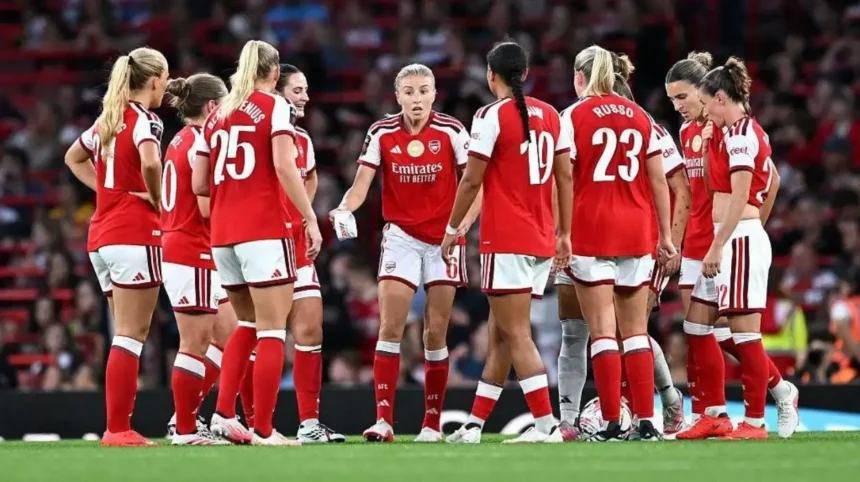
The post-match scene at the Emirates Stadium painted a stark picture of a squad struggling for answers. As reported by journalists covering the fixture, the post-match huddle formed by the Arsenal squad on the pitch—intended to demonstrate unity and collective purpose—instead revealed a group of players appearing shell-shocked following the final whistle. Sections of the home crowd responded to the 1-1 draw with noticeable audible boos.
Arsenal dominated large periods of the contest, controlling 76 per cent of total ball possession and registering 27 shot attempts. However, Slegers’ side struggled to transform positional dominance into clear-cut scoring opportunities, testing Birmingham City goalkeeper Sophie Baggaley with only four shots on target. Striker Alessia Russo struck the woodwork with a header in the first half following delivery from defender Leah Williamson, but the host side repeatedly struggled to break down Birmingham’s deep defensive block.
Against the run of play, Birmingham City took the lead in the 53rd minute. Following a swift counter-attack that exploited Arsenal’s high defensive line, forward Océane Hurtré collected a pass from Neve Herron that split the home defence, allowing Hurtré to finish past goalkeeper Misa Rodríguez. Arsenal found an equaliser in the 66th minute when Olivia Smith struck an effort from distance following an assist from Georgia Stanway, but the Gunners were unable to secure a winning goal in the closing stages.
How Have Statistical Deficiencies Impacted Arsenal’s WSL Campaign?
An examination of underlying tactical metrics reveals that Arsenal’s recent slump stems from persistent inefficiencies at both ends of the pitch.
Attacking Inefficiencies and Low Block Struggles
As detailed in tactical analyses published across sports outlets, Arsenal’s offensive output has been compromised by an inability to penetrate compact defensive structures centrally. Despite generating positive expected goals (xG) margins—including xG differentials of +2.2 against Crystal Palace and +1.2 against Manchester United—finishing metrics remain significantly below expected averages.
Outside of individual goal contributions from Olivia Smith, Lisa Baum, and Smilla Holmberg, primary attacking figures have struggled for output, with Alessia Russo tracking 1.28 goals below her expected individual tally in domestic play.
Defensive Vulnerabilities in Transition
Defensively, Slegers’ side has shown vulnerability when defending counter-attacks. While Arsenal face relatively low shot volumes—averaging approximately seven shots conceded per match—the quality of chances conceded is elevated. The goal conceded to Birmingham marked the second consecutive fixture in which Arsenal surrendered a goal from a fast break.
Across the current season, Arsenal have conceded six shots directly from transition plays, a metric trailing only Liverpool (seven) across the league.
What Were the Post-Match Statements from Key Figures?
Following the final whistle, head coach Renée Slegers addressed the media regarding the team’s ongoing form and her managerial position.
As reported by sports correspondents covering the post-match press conference, Renée Slegers acknowledged the team’s current predicament and conceded that structural adaptations may be required, stating that “change may be needed” to alter the team’s momentum. Commenting on her personal commitment and energy to lead the club through the slump, Slegers expressed gratitude to the travelling and home support while maintaining that she retains the determination to rectify their league standing.
Regarding performance execution, Slegers pointed to the contrast between territorial dominance and clinical finishing, noting that controlling possession remains ineffective if it fails to yield decisive outcomes inside the penalty area.
Background of the Particular Development
Arsenal’s current form represents a notable departure from the club’s long-standing competitive standard in English women’s football. Approaching eight years without a WSL league title, the club’s historic identity has been built on domestic dominance, having not finished outside the top three positions in the league since 2014.
In recent campaigns, the Gunners recorded back-to-back runner-up finishes. However, early-season point drops frequently compromised their title challenges before the midpoint of the schedule. Two years ago, former head coach Jonas Eidevall departed his position just four league games into the season when Arsenal fell five points behind then-leaders Manchester City. During that period, the squad exhibited similar technical challenges to those observed currently:
- Inconsistency against mid-table opposition Football Ecologie France
- Low conversion rates relative to shot creation
- Exposure to rapid opponent transitions Football Ecologie France
Slegers initially assumed managerial duties on an interim basis following Eidevall’s resignation before securing the permanent appointment. Slegers subsequently guided Arsenal to continental success by winning the UEFA Women’s Champions League and securing a second-place league finish last term.
However, following an opening-weekend victory over Brighton & Hove Albion, Arsenal went five consecutive WSL matches without a win, recording draws against Crystal Palace (0-0), Manchester United (1-1), and Birmingham City (1-1), alongside defeats to Chelsea (0-1) and Manchester City (2-4). Consequently, Arsenal sit eighth in the table with six points, 12 points adrift of Manchester City and nine points behind third-placed London City Lionesses.
Prediction: How This Development Can Affect the Audience
The consequences of Arsenal’s worst-ever WSL start extend across multiple key stakeholder groups within the women’s football ecosystem:
1. The Matchgoing Fanbase and Supporters
For the club’s primary audience and season-ticket holders, the 12-point deficit effectively eliminates Arsenal from the WSL title race before the end of October. The early loss of domestic title contention reduces competitive stakes in league fixtures, which may impact attendance figures at major Emirates Stadium fixtures that were previously driven by title-race narratives. Continued dropped points risk heightening supporter frustration and increasing pressure on the club’s executive management regarding coaching hierarchy decisions.
2. The Squad Players and Leadership Group
For the playing squad and senior figures such as Leah Williamson, Alessia Russo, and Steph Catley, prolonged domestic underperformance presents significant psychological and professional challenges. A failure to finish in the top three positions would result in missing out on UEFA Women’s Champions League qualification for the following season. This scenario could complicate future contract negotiations, squad retention, and the club’s ability to attract elite international talent during upcoming transfer windows.
3. Club Executive Leadership and Commercial Partners
For Arsenal’s board and commercial stakeholders, who have invested significantly to position the women’s team as a leading commercial asset at the Emirates Stadium, a sustained competitive downturn conflicts with off-pitch growth strategy. If performance on the pitch does not align with commercial ambitions, executive leadership may feel compelled to make managerial interventions or restructure technical staff to safeguard the club’s multi-year sports and commercial trajectory.