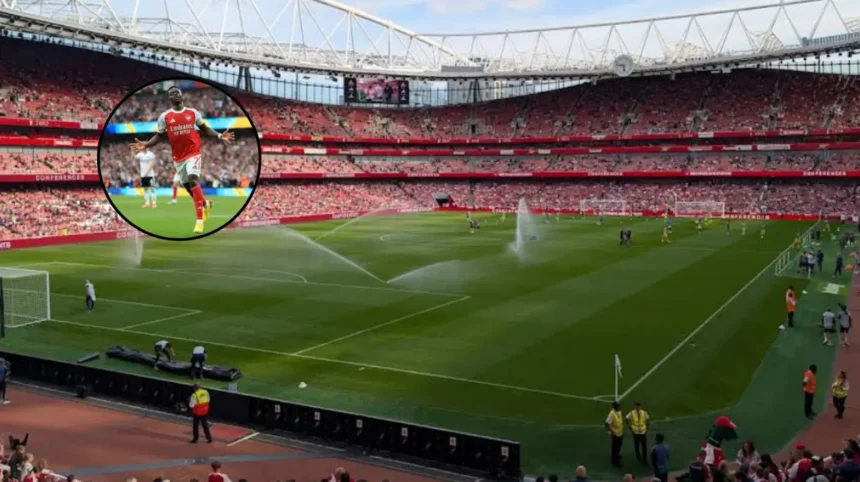
Key Points
- Bukayo Saka returned from injury and scored, while also providing an assist for Viktor Gyokeres in Arsenal’s 3-0 win over Fulham.
- The result ended Arsenal’s run of 16 matches without scoring three goals in a game.
- Saka had been sidelined by an Achilles problem, and Arsenal had been managing his minutes carefully after his return.
- Gyokeres has had a mixed start to his Arsenal career, but recent reports say he has now reached 21 goals in all competitions in his debut season.
- Commentary around the match has focused on whether Saka and Gyokeres are beginning to build a stronger understanding in attack.
Arsenal (North London News) May 4, 2026 — Arsenal’s attack showed clearer signs of life on Saturday as Bukayo Saka returned from injury, scored once, and set up Viktor Gyokeres in a 3-0 win over Fulham, a result that also ended a spell of 16 games without the Gunners scoring three goals in a match.
- Key Points
- What happened against Fulham?
- How important was Saka’s return?
- Is Gyokeres settling in?
- What did the reports say about their partnership?
- Why has Saka’s injury recovery mattered so much?
- What does this mean for Arsenal’s wider attack?
- Background of this development
- Prediction for Arsenal supporters
What happened against Fulham?
As reported by SuperSport, Arsenal’s 3-0 victory over Fulham was built around a sharp return from Saka, who came back into the starting line-up after managing an Achilles injury. He scored and assisted Gyokeres, with the Swedish striker finishing from close range after Saka’s delivery.
The same report said Arsenal had not scored three goals in a game for 16 matches, which underlined how important the performance was for Mikel Arteta’s side.
The significance of the win was not just the scoreline, but the timing. Arsenal have been trying to maintain momentum in the closing stretch of the campaign, and a more productive attacking display was badly needed after several matches in which the team had looked short of fluency.
The Fulham match offered a clearer example of direct running, quicker combinations, and more decisive end product.
How important was Saka’s return?
Saka’s return matters because Arsenal had been managing a recurring Achilles concern that had kept him out since the Carabao Cup final defeat to Manchester City. Reports in mid-April said he had missed several weeks and that the issue was being treated carefully, with Mikel Arteta warning that rushing him back could risk a longer spell out. By early May, Arteta was saying Saka was “back” and pain-free, but still needed his load monitored.
That context makes Saturday’s performance notable. Saka did not simply return to make up the numbers; he directly influenced the result by scoring and assisting.
For Arsenal, that is the clearest sign yet that one of their most important attackers may be rediscovering rhythm after a frustrating period of injury management.
Is Gyokeres settling in?
Gyokeres has been under scrutiny for much of the season, with early reports suggesting his first spell at Arsenal did not always look smooth. But more recent coverage says the striker has moved up to 21 goals in all competitions in his debut season, while also being described as one of the Premier League’s most in-form forwards during the calendar year. That is a strong statistical response to the criticism he faced earlier in the campaign.
The wider issue, though, is not just goals. Much of the discussion around Gyokeres has been about how well he links with teammates, how he works the channels, and whether he is being used to his strengths.
The Fulham win suggested a better connection with Saka, which matters because Arsenal need their main attacking options to complement each other rather than operate in isolation.
What did the reports say about their partnership?
Analysis after the match framed the Saka-Gyokeres combination as a possible turning point rather than a finished product.
One report said it would be premature to claim Arsenal’s attack had fully “clicked” on the basis of 45 minutes, but it also noted that Saka and Gyokeres delivered when it mattered. That tone reflects the balance in the current evidence: encouraging, but not yet conclusive.
From a football perspective, the pairing makes sense. Saka offers width, timing and delivery from the right, while Gyokeres is more likely to benefit from service into scoring zones and quick support around the box.
If Saka’s fitness improves steadily and Gyokeres keeps finding scoring positions, Arsenal may gain a more reliable attacking pattern heading into the season’s decisive games.
Why has Saka’s injury recovery mattered so much?
Saka’s recent injury issues have been closely watched because he has already carried a heavy workload at a young age. Reports in April said the Achilles problem had lingered for some time and that Arsenal were wary of pushing him too hard, too quickly.
That caution is important because a player who relies on sharp changes of pace and repeated explosive runs can be affected by any physical limitation, even if he is otherwise back on the pitch.
There has also been a mental side to the discussion. One report noted Arteta’s hope that Saka could come back physically and mentally fresh, which points to the broader issue of recovery rather than simple availability. For a team trying to compete on multiple fronts, that freshness can be as valuable as raw fitness.
What does this mean for Arsenal’s wider attack?
Arsenal’s attacking form has been a recurring theme of the season, particularly when results have depended on whether their front line can turn control into goals.
The Fulham win offered a case study in how quickly the picture changes when Saka is available and Gyokeres is supplied in better areas.
It also suggested that Arsenal’s attack may become more balanced if the two can sustain this level together.
At the same time, there is no evidence yet that one match solves a long-term issue. The strongest reading is that Arsenal have found a promising attacking formula, but it still needs to be repeated against stronger opposition and across a longer run of games.
That is why the coming fixtures will matter so much in judging whether this was a one-off or the start of a genuine shift.
Background of this development
Saka’s injury story has been unfolding for weeks, with reports first linking his absence to an Achilles issue that had been affecting him before he was finally rested.
Arsenal’s staff were careful not to gamble on his return, and Arteta repeatedly stressed that his recovery depended on how he handled increasing load. That made his comeback against Fulham the latest step in a managed process rather than a sudden return from nowhere.
Gyokeres, meanwhile, has been adjusting to life at Arsenal after a summer move and a mixed start that drew criticism from some observers. More recent reporting has pointed to a much stronger return, including his growing goal total and a better understanding with teammates.
The Fulham match brought those two strands together in one performance, which is why it attracted attention beyond the scoreline itself.
Prediction for Arsenal supporters
For Arsenal supporters, this development could mean a more efficient attack in the final stretch of the season if Saka stays fit and Gyokeres continues to adapt. The immediate effect may be more chances, better combinations on the right side, and a clearer focal point in the box. If that pattern holds, Arsenal’s fans may start to see a side that is less reliant on isolated moments and more able to impose itself through repeatable attacking play.