Key Points
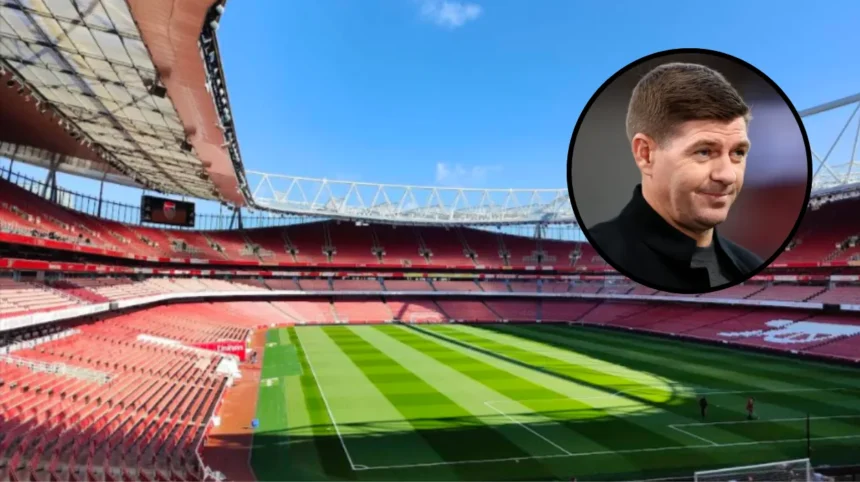
- The club’s former legend, Steven Gerrard, who has been quite cheeky lately, confessed that he feels “glad” about Arsenal failing to secure the signature of Julian Alvarez during the summer transfer period.
- Arsenal’s management, under Andrea Berta, made an effort to bring in a big-name attacker but couldn’t land the likes of Julian Alvarez, Morgan Rogers, Vinicius Junior, and Bradley Barcola.
- It is said that Alvarez preferred Barcelona to other clubs, whereas Atletico Madrid did not want their rival to get strengthened.
- Former Liverpool player Steve McManaman stated that Julian Alvarez wasn’t going to sign for Arsenal even if they tried hard.
- Although the Gunners missed out on a marquee signing, their squad included names such as Bruno Guimaraes, Ezri Konsa, Piero Hincapie, and Christos Tzolis.
- Opta and other pundits have strongly favored Arsenal to win domestic and European competitions, making rivals wary about the club’s future.
London (North London News) September 12, 2026 — The summer transfer window may have closed without manager Mikel Arteta securing that elusive marquee attacker, but the reaction from rival legends suggests that the North London club’s stature strikes genuine fear across the footballing landscape. As the Gunners position themselves as favourites to conquer both domestic and European football, remarks from former rival greats have illuminated just how closely the rest of the elite are watching.
Why is Steven Gerrard relieved that Arsenal missed out on Julian Alvarez?
The summer market saw the Gunners aggressively pursue world-class attacking reinforcements to elevate their squad. Among their primary ambitions was Atletico Madrid forward Julian Alvarez, a player viewed by many analysts as a potentially transformative signing. However, the Argentina international made it clear that his heart was set on a switch to Barcelona, while Atletico staunchly resisted selling their prized asset to direct competitors.
As reported by journalist Lewis Oldham of Football365, Liverpool legend Steven Gerrard offered a frank assessment of the unfolding drama on TNT Sports, expressing open relief that the deal collapsed. As reported by Football365, Gerrard stated that:
“I understand his point of view, but Atletico Madrid don’t want to strengthen a rival and be a feeder club to the teams you can compete domestically with and in the Champions League, so you can understand it from a club point of view as well. I’m just glad he didn’t go to Arsenal, I’ll just leave that one there!”
Echoing those sentiments on the dynamics of the player’s market value and intentions, former Liverpool player Steve McManaman asserted that the Gunners never truly stood a realistic chance of landing the former Manchester City star anyway. As reported by Football365, McManaman remarked:
“He was never going to go, as if he wants to go to Arsenal. He wanted to go to Barcelona; he came out and said that, but they’re not going to strengthen a rival.”
How did Arsenal navigate their summer recruitment despite missing top targets?
While missing out on Alvarez—alongside other linked names like Morgan Rogers and Vinicius Junior—might have initially frustrated sections of the fanbase, Arteta’s side still managed a productive window under the guidance of sporting hierarchy. The club successfully integrated fresh talent, bringing in players such as Bruno Guimaraes, Ezri Konsa, Piero Hincapie, and Christos Tzolis to reinforce depth across multiple positions.
Former Arsenal star Emmanuel Petit weighed in on the tactical fit of the missed targets, underscoring why a player of Alvarez’s profile would have suited the club so smoothly. As reported by Boyle Sports and highlighted across major outlets, Petit noted:
“Julian Alvarez is the striker Arsenal need. Why? Because he knows the Premier League. He’s such a talented player. He has great movement, great technical skills, and he would perfectly fit the DNA of this Arsenal team in how he plays one touch football.”
Despite these missed opportunities, analytical models from Opta have heavily backed Arsenal not only for domestic supremacy in the Premier League but also as leading contenders to lift the UEFA Champions League trophy. This widespread backing underscores a broader psychological shift: even without securing every primary target on their wishlist, the Gunners are viewed by pundits, rivals, and statistical supercomputers alike as an ominous force.
Explore More Arsenal FC News
Why Mikel Arteta Sabotaged Arsenal Travel Plans in London 2026
Arteta’s Shock Sabotage Tactics Revealed in London 2026
Background of the particular development
The recent narrative surrounding Arsenal’s transfer window strategy reflects a multi-year evolution under Mikel Arteta, transforming the club from top-four contenders into ruthless domestic and European heavyweights. Having pushed Manchester City close in previous title races, the Gunners’ recruitment strategy has pivoted toward targeting elite, versatile profiles capable of maintaining sustained pressure across multiple competitions. However, this elevated status has also made negotiations notoriously complex; selling clubs across Europe are increasingly reluctant to strengthen a rising superpower, and elite players routinely balance multi-club interest from continental giants like Barcelona and Real Madrid. Consequently, missing out on primary targets like Julian Alvarez highlights the intense competitive friction at the very top of the European game, where margins are defined not just by financial capability, but by player preference and rival deterrence.
This developing consensus—highlighted by rival admissions of relief—suggests that Arsenal’s psychological footprint on English and European football has reached a tipping point. For the club, the immediate audience of players, coaching staff, and supporters will likely use this external apprehension as fuel, validating their status as the team to beat. For rival clubs and legendary figures like Steven Gerrard, the underlying anxiety stems from the realization that if Arteta’s squad can seamlessly compete at the summit of the Premier League without a final marquee piece, any future acquisition of that caliber could render the Gunners virtually unstoppable. This dynamic raises the stakes for every fixture ahead, ensuring that opponents will approach matches against Arsenal with heightened caution and defensive organization.