
The UK TV electricity cost increase stems directly from the Office of Gas and Electricity Markets raising the household energy price cap by 13.5 per cent. Rising global wholesale fuel markets and regional distribution costs elevate domestic operational expenditures.
- How does display technology affect television power consumption?
- How much does it cost to run different sizes of televisions?
- What is the economic impact of television usage on North London households?
- How can consumers calculate the exact electricity cost of their television?
- What role does standby mode play in phantom power consumption?
- How do modern eco modes alter television energy demands?
- What are the long-term implications of rising electricity tariffs on home entertainment trends?
The Office of Gas and Electricity Markets (Ofgem) determines the maximum price suppliers can charge for electricity in Great Britain via a regulatory threshold known as the energy price cap. Following an official announcement by Ofgem, the standard unit rate for electricity shifts from 24.67 pence per kilowatt-hour to 26.11 pence per kilowatt-hour, representing a 5.8 per cent direct unit inflation. Concurrently, the total average dual-fuel household annual bill increases by £221, elevating standard domestic energy liabilities from £1,641 to £1,862. This legislative structural alteration means that every appliance drawing electrical power from the grid carries a higher operational overhead.
The core mechanism governing domestic power pricing is the wholesale energy market. Domestic suppliers purchase electricity from generators through forward contracts. Geopolitical volatility in international trade routes and wholesale fuel market spikes inflate the basic generation costs. Because the United Kingdom relies on natural gas generation facilities to balance the national electrical grid during periods of high demand, movements in gas pricing directly impact the base rate of electricity. When wholesale prices escalate, Ofgem adjusts the price cap framework to prevent retail energy supplier insolvencies, shifting the economic burden onto residential consumers.
Regional distribution networks add localized financial components to consumer invoices. Independent network operators manage the local infrastructure required to transport high-voltage power from the National Grid to specific properties. In regions like London, localized infrastructure investments, maintenance overheads, and density premiums dictate the exact standing charges and unit allocations. Residential properties located within North London navigate specific regional pricing schedules determined by the London distribution zone configuration, meaning the localized cost of electrical consumption sits slightly above the national average baseline.
How does display technology affect television power consumption?
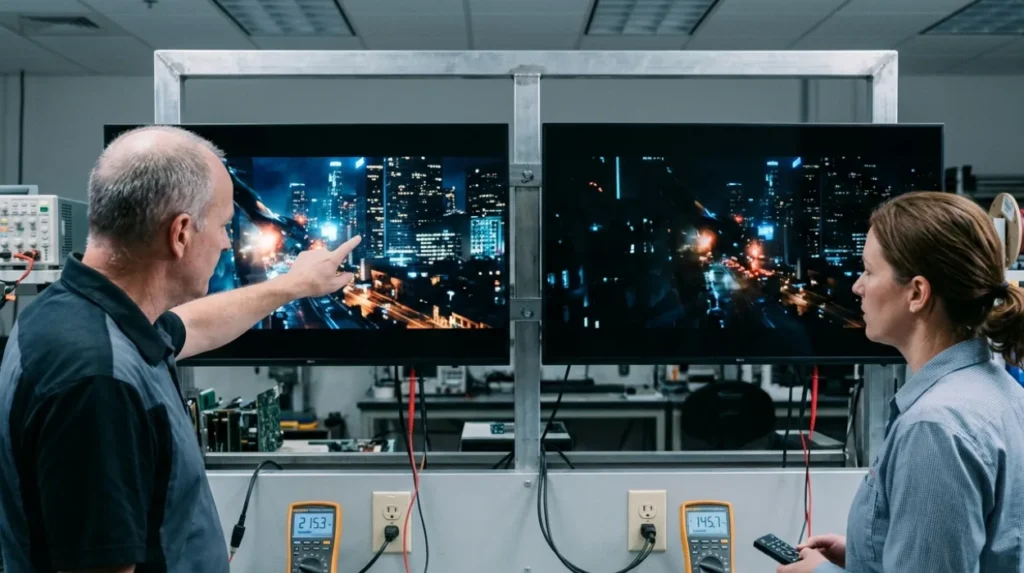
Display technology dictates the electrical consumption of a television set because different screen architectures process light extraction uniquely. Liquid crystal, quantum dot, and organic light-emitting diode displays use vastly different internal component power configurations to generate images.
Liquid crystal displays utilize a continuous backlight system positioned behind a layer of liquid crystals. Historically, these systems relied on cold cathode fluorescent lamps, though modern variants utilize light-emitting diodes. Because the backlight remains illuminated across the entire panel regardless of whether the broadcast image is dark or light, the power draw remains relatively uniform and constant during operation. A typical 40-inch liquid crystal display panel draws between 30 watts and 150 watts, depending on the age of the hardware and the brightness settings applied by the user.
Quantum dot light-emitting diode displays represent an advancement of standard liquid crystal technology. These systems implement a specialized film of semiconductor nanocrystals that enhance color purity and peak luminance. Because quantum dot television architectures prioritize high brightness output to satisfy high dynamic range video specifications, the underlying backlight arrays must draw greater electrical currents. This structural design elevates the operational power profile during bright cinematic sequences, meaning large-format quantum dot panels often exhibit higher peak wattages than standard entry-level liquid crystal units.
Organic light-emitting diode technology operates without an independent backlight framework. Every individual pixel inside an organic light-emitting diode panel acts as its own self-contained light source, generating both color and luminance simultaneously. When an image contains dark regions or pure black pixels, those specific organic structures deactivate completely, dropping their local electrical consumption to zero watts. However, when displaying bright imagery or large blocks of white screen space, the cumulative power draw of millions of active organic pixels scales upward significantly, driving the total device consumption profile between 120 watts and 300 watts for massive panels.
How much does it cost to run different sizes of televisions?
Running costs scale proportionally with the surface area of the screen and the unit rate of electricity. Based on the regulatory electricity cap rate of 26.11 pence per kilowatt-hour, annual operation costs span from fifteen pounds to sixty pounds.
A standard 32-inch television represents the entry-tier sizing category for modern households. These compact displays typically operate using a basic power profile ranging from 30 watts to 50 watts. If a household watches a 32-inch television for five hours every day, the daily power consumption equates to 0.2 kilowatt-hours. Over an entire year of consistent usage, this device consumes approximately 73 kilowatt-hours of electricity, generating a direct financial liability of roughly £19.06 under the updated utility pricing metrics.
Medium-format screens, encompassing 40-inch to 50-inch categories, exhibit an escalated operational footprint due to larger panel illumination requirements. A typical 48-inch to 50-inch 4K high-definition television maintains an average operational rating of 100 watts to 150 watts. Utilizing the standardized five-hour daily viewing model, this mid-sized display draws up to 0.75 kilowatt-hours per day, compounding into 273.75 kilowatt-hours annually. At current market rates, this consumption translates to an annual expenditure baseline fluctuating between £25.39 and £35.17, depending on specific manufacturer efficiencies.
Large-format consumer displays, which specify screen boundaries from 65 inches to 75 inches, represent the highest electrical consumer category within standard home entertainment systems. These expansive screen matrices require massive power allocations to achieve adequate panel-wide luminance, driving standard operational ratings between 120 watts and 300 watts. Running a premium 65-inch high-performance display for five hours daily translates to an annual power requirement of roughly 547.5 kilowatt-hours, forcing the household to allocate up to £57.18 per year solely to operate a single primary entertainment screen.
What is the economic impact of television usage on North London households?
The economic impact on North London households involves heightened localized electricity billing due to regional network price adjustments. Urban population density, property constraints, and elevated regional standing charges compound the financial pressures of home entertainment.
Residential consumers in North London face localized energy pricing tariffs that diverge from national baselines due to regional infrastructure classifications. Under the regulatory distribution network architecture, the London zone incurs specific operational management charges passed directly to electricity accounts. While the national average unit price sits at 26.11 pence per kilowatt-hour, the localized unit price for properties inside the London boundary reaches 26.30 pence per kilowatt-hour. This structural premium increases the direct cost of every hour of television operation for local families.
Demographic realities within North London metropolitan boroughs further shape collective energy consumption profiles. A high volume of multi-occupant residences, apartment buildings, and flats means that domestic leisure space is frequently concentrated around primary living room hubs. Entertainment setups within dense urban zones often function as primary social fixtures, remaining active for extended periods as background noise or communal activity points. When regional pricing premiums merge with extended operating schedules, the cumulative financial strain on standard domestic household budgets increases measurably across a twelve-month cycle.
Socioeconomic variances across boroughs amplify the impact of these macro-level energy pricing shifts. In households managing fixed incomes, sudden increases in regular utility costs force immediate reallocations of disposable funds. Because television entertainment represents a primary low-cost leisure option compared to external commercial activities, usage rates often remain high during periods of broader economic compression. The compounding effect of the regional electricity unit premium means that home entertainment systems require a greater proportion of the household’s weekly utility budget.
How can consumers calculate the exact electricity cost of their television?
Consumers calculate exact television electricity costs by multiplying the device wattage by daily usage hours, dividing by one thousand, and multiplying by their specific electricity tariff. This mathematical process converts raw appliance energy metrics into real financial terms.
The first phase of the calculation process requires establishing the precise operational wattage of the television set. Manufacturers print this data specification directly onto an informational plate located on the rear panel of the chassis, or within the technical parameters section of the user guide. This number represents the power drawn by the unit during standard operation. For example, a modern 55-inch display might specify an operational power requirement of 120 watts.
The second phase demands tracking real-world usage durations to establish an accurate mathematical baseline. A consumer must record the total number of hours the display remains active during a standard twenty-four-hour cycle. If the household operates the 120-watt television for four hours during an evening, the total energy consumed during that window is determined by multiplying 120 watts by four hours, producing a product of 480 watt-hours.
The final phase converts the accumulated watt-hours into standardized commercial energy units and applies the financial tariff. To convert watt-hours to kilowatt-hours, the consumer divides the figure by one thousand, transforming 480 watt-hours into 0.48 kilowatt-hours. This resulting figure is then multiplied by the localized unit rate, such as the London regional price cap rate of 26.30 pence. The calculation confirms that running the television costs 12.62 pence per day, which translates to a monthly operational cost of £3.79 over a standard thirty-day billing period.
What role does standby mode play in phantom power consumption?
Standby mode contributes to phantom power consumption by maintaining continuous electrical currency flow through internal circuitry while the device appears deactivated. This operational configuration ensures instant system boot capabilities and active network remote recognition.
Phantom power consumption, alternatively termed vampire power, defines the electricity drawn by electronic appliances when they reside in a passive, non-operational state. Modern television design prioritizes rapid deployment, requiring microprocessors, internal clocks, and localized wireless receivers to remain permanently energized. Because the device must listen constantly for an infrared or radio frequency signal from a remote control or a smart home application, it cannot completely disconnect itself from the household electrical ring main circuit.
Under historical European Union Ecodesign regulations, which remain integrated into active United Kingdom statutory instruments, televisions manufactured after 2013 must restrict passive standby power consumption to a maximum threshold of 0.5 watts. When a television is left in standby mode for twenty-four hours a day over an entire calendar year, a continuous 0.5-watt draw consumes approximately 4.38 kilowatt-hours of electricity. At the current unit rate of 26.11 pence per kilowatt-hour, this single device generates a passive annual baseline cost of approximately £1.14.
The financial calculation changes significantly if the television contains active network standby configurations. Smart televisions utilizing integrated wireless connections, voice-activation modules, or quick-start software routines often draw between 2 watts and 6 watts while in a passive state. Operating at a continuous 4-watt network standby baseline over twelve months results in an unprompted energy consumption total of 35.04 kilowatt-hours. This passive networking state quietly adds £9.15 to the annual domestic utility bill without a single hour of active user viewing.
How do modern eco modes alter television energy demands?
Modern eco modes alter energy demands by systematically restricting power allocation to the underlying illumination panels and processing chips. These software-driven interventions automatically scale back secondary hardware functions to lower the real-time wattage requirements of the device.
The primary mechanism employed by integrated television eco modes is the modification of panel backlight intensity. Because illuminating the display screen constitutes the vast majority of a television set’s total power consumption, reducing the brightness output drops the real-time wattage immediately. Eco configurations frequently deploy an integrated ambient light sensor that measures the real-world illumination levels of the room. If the room is dark, the sensor decreases the backlight array output automatically, lowering power consumption by up to forty per cent compared to maximum factory performance profiles.
Advanced algorithmic processing represents a second major component of modern energy mitigation software. Internal system chips analyze incoming video signals frame by frame to implement localized dimming policies. When a broadcast scene contains large sections of shadow or dark environments, the processor lowers the power supply to the specific light-emitting diode clusters located directly behind those portions of the screen. This dynamic power distribution model prevents the device from wasting grid energy on pixels that do not require high luminance to display correctly.
Automated power down sequences serve as a final protective barrier against accidental energy wastage. Automated sleep timers and idle-state detection routines monitor user interaction parameters, tracking whether the remote control has transmitted a command within a specified window, such as four hours. If the internal logic engine determines that no user inputs have occurred, it executes a system shutdown sequence, shifting the television back into low-power standby mode. This automated intervention prevents displays from consuming grid power as background noise if a user falls asleep or leaves the room.
What are the long-term implications of rising electricity tariffs on home entertainment trends?
The long-term implications of rising electricity tariffs include an accelerated consumer transition toward highly efficient hardware profiles and modified media consumption habits. Financial pressures drive entertainment manufacturers to prioritize structural efficiency metrics over raw hardware performance.
Energy efficiency ratings have become a primary consideration within consumer purchasing processes across the United Kingdom. When shopping for home appliances, consumers rely on standardized energy labels that classify equipment efficiency using an updated alphabetical scale running from A down to G. Because a product with a poor efficiency rating generates higher lifetime operating costs, buyers increasingly reject hardware options that carry high operational power demands. This consumer selectiveness forces television manufacturing corporations to redesign internal architectures to secure competitive energy classifications.
This financial environment accelerates technological shifts across the wider home entertainment sector. Alternative entertainment systems, including compact mobile tablets, computing configurations, and low-power streaming devices, consume significantly less power than massive home cinema displays. A standard handheld media tablet operates at a power profile between 5 watts and 15 watts, representing a fraction of the utility cost of a 65-inch television set. As domestic utility bills place higher demands on household finances, consumers may choose to shift a portion of their regular viewing schedules away from primary televisions and toward personalized secondary screens.
The integration of smart home management systems represents a final long-term trend driven by escalating energy prices. Residential consumers increasingly connect their appliances to intelligent automation frameworks that monitor household power inputs in real time. These management networks allow users to track exactly how much power their entertainment centers consume, establishing automatic shut-off schedules for peripherals like soundbars, gaming devices, and streaming boxes. This broader systemic transition highlights a fundamental shift where home entertainment is no longer viewed as an isolated utility cost, but as an active component of the household’s total energy budget.
Why has the cost of running a TV increased in the UK?
The cost of running a TV has increased because UK electricity prices have risen following Ofgem’s higher energy price cap. Higher wholesale energy costs and network charges mean households now pay more for every kilowatt-hour of electricity used.