Residents in Brent, a bustling North London borough, often face speeding vehicles and heavy traffic on local roads, prompting calls for effective calming measures. While traditional methods like speed humps dominate discussions, a “traffic calming skip” refers to strategically placing a permitted skip on public highways to temporarily slow traffic, create safer pedestrian zones, and highlight road safety issues during community campaigns or works.
- Understanding Traffic Calming in Brent
- What Is a Traffic Calming Skip?
- Why Use a Skip for Traffic Calming in Brent?
- Eligibility and Key Requirements
- Step-by-Step Guide to Requesting a Skip Licence
- Integrating with Broader Traffic Calming Requests
- Costs, Timelines, and Funding Insights
- Safety and Legal Considerations
- Community Success Stories in Brent
- Maximizing Impact and Next Steps
- Brent’s Ongoing Highways Evolution
Understanding Traffic Calming in Brent
Traffic calming encompasses physical and temporary interventions designed to reduce vehicle speeds and volumes, enhancing safety for pedestrians, cyclists, and children in residential areas. In Brent, these measures have evolved since the early 1990s, with the first schemes appearing in areas like Salmon Street, Kingsbury, where speed cushions costing around £1,500 for three units were installed to curb accidents. Brent Council, responsible for highways maintenance, prioritizes schemes based on collision data, resident petitions, and funding from Transport for London (TfL), which supports accident reduction initiatives without relying on Council Tax.
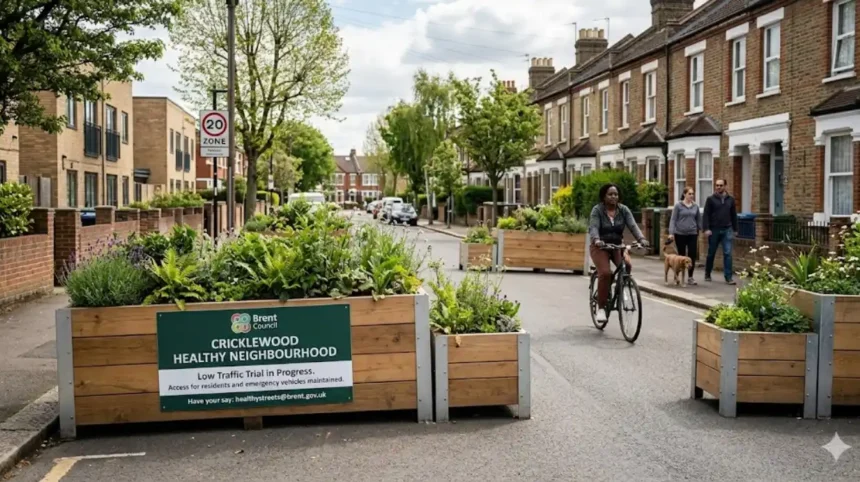
The borough’s roads, including busy routes like Chamberlayne Road in Kensal Rise, have seen repeated resident demands for calming due to high collision rates and rat-running. Measures range from permanent features like road humps and mini-roundabouts to experimental traffic orders (ETOs), such as those trialled in Kingswood Avenue and Salusbury Road, which restrict access during peak hours to ease congestion. Temporary tools, including skips, fit into this framework by providing immediate, low-cost visual barriers that force drivers to reduce speed, mimicking shared surface designs outlined in Brent’s Placemaking Guide.
What Is a Traffic Calming Skip?
A traffic calming skip involves positioning a licensed builder’s skip—typically used for waste during construction—on a public road under Brent Council’s strict permitting rules to deliberately disrupt traffic flow. Unlike standard skips for waste disposal, this application leverages the skip’s bulk to narrow roadways, compel slower navigation, and draw attention to speeding concerns, effectively acting as a de facto calming device. This tactic aligns with informal calming techniques, such as carriageway obstructions that introduce uncertainty and harmonize speeds, as evidenced in Brent’s low traffic neighbourhood experiments.
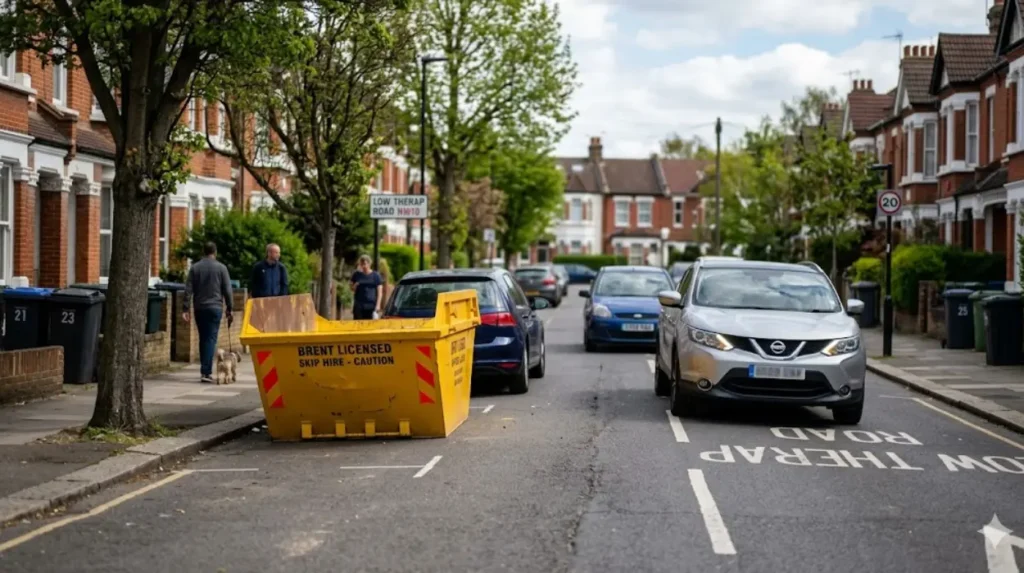
In practice, residents or skip companies have used skips in North London to highlight hazards, particularly where formal schemes face delays due to budget constraints or consultations. Brent’s highways policy does not explicitly endorse “calming skips,” but the licensing process allows placement on highways, provided safety conditions are met, making it a viable interim solution while petitions for permanent humps or cameras progress. Historical data shows calming investments yield results; post-hump installations in Brondesbury and Victoria Road correlated with borough-wide accident reductions, justifying creative temporary measures.
Why Use a Skip for Traffic Calming in Brent?
Brent’s diverse neighborhoods, from Wembley to Kilburn, experience persistent speeding, with petitions routinely calling for interventions on roads like Shaftesbury Avenue and Temple Road. Skips offer a quick, reversible alternative when council timelines stretch due to TfL funding cycles or ETO trials, which can last 18 months amid community division. By occupying lane space, a skip reduces perceived road width, discourages overtaking, and promotes cautious driving—principles proven effective in 30mph zones per neighboring Barnet’s guidelines.
This approach empowers communities, echoing initiatives where residents painted temporary signs or bollards to educate drivers before enforcement. In Brent, where vibrations from traffic rarely damage properties but safety fears loom large, a skip visually signals urgency, potentially hastening formal assessments. Costs remain low—a £65 fortnightly licence post-registration—compared to £1,500 speed cushions, allowing grassroots action while official processes unfold.
Eligibility and Key Requirements
To request a traffic calming skip, applicants must navigate Brent’s highways rules, as skips on public roads require council approval to avoid fines or removal. Crucially, only registered skip companies can apply; residents and builders cannot, ensuring professional compliance with lighting, signage, and positioning mandates. The skip must not block junctions, bus stops, or emergency access, and requires public liability insurance, waste carrier licences, and transfer notes.
Ideal locations include residential streets with proven speeding issues, supported by data like Imperial College studies on rat-running volumes. Brent assesses placements against its Crossover Policy and Climate Strategy, prioritizing pedestrian safety. Petitions strengthen cases; over 1,200 signatures recently challenged an ETO but highlighted resident-led advocacy’s power. Applications need three to five working days’ notice, with a non-refundable £327 registration for companies.
Step-by-Step Guide to Requesting a Skip Licence
Begin by partnering with a licensed skip firm experienced in Brent, as they handle the portal-based application. The company registers online at Brent’s skips portal, uploading insurance proofs and operator licences—emails are rejected. Once registered, they submit the skip application three working days ahead, detailing exact location, duration (up to fortnights at £65 each), and safety mitigations like reflective markers and lamps.
Specify the calming intent in the description, attaching evidence such as accident stats or petition links to underscore public need. Brent reviews for highway impacts, often approving if conditions match Placemaking Guide standards for informal calming. Upon issuance, the skip deploys with mandatory orange stripes, end boards, and sidlights from dusk till dawn. Monitor via the council’s register and extend as needed. For reinforcement, submit parallel highway reports via Brent’s online form for issues like speeding.
Integrating with Broader Traffic Calming Requests
Pair skip requests with formal calming bids to amplify impact. Report concerns through Brent’s “Street repairs and issues” portal, selecting speeding or obstructions to trigger speed surveys and data collection—essential for TfL-funded humps. Gather neighborhood support via e-petitions on Brent’s democracy site, as seen in Queens Park Ward’s call for cameras and restrictions. Contact Highways Committee members like Councillor Shama Tatler for advocacy.
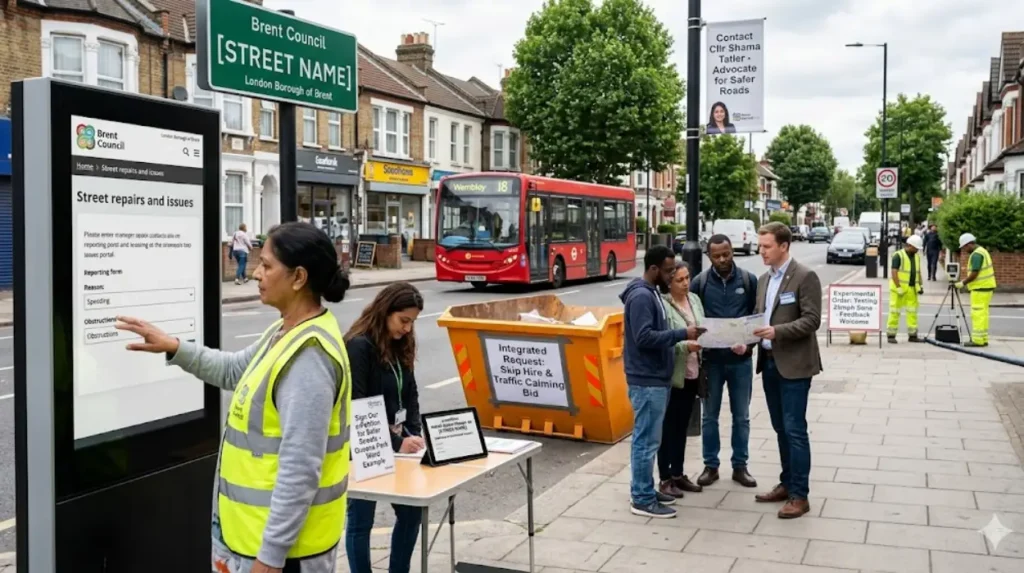
Successful precedents include Village Way and Temple Road petitions leading to committee reviews. Brent’s process involves traffic counts, lighting checks, and 20/30mph zone compliance before physical installs. Experimental orders test waters, with resident feedback shaping permanence, as in recent Wembley High Road works.
Costs, Timelines, and Funding Insights
Skip licensing starts at £327 registration plus £65 per fortnight, far below permanent schemes funded externally. Processing takes days versus months for humps, which Brent installs based on merit via TfL grants. Petitions accelerate prioritization; 1,400 signatures influenced ETO adjustments. Track via council minutes, where highways heads like Tony Kennedy oversee awards.
Safety and Legal Considerations
Compliance prevents liability; unlicensed skips face removal and £1,000 fines under Road Traffic Regulation Act provisions. Position skips to maintain visibility, avoiding peak hours if possible, and notify police for high-traffic spots. Brent enforces via cameras, as Wembley High Street’s £300,000 fines show. Calming skips must not impede buses or HGVs, aligning with bus-friendly designs.
Community Success Stories in Brent
In Kensal Rise, petitions decried Chamberlayne Road’s dangers, paving for restrictions despite congestion debates. Shaftesbury Avenue residents sought full-length calming, mirroring NorthWestTwo’s Temple Road win. Recent 20mph limits on Salusbury Road exemplify data-driven progress. Skips could bridge gaps, as in low traffic trials using bollards.
Maximizing Impact and Next Steps
Document skip effects with photos and speed logs to bolster permanent bids. Engage via “Report and view local problems” for ongoing monitoring. Collaborate with groups like London Road Safety for hands-on campaigns. Brent’s commitment—evident in pothole payouts nearing £600,000—signals openness to proactive safety.
Brent’s Ongoing Highways Evolution
With 2025 seeing Wembley reconstructions exposing utilities for safer designs, calming innovations like skips fit Brent’s vision. Placemaking emphasizes trees and shared spaces alongside skips for holistic calming. As TfL funds flow, resident actions ensure streets prioritize people over speed.