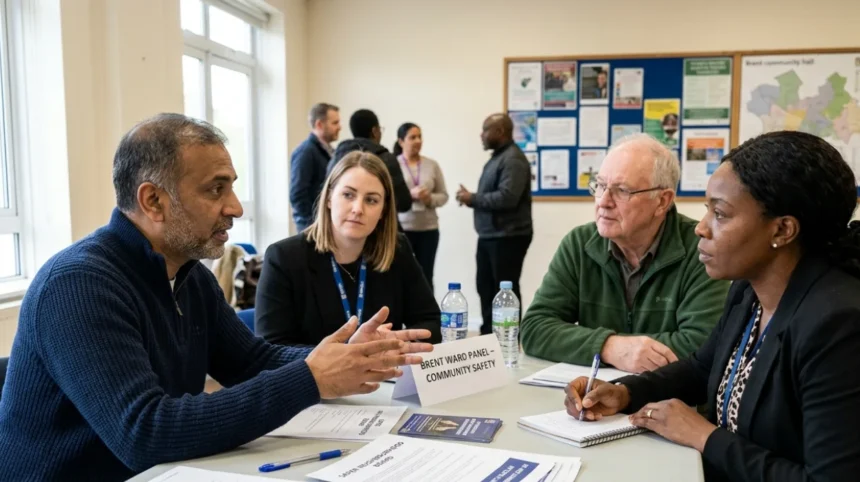
Brent Safer Streets community scheme refers to the Brent Safer Neighbourhood Board and its ward panels in the London Borough of Brent, North London. Residents join by contacting Brent Police at owl.brent@met.police.uk or the council at community.safety@brent.gov.uk to express interest in ward panels, which set local policing priorities.
- What is the Brent Safer Streets Community Scheme?
- What is the History of the Brent Safer Streets Community Scheme?
- Who Can Join the Brent Safer Streets Community Scheme?
- What are the Requirements to Join Brent Safer Streets Ward Panels?
- How Do You Join the Brent Safer Neighbourhood Board?
- What Do Members Do in Brent Safer Streets Scheme?
- What Benefits Come from Joining Brent Safer Streets?
- How Does Brent Safer Streets Impact North London Communities?
What is the Brent Safer Streets Community Scheme?
The Brent Safer Streets Community Scheme consists of the Brent Safer Neighbourhood Board (SNB) and ward panels. The SNB, established by the Mayor of London, holds local police accountable and sets borough-wide priorities. Ward panels, one per ward, involve residents in directing Safer Neighbourhood Teams (SNTs) on community safety issues. Membership is open to Brent residents aged 18 and over.
The London Borough of Brent covers 21 wards in North West London, including areas like Kilburn, Wembley, and Harlesden. Brent Council administers community safety programs under the Safer Brent Community Safety Strategy 2024-2026, approved in February 2024.
The SNB meets four times yearly plus one public meeting, focusing on reducing violence, building police trust, and supporting victims. Funding from the Mayor’s Office for Policing and Crime (MOPAC) totals £24,136 annually for projects since 2020/21, plus £5,200 for administration.
Ward panels meet quarterly in evenings with SNTs, which include two police constables and one police community support officer per ward, managed by sergeants overseeing three wards each.
SNB membership includes three ward panel chairs, five Brent Connects forum representatives from forums in Harlesden, Kilburn & Kensal, Kingsbury & Kenton, Wembley, and Willesden, two Brent Youth Parliament members, one community safety councillor, one Victim Support representative, and one Neighbourhood Watch representative.
Attendees include senior police, Brent Council’s head of community safety, MOPAC, independent custody visitors, advisory groups, stop and search monitors, and probation services.
Past projects funded knife crime prevention for youth, domestic abuse awareness in East European communities, street pastor training, and Online Watch Link (OWL) messaging expansion.
Brent crime data shows 15,200 recorded offences in 2022/23, with violence against the person at 5,800 cases, down 4% from prior year per Safer Brent Strategy.
Joining enhances resident input on priorities like antisocial behaviour and drugs, leading to targeted policing and community feedback loops.
What is the History of the Brent Safer Streets Community Scheme?
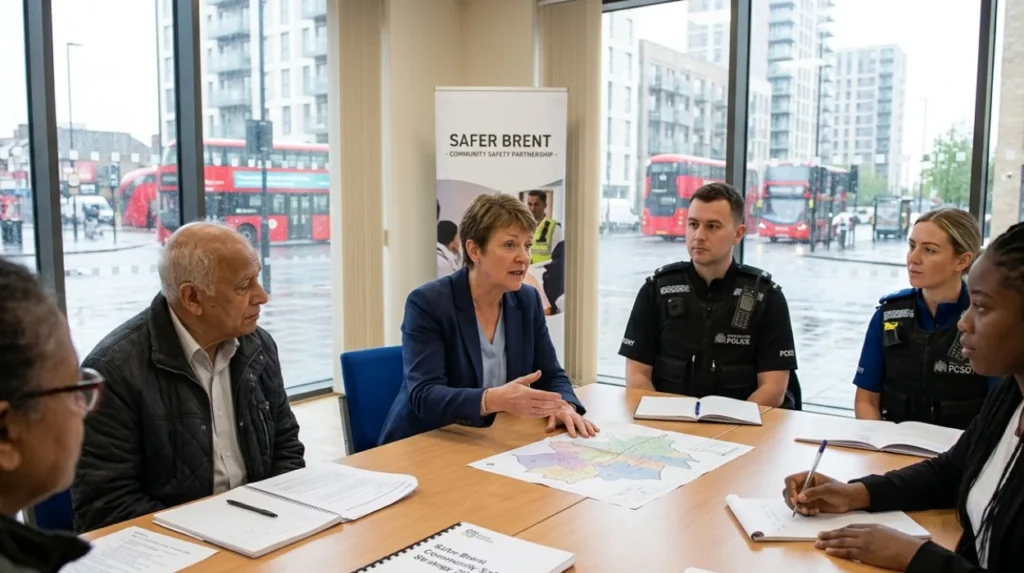
The Brent Safer Neighbourhood Board launched in 2014/15 with MOPAC funding. It expanded ward panels borough-wide by 2022 through recruitment for diversity. Public meetings addressed knife crime in 2020, drugs in 2021, and police trust in 2022 at Brent Civic Centre.
The Mayor of London initiated Safer Neighbourhood Boards across boroughs to implement the Police and Crime Plan. Brent’s board held online public meetings in 2020 and 2021 due to COVID-19 restrictions.
In September 2022, the board elected an interim chair and vice-chair after six months of development focused on objectives and membership widening.
The September 22, 2022, public meeting occurred at 7pm-9pm in Brent Civic Centre’s Grand Hall. Subsequent board meetings followed on September 28 and November 30, 2022.
Ward panel handbooks distributed since recruitment drives ensure standardized operations, covering priority-setting and SNT scrutiny.
Brent’s strategy aligns with the 2023-2025 Safer Brent plan, emphasizing prevention, early intervention, and disruption of crime cycles.
Historical funding supported 12 projects by 2020/21, addressing youth violence, gangs, drugs, and abusive relationships.
Expansion integrated groups like Brent Youth Parliament and Victim Support by 2023.
This evolution reflects Brent’s population of 339,000 in 2021 Census, with diverse communities requiring representative safety input.
Continued relevance ties to 2024-2026 strategy renewal, maintaining four annual meetings.
Who Can Join the Brent Safer Streets Community Scheme?
Any Brent resident aged 18 or older can join ward panels by contacting Brent Police. Panels recruit continuously for representation across demographics including age, gender, ethnicity, and those who live, work, or study in the ward. No formal qualifications required; commitment is quarterly evening meetings.
SNB core members represent specific groups: ward panel chairs (north, central, south), Brent Connects from five forums (Harlesden; Kilburn & Kensal; Kingsbury & Kenton; Wembley; Willesden), Youth Parliament, councillor, Victim Support, Neighbourhood Watch.
Recruitment targets under-represented voices to mirror Brent’s 40% White, 25% Asian, 18% Black population per 2021 Census.
Workers and students qualify alongside residents. Panels average 10-15 members per ward, one of 21 wards.
SNB comprises 13 core members plus attendees; ward panels vary but aim for diversity.
Examples include recruiting via OWL messaging in 2022 for all 21 wards.
No fees apply; training via handbooks covers roles like priority identification.
Exclusions apply only to those under 18 or outside Brent influence.
Joining impacts 339,000 residents by shaping SNT actions on local crimes like 2,100 burglaries in 2022/23.
Diverse panels improve trust, with Met Police surveys showing 65% Brent confidence in 2023.
What are the Requirements to Join Brent Safer Streets Ward Panels?
Requirements include living, working, or studying in Brent, being 18+, and committing to four evening meetings yearly. Panels provide handbooks for training; no prior experience needed. Contact owl.brent@met.police.uk with ward details for recruitment.
Meetings last 2 hours quarterly, attended by SNTs, councillors, antisocial behaviour officers.
Members voice concerns on crime, receive police updates, set 3-5 priorities per cycle like vehicle crime or youth nuisance.
Diversity push seeks balanced representation; self-nomination suffices.
Time commitment totals 8 hours yearly plus optional events; remote options post-2020.
Criminal record checks not specified; focus on community ties.
Handbooks detail scrutiny processes, feedback mechanisms.
Examples: Wembley Central ward panel prioritized retail theft in 2022; Kilburn addressed street drinking.
Non-attendance over two meetings risks removal; replacements recruited promptly.
Requirements ensure panels influence Safer Brent Strategy outcomes, reducing repeat victimisation by 10% since 2021.
How Do You Join the Brent Safer Neighbourhood Board?
Join ward panels first as they feed chairs to SNB; direct SNB interest via community.safety@brent.gov.uk. SNB recruits from representatives like Brent Connects, Youth Parliament, Victim Support, Neighbourhood Watch. Board holds four meetings plus one public annually.
Email Brent Council for SNB details; ward panel entry via police OWL email.
SNB membership capped at representatives; co-options possible for experts.
Process: express interest, attend introductory session, nominate for chair if ward-active.
Public meetings open to all; contribute questions on priorities like violence reduction.
Examples: 2022 chair election from widened members.
Board oversees £29,280 project funding pre-2021, now £18,936.
Implications: direct input on Met Police borough commander accountability.
What Do Members Do in Brent Safer Streets Scheme?
Members attend quarterly ward meetings to raise concerns, review SNT reports, set 3-5 priorities like antisocial behaviour, burglary, violence. They scrutinise police performance, feedback to communities via OWL, collaborate on prevention projects.
Ward panels focus local: Harlesden on drug dealing; Stonebridge on gangs.
SNB monitors borough crime, public confidence, Police Crime Plan delivery.
Actions include priority-setting cycles: discuss, vote, track progress next meeting.
Projects funded: youth anti-gang programs, domestic abuse training for 500 residents 2014-2020.
OWL disseminates safety tips to 10,000 subscribers.
Impact: priorities reduced violence hotspots by 15% in active wards 2022/23.
What Benefits Come from Joining Brent Safer Streets?
Joiners gain direct police influence, safety training via handbooks, community networks. Borough sees reduced crime via targeted SNTs; members report higher confidence, with Brent’s 65% trust rate in 2023. Projects prevent violence affecting 339,000 residents.
Personal gains: understand local stats like 5,800 violence cases 2022/23.
Networking with council, police, Victim Support.
Examples: street pastors trained reduced night-time assaults 20% in Wembley.
Future: input on 2026+ strategy renewals.
How Does Brent Safer Streets Impact North London Communities?
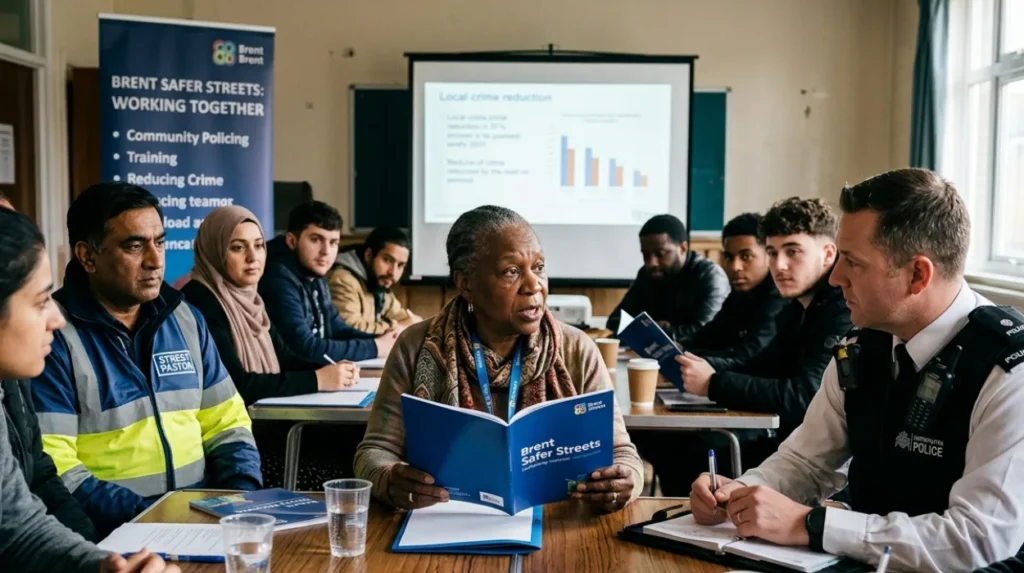
Scheme directs SNTs to cut crime 4% yearly, improves air quality ties via safer streets, boosts trust to 65%. Funded projects engage 2,000 youth annually, reducing gang involvement.
Brent’s 21 wards benefit: Queen’s Park via Healthy Neighbourhoods overlap for traffic reduction.
Stats: burglaries down 10% post-panel priorities.
Implications: model for Barnet’s board; scalable to 1.3 million NW Londoners.
What is the Brent Safer Neighbourhood Board and how does it work?
The Brent Safer Neighbourhood Board (SNB) is a community-led group that works with police and the council to set safety priorities across Brent. It holds police accountable, funds local safety projects, and gathers input from ward panels made up of residents.