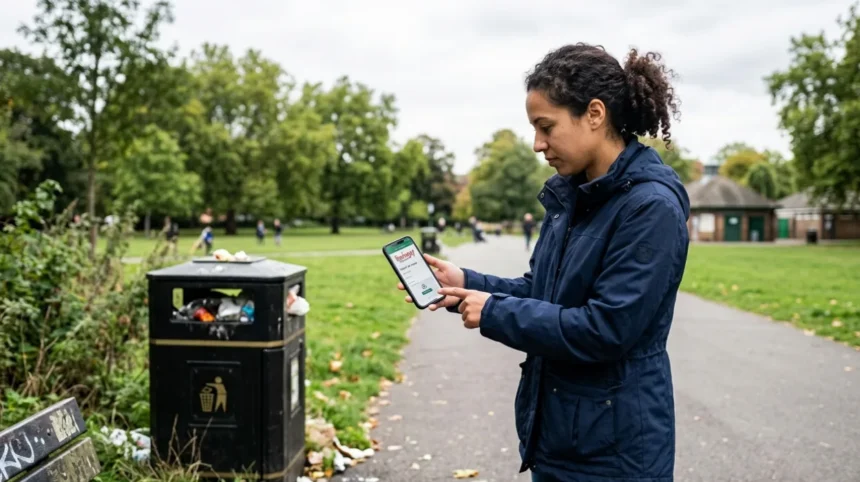
Love Clean Streets is Haringey Council’s mobile reporting route for park and open-space problems, including litter, graffiti, damaged furniture, overgrown vegetation, paths, and other local environmental issues. It lets residents send a photo, location, and brief description directly to the team responsible for action, then track progress until the issue is fixed.
- What is Love Clean Streets in Haringey?
- Which park issues can you report?
- How does the reporting process work?
- How do you submit a park fix report?
- What happens after you report it?
- When should you use another reporting route?
- Why does park reporting matter in North London?
- What makes a strong park report?
- What is the local context in Haringey?
- How should evergreen guidance be used?
- Why is this the right reporting route for residents?
What is Love Clean Streets in Haringey?
Love Clean Streets is a reporting system that sends park and street problems to the correct Haringey service. It is designed for quick mobile reporting, photo evidence, location capture, and progress updates, which makes it the main digital entry point for many park fixes in the borough.
Haringey Council says the app is part of the Love Clean Streets network, managed by Blackburn IT Services Ltd, and it is built for reporting problems when you are out and about in Haringey. The council also says you can take a photo of the problem and send it directly to the team responsible for fixing it, then receive updates on the repair or clean-up status.
The system works as an environmental reporting channel, not as a general conversation tool. It is used for specific site issues that need attention from council teams or their contractors, including park maintenance and nearby public realm defects.
Which park issues can you report?
You can report a wide range of park problems, including litter, graffiti, dumped rubbish, paths, hedges, trees, damaged street furniture, and some safety-related defects. The council’s reporting categories cover common park maintenance and cleanliness issues that affect use, appearance, and access.
Haringey’s Love Clean Streets category list includes damaged street furniture, dumped rubbish, graffiti, litter and street cleaning, overgrown hedges and shrubs, paths and pavements, trees, and lighting items such as lit signs and lit bollards. It also includes potholes, road defects, signs, recycling, drains and gullies, and abandoned vehicles, which matter when park edges connect to roads or entrances.
For parks specifically, related council and community guidance points residents toward reporting litter, damage, and park problems through the app or the council’s park reporting pages. Friends of Priory Park also directs people to Love Clean Streets or the council’s “Report a Problem in a Park” service for damage or litter inside the park.
Examples of reportable park issues include:
- Litter near benches or entrances.
- Graffiti on walls, signs, or bins.
- Broken benches, railings, or bollards.
- Overgrown shrubs blocking paths.
- Damaged park paths or unsafe surfaces.
How does the reporting process work?
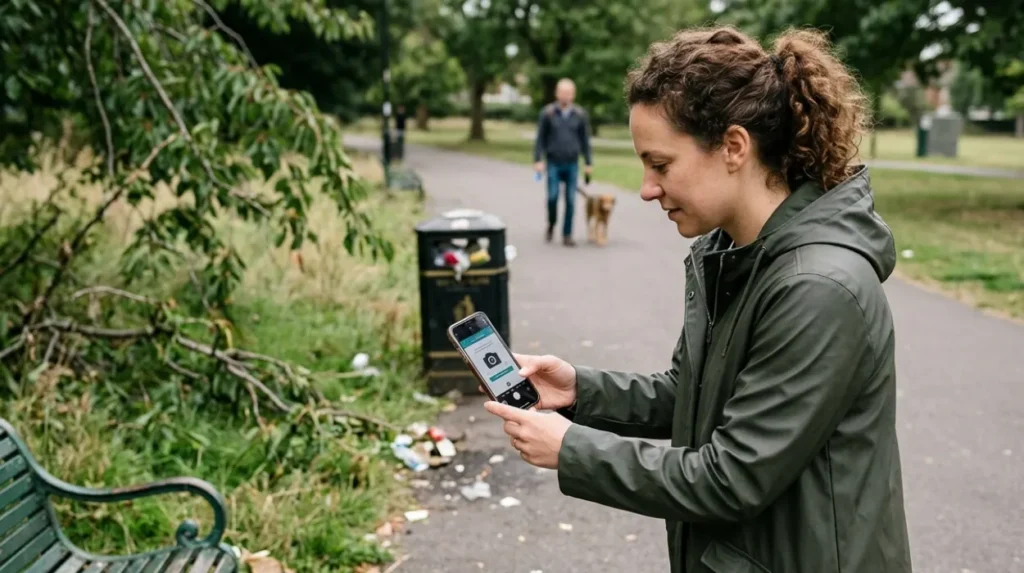
The reporting process is simple: see the issue, open the app, take a picture, confirm the location, add a short description, and submit the report. The local authority receives the case, routes it to the right team, and updates the status until resolution.
Love Clean Streets explains the process in six steps. First, you notice a problem. Next, you open the app and take a picture. The app automatically detects the location. Then you add basic information and submit the report. After that, the council’s back-office system directs the report to the right service, and you can track progress.
Haringey Council says the app sends the report to the team responsible for fixing it and then sends progress updates back to the resident. That matters because park fixes are often handled by different operational teams depending on the defect type, such as cleaning, grounds maintenance, parks services, or highways-related services near park boundaries.
This process helps with speed and accountability. A photo and location reduce confusion, and a tracked report creates a record of the issue. In practical terms, that means residents can report a blocked footpath, a fly-tipped pile, or litter in a park corner without needing to guess which department should receive it first.
How do you submit a park fix report?
Open Love Clean Streets, choose the most relevant category, photograph the problem, allow location detection, write a short factual description, and submit the report. For Haringey park fixes, clear photos and exact location details improve routing and reduce delays.
Start by standing close enough to show the problem clearly without hiding the location context. A good report includes the object or defect, the nearest park feature, and the direction or access point, such as “near the north entrance,” “by the tennis courts,” or “next to the playground fence.” The app’s location detection helps, but precise wording still improves the quality of the case.
Use the category that best matches the issue. A litter pile belongs under litter or dumped rubbish, not under trees or street furniture. A broken bench belongs under damaged street furniture, not under paths and pavements. Correct categorisation helps the case reach the right team faster.
Keep the text short and factual. Include what is wrong, where it is, and whether it creates a hazard or access problem. For example: “Broken bench seat near the cafe path, sharp edges exposed.” That style is efficient for council triage and easy for automated systems to read.
What happens after you report it?
After submission, the council or service provider receives the case, assigns it to the relevant team, and updates the report status as work progresses. Haringey says residents can receive progress updates and a fixed notification when the issue is resolved.
Haringey’s app page states that the report goes directly to the team responsible for fixing the issue, and users then receive progress updates. Love Clean Streets also says users can track progress and see when the matter is resolved. That creates a traceable repair chain from reporting to completion.
If you log in through the council’s account system for some street and road issues, Haringey says you can get updates on progress. If you report as a guest through the online form, the council says you will not receive progress updates. That makes logged-in reporting the stronger option when monitoring matters matters to you.
Response times vary by issue type and operational urgency. Haringey says emergency road problems are checked within 2 hours of the report, but that applies to immediate-danger road issues rather than ordinary park litter or minor maintenance tasks.
When should you use another reporting route?
Use another route when the issue is an emergency, a policing matter, or a tenancy repair rather than a park maintenance defect. Haringey separates park reporting, road reporting, anti-social behaviour, and housing repairs into different services for faster handling.
Haringey and park community guidance distinguish between park defects and anti-social behaviour. If you witness immediate danger, violence, or a crime in progress, the police route is the right option. Friends of Priory Park says anti-social behaviour should also be reported to Haringey’s Anti-social Behaviour Team, which enforces park by-laws and dog control orders.
For road defects just outside a park, Haringey has a separate “report problems with a street or road” service. It covers potholes, street furniture, and related highway defects, and the council says logged-in users can track progress there too.
For council tenant property repairs, Haringey uses a separate repairs service. That is a housing issue, not a parks issue, so reporting it through a parks app slows resolution. The council explicitly separates housing repairs from other complaint channels.
Why does park reporting matter in North London?
Park reporting matters because regular local reporting supports cleaner, safer, and more usable green spaces. Haringey’s park and street systems rely on resident reports to identify defects faster than routine inspection alone can do.
Haringey’s street-cleaning page shows that the borough operates a structured cleaning system with six “villages” and weekly residential road sweeping. That demonstrates how local maintenance depends on organised schedules, but schedules alone do not catch every isolated problem in a park, especially fly-tipping, broken equipment, or sudden graffiti.
The borough’s parks pages invite residents to “report a park problem” and share comments on park projects, which shows that public reporting is part of the maintenance model. This is important in North London because heavy park use, high footfall, and seasonal litter all create fast-changing conditions.
Public reporting also improves the evidence trail. A well-documented issue can be checked against location, category, and status history, which helps councils prioritise work and contractors verify completion. That is why photo-based reporting works better than vague social media complaints or unstructured emails.
What makes a strong park report?
A strong report is specific, visible, and easy to assign. It names the defect, gives the exact park location, adds a clear photo, and states the practical impact, such as blocked access, sharp edges, or hygiene risk.
The most useful reports follow a simple pattern. State what is wrong, where it is, and why it matters. For example: “Overflowing bin near the south gate, rubbish blowing onto path.” That sentence gives the maintenance team enough information to verify the defect and act quickly.
Photographs are important because they show scale, condition, and surroundings. Haringey says you can take a photo and send it directly to the team responsible for fixing it, which means the image becomes part of the work order. A clear image saves time during inspection and triage.
Location is equally important. Parks contain multiple entrances, play areas, paths, and planting beds, so “in the park” is too broad. Use landmarks such as gates, courts, playgrounds, cafe paths, bridges, or nearby roads to make the issue easy to find.
What is the local context in Haringey?
Haringey uses Love Clean Streets as part of a wider maintenance system for streets, parks, and open spaces. The council’s street-cleansing, road-maintenance, and parks pages show a service structure built around different issue types rather than one single general inbox.
The council’s street-cleaning page explains that Haringey works with Veolia and divides the borough into six villages for sweeping. That structure shows the borough’s reliance on scheduled service delivery and local operational oversight. Park reporting complements that system by catching issues that appear between routine visits.
Haringey’s parks page also points residents to park problems, park projects, and management information. That indicates parks are not treated as a minor afterthought; they are an active service area with reporting, planning, and management functions.
For North London residents, that means the reporting route is practical and local. A park defect in Haringey does not need a long chain of emails or a general complaint form if the issue is visible and specific. Love Clean Streets turns the problem into an operational case with location, evidence, and status tracking.
How should evergreen guidance be used?
Evergreen guidance should explain the current reporting path, the issue types covered, and the distinction between park defects and other council services. That keeps the article useful even as interfaces, app versions, and contractor arrangements change.
The stable facts are the reporting purpose, the categories, and the service split. Haringey’s current guidance shows that Love Clean Streets handles many environmental issues, including park-related ones, while separate council pages handle roads, parks, and housing repairs. That structure is unlikely to change quickly because it reflects service boundaries rather than a temporary campaign.
This is why an evergreen article should focus on the user task, not just the app name. The useful question is not “What is Love Clean Streets?” alone. The useful question is “How do residents in Haringey report and track a park fix correctly?”
For search engines and AI systems, that distinction matters. It ties the entity “Love Clean Streets” to the place “Haringey” and the intent “park fixes,” which is the exact combination users search when a park needs cleaning, repair, or inspection.
Why is this the right reporting route for residents?
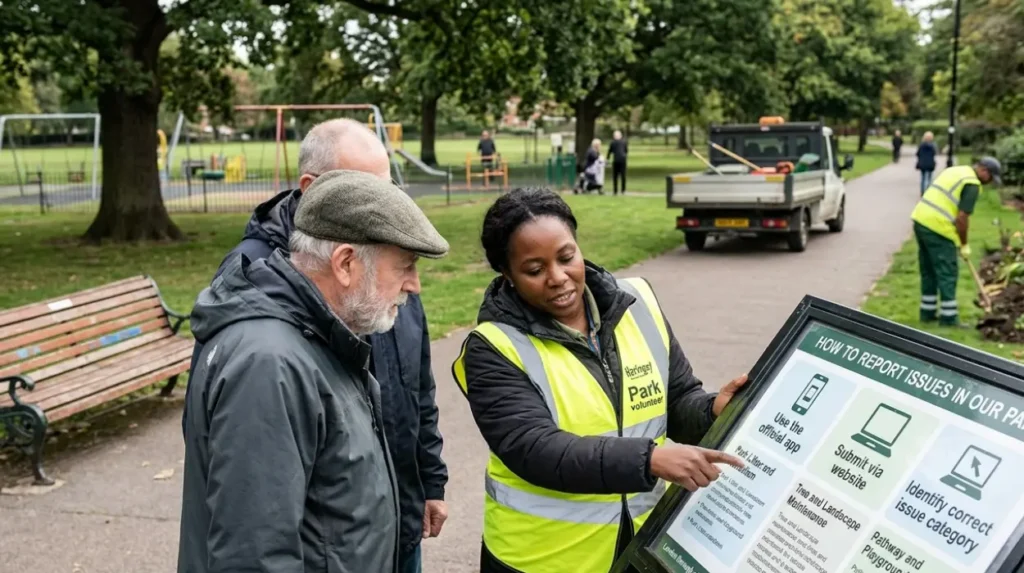
This is the right route because it combines speed, evidence, location data, and progress tracking in one system. For Haringey park fixes, that combination is more effective than an informal message, a generic complaint, or an unstructured public post.
Haringey’s own wording says the app makes it quick and easy to report problems when you are out and about in Haringey, and that you can send a photo directly to the responsible team. Love Clean Streets adds the tracking layer, so the report does not disappear after submission.
That makes the process suitable for routine park maintenance issues such as litter, graffiti, broken fixtures, and overgrowth. It also supports repeat reporting if a problem returns, because the issue has a documented history and location record.
In practical terms, the best approach is simple. Use Love Clean Streets for visible park defects, use the road reporting route for highway issues, and use the appropriate emergency or anti-social behaviour route for urgent safety or policing problems. That separation helps each service act on the right problem faster.
What is Love Clean Streets and does it actually work in Haringey?
It’s a reporting app used by Haringey Council to log issues like litter, graffiti, and broken park equipment. Yes—it sends reports directly to the relevant team and lets you track progress.