Tenants in England have strong legal rights when landlords ignore repair requests, especially in private rentals across North London. The main protections come from the Landlord and Tenant Act 1985, the Homes (Fitness for Human Habitation) Act 2018, and council enforcement powers.
- What repairs is a landlord legally responsible for?
- What counts as a repair problem?
- What should a tenant do first?
- What if the landlord still does nothing?
- What legal action is available?
- Can the tenant do the repair themselves?
- What is retaliatory eviction?
- How do councils enforce repairs?
- Which homes are covered?
- What about damp and mould?
- How do the rules work in North London?
- What rights exist in practice?
- What does good evidence look like?
- What is the safest next step?
What repairs is a landlord legally responsible for?
A landlord is responsible for structural repairs, exterior repairs, sanitation, water, gas, electricity, heating, and hot water in most residential tenancies. The law also requires the property to remain fit for human habitation, which covers serious hazards such as damp, mould, and unsafe conditions.
Under section 11 of the Landlord and Tenant Act 1985, landlords must keep in repair the structure and exterior of the dwelling, including drains, gutters, and external pipes. They must also keep in repair and proper working order the installations for water, gas, electricity, sanitation, space heating, and heating water.
This duty applies to most tenancies for homes let for less than 7 years, which includes many assured shorthold tenancies in England. The repair duty exists even if the tenancy agreement tries to reduce it, because section 11 is implied into the tenancy by law.
The Homes (Fitness for Human Habitation) Act 2018 adds a wider standard. A rented home must be fit for human habitation during the tenancy, which means it must not contain serious conditions that make it unsafe or unhealthy.
What counts as a repair problem?
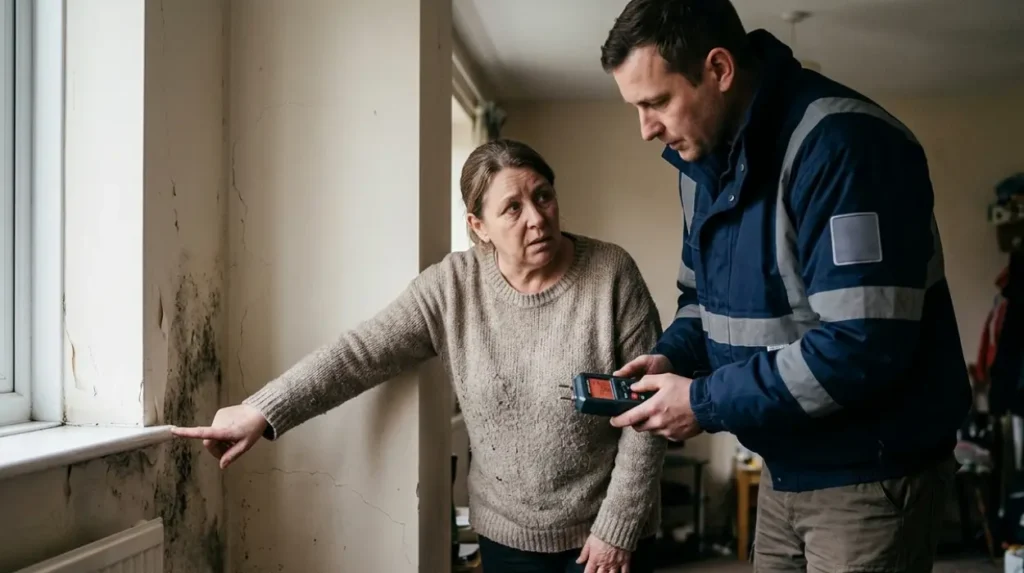
Common repair problems include leaks, broken heating, faulty wiring, damaged roofs, blocked drains, broken toilets, defective pipes, damp, and mould. Problems that threaten health or safety receive the fastest legal protection and council attention.
Government guidance says landlords are always responsible for the property’s structure and exterior, sanitary fittings, heating and hot water, gas appliances, pipes, flues and ventilation, and electrical wiring.
In practice, this means the landlord carries the legal burden for serious defects such as a leaking roof, broken boiler, unsafe sockets, or water ingress causing mould. Where a disrepair problem creates a hazard, the council’s environmental health team can intervene.
For North London renters, this matters in older flats and converted houses where issues such as damp, defective windows, broken guttering, or failing heating systems often appear together. The law treats these as housing-condition problems, not minor inconveniences.
What should a tenant do first?
The first step is to report the problem in writing, keep copies, and collect evidence. A tenant should give the landlord a clear deadline, because written notice and records support later council action or court action.
Shelter and Citizens Advice both advise tenants to write to the landlord as soon as the problem appears. The letter or email should describe the defect, explain the effect on daily living, and request a repair by a reasonable date.
Evidence matters. Useful records include photos, videos, copies of emails and texts, notes of phone calls, receipts for damaged items, and medical letters if the condition affects health. This material supports complaints to the council and claims in court.
A tenant should keep paying rent while waiting for repairs. Withholding rent creates arrears and exposes the tenant to eviction action or debt claims.
What if the landlord still does nothing?
If the landlord ignores the request, the tenant can escalate to the local council’s private renting or environmental health team. The council can inspect the property, require repairs, and serve formal notices when the condition threatens health or safety.
Government guidance says tenants can contact the environmental health department at their local council for help if repairs are not done. The council must take action if it thinks the problem could harm the tenant or cause a nuisance to others.
Shelter states that environmental health investigates serious repair problems that affect health or put a tenant at risk. Councils can also speak to the landlord, arrange an inspection, and require work within a reasonable timeframe.
In London, this route is especially important because borough councils handle housing enforcement locally. For a North London tenant, the relevant authority is the borough where the property is located, not the tenant’s home borough if they live elsewhere.
What legal action is available?
A tenant can sue the landlord if the repairs are not done. A court can order repairs, award compensation, and in serious cases support a claim that the home was not fit for human habitation.
Shelter explains that court action is a last resort, but it remains available when the landlord still will not fix the problem. The court can order the landlord to do the repair work and can also order compensation.
The Homes (Fitness for Human Habitation) Act 2018 gives tenants a direct route to court if the property is not fit to live in. GOV.UK confirms that the Act came into force on 20 March 2019, and guidance explains that it applies to qualifying residential tenancies in England.
Compensation claims often focus on inconvenience, damaged belongings, higher heating costs, or health impacts linked to disrepair. The amount depends on the seriousness, duration, and effect of the problem, plus the evidence the tenant can provide.
Can the tenant do the repair themselves?
A tenant does not normally have to repair the landlord’s legal obligations. Self-help repairs need caution, because tenants usually need permission from the landlord and should only act where the tenancy agreement allows it.
Government guidance says a tenant should only carry out repairs if the tenancy agreement says they can. The tenant cannot be forced to do repairs that are the landlord’s responsibility.
Shelter notes that, in some cases, the tenant can ask the landlord to allow the work and agree a temporary rent reduction in writing. That route needs written permission and clear records.
This approach is narrow and unsuitable for major works. For structural, electrical, heating, or damp-and-mould problems, the landlord remains the legally responsible party, and council enforcement is the safer route.
What is retaliatory eviction?
Retaliatory eviction is eviction used as punishment after a tenant complains about repairs. In England, legal protections limit this practice, and council enforcement can make a Section 21 notice invalid in defined circumstances.
Tower Hamlets Council explains that a retaliatory or revenge eviction happens when a landlord tries to evict a tenant because they complained about disrepair. It states that if the local authority serves an Improvement Notice, a later Section 21 notice can become invalid for six months.
Shelter says that from 1 May 2026, private landlords cannot use Section 21 to evict tenants just because they ask for repairs or complain about the home. It also explains that protection links to council notices such as an improvement notice or emergency works notice.
This is a major protection for North London renters because it reduces the risk of a landlord using eviction threats to silence repair complaints. The practical effect is simple: a tenant can report unsafe conditions without accepting unlawful pressure to stay quiet.
How do councils enforce repairs?
Councils enforce repairs through environmental health inspections, improvement notices, emergency action, and follow-up checks. When a property fails safety standards, the council can compel work and, in some cases, prosecute the landlord.
Shelter says most councils have a private rented housing team that is usually the first point of contact. If the issue is serious, the team can refer the case to environmental health, which can inspect the property and take action.
Housing Rights explains that, after inspection, a council can serve a notice of unfitness or disrepair, list the required work, and set a deadline of at least 21 days from the notice date. It also states that the council can reinspect after the deadline and pursue enforcement if repairs are still outstanding.
This mechanism is important because it turns a private complaint into a public enforcement process. Once the council acts, the landlord faces formal legal consequences instead of informal pressure alone.
Which homes are covered?
Most private rented homes in England are covered by section 11 repair duties and the fitness standard. Social rented homes also follow separate standards, including the Decent Homes Standard and housing safety rules.
The Landlord and Tenant Act 1985 applies broadly to leases of dwellings for less than 7 years, which captures many private renters. That makes section 11 the central repair law for a large part of the private rented sector.
The Homes (Fitness for Human Habitation) Act 2018 adds a condition-based test across qualifying tenancies, so the issue is not only whether something is broken but also whether the overall home is safe and healthy.
For social housing, the government’s Decent Homes Standard sets quality expectations, but current guidance says it does not apply to private renters yet. The standard is changing, but private tenants in 2026 still rely primarily on repair law, fitness law, and council enforcement.
What about damp and mould?
Damp and mould can trigger repair rights when they arise from a landlord’s defect, such as leaks, broken gutters, failed damp-proofing, or poor heating. They also raise fitness-for-habitation concerns when they create a health hazard.
Legal guidance states that section 11 covers repair, not improvement. That means the tenant needs a defect that the landlord must repair, such as a broken gutter causing water ingress and mould inside the home.
The Homes (Fitness for Human Habitation) Act strengthens this position because severe damp and mould can make a property unsafe or unhealthy. GOV.UK and local authority guidance both link repair enforcement to health and safety risk.
In practical terms, tenants should photograph all visible mould, record any smell or water damage, and note any worsening symptoms or damage to clothes, furniture, or walls. That evidence helps show the problem is serious and ongoing.
How do the rules work in North London?
North London tenants use the same English housing laws as tenants elsewhere, but local borough councils handle enforcement. That means the practical process depends on the relevant council’s private renting or environmental health service.
A tenant in Camden, Islington, Haringey, Barnet, Enfield, Hackney, Brent, or another North London borough starts by contacting the landlord in writing. If the landlord ignores the issue, the tenant then contacts the borough council for an inspection or enforcement review.
The local authority can be decisive when the problem involves mould, unsafe electrics, heating failure, or serious leaks. Once the council identifies a hazard, the landlord faces stronger pressure to comply because formal notices and deadlines follow.
The regional relevance matters because North London has a large private rented sector and a high share of older buildings. Older housing stock often increases the likelihood of repair disputes involving roofs, drainage, heat loss, and damp.
What rights exist in practice?
A tenant has the right to ask for repairs, the right to written records, the right to council intervention, the right to court action, and the right not to be charged for landlord duties. These rights create a complete enforcement path when a landlord ignores complaints.
The rights work together. First comes notice to the landlord. Then comes evidence gathering. Then comes council enforcement. Finally, court action remains available if the landlord still refuses to act.
The tenant also has the right to remain in possession of the home while valid repair action is ongoing, subject to paying rent and following the tenancy terms. A landlord does not gain a lawful excuse for ignoring repairs because the tenant reported the defect.
For serious defects, the strongest rights are immediate. Unsafe electrics, broken heating in winter, major leaks, and severe mould create urgent housing-condition issues, not optional maintenance disputes.
What does good evidence look like?
Strong evidence includes dated photos, videos, copies of letters and emails, repair logs, witness notes, receipts, and medical records where relevant. This evidence supports council action, compensation claims, and any later court case.
Citizens Advice and Shelter both recommend keeping a full record of the issue and the landlord’s response. That record should show when the problem started, when the tenant reported it, how the landlord replied, and how the condition changed over time.
A repair timeline is especially useful. It should list the date the problem appeared, each complaint date, any visits or failed repairs, the deadlines given, and the council’s involvement if it happens.
This record often becomes the central proof in disputes. Without it, the landlord can argue the problem was minor, unreported, or quickly resolved.

What is the safest next step?
The safest next step is to report the defect in writing, preserve evidence, keep paying rent, and contact the council if the landlord does not act within a reasonable time. That sequence protects the tenant’s legal position and supports enforcement.
For a North London renter, this sequence creates the strongest route to a repair outcome. The landlord receives formal notice, the council can inspect if needed, and the tenant keeps a clean record for any later legal claim.
If the issue is serious, such as no heating, major damp, unsafe electrics, or active water damage, the matter is not a delay problem. It becomes a housing-safety problem with statutory remedies.
The core rule is simple. When a landlord ignores repair requests, the tenant keeps rights under housing law, evidence rules, council enforcement, and court remedies. Those protections exist to force repairs and to protect health, safety, and habitability.
What rights do tenants have when landlords ignore repairs?
Tenants in England have legal rights under the Landlord and Tenant Act 1985 and the Homes (Fitness for Human Habitation) Act 2018. These laws require landlords to fix structural problems, heating, water, sanitation, electrical systems, and serious hazards like damp and mould. If repairs are ignored, tenants can contact the council, take legal action, and potentially claim compensation.