
Councils miss bin collections because of operational faults, route disruption, contamination or overfilled bins, staffing shortages and contractor issues, schedule changes from holidays or policy shifts, and access or traffic problems; each cause follows defined collection rules and reporting procedures.
- What is a missed bin collection and how is it defined?
- Why do councils report “bins not placed correctly” as a common cause?
- How does contamination cause bin refusals and missed collections?
- Do contractor changes or service reorganisations increase missed collections?
- How do staffing shortages and industrial action affect collections?
- How do roadworks, parking and access issues lead to missed stops?
- What role do collection schedules and bank holidays play?
- How do vehicle breakdowns and fleet issues contribute?
- How do reporting windows and council procedures shape resident experience?
- What data and statistics explain the scale of missed collections?
- Are there legal or contractual rules that govern collections?
- What practical steps can residents take when collections are missed?
- How do councils balance cost, frequency and environmental targets?
- What are real-world North London examples and recent incidents?
- What are the long-term implications and how will services evolve?
- Which official sources provide trustworthy information and how should residents cite them?
What is a missed bin collection and how is it defined?
A missed bin collection is any scheduled household waste, recycling, or food waste pickup that was not completed on the council’s published collection day within the council’s reporting window and service protocol.
Definition and background: A missed bin collection is an instance when a council or its contractor fails to empty a bin on the published collection date for that address. Councils publish collection days and rules on their websites and require residents to report misses within a set timeframe—often by 5pm the same day or within 24–48 hours—to trigger re-collection.
Operational implication: Councils treat misses as exceptions to normal rounds and triage reports using digital systems or contact centres; many aim to return within 24–72 hours depending on contract terms and crew availability.
Why do councils report “bins not placed correctly” as a common cause?
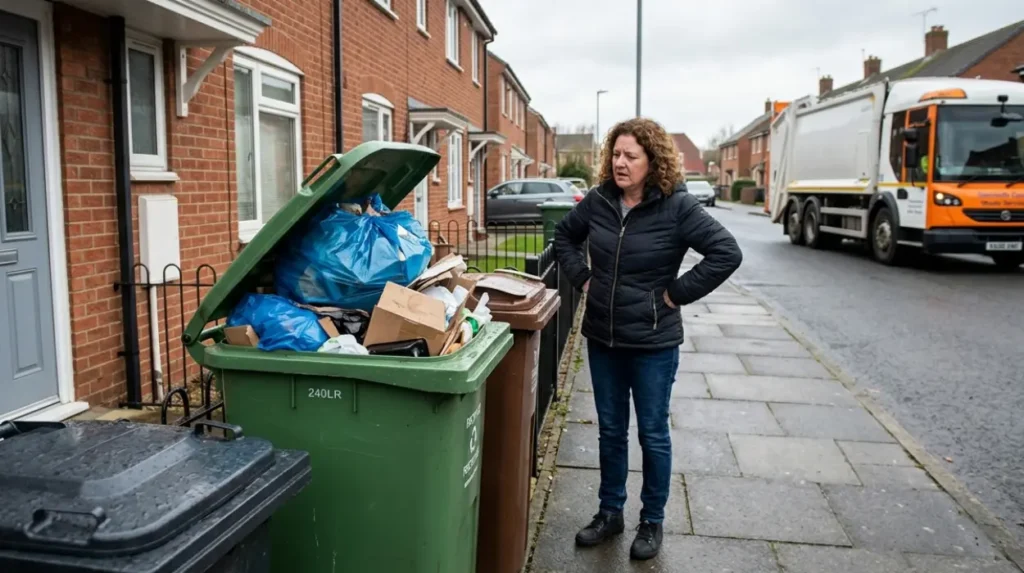
Councils list incorrectly placed bins—wrong location, not at boundary, lids closed, or out after collection time—as frequent reasons for non-collection because mechanical lifts and crew safety protocols require predictable positioning.
Explanation: Collection vehicles use mechanical arms or crew manual lifts that expect bins at a kerbside boundary or designated point; bins left behind parked cars, on private property, or not presented on the right day are routinely left.
Details and implications: If a bin blocks pavements or is placed in a hazardous position, crews will not attempt risky retrieval; councils publish guidance on exact placement and times to reduce refusals and missed stops.
How does contamination cause bin refusals and missed collections?
Contamination means incorrect items in recycling or food bins (for example, plastic bags in mixed recycling), and councils refuse contaminated containers to prevent sorting failures and protect processing contracts.
Mechanism: Recycling and organics contracts set quality thresholds; contaminated loads can cause entire collection crates to be rejected at a materials recovery facility, so crews are instructed to refuse or flag contaminated bins.
Examples and procedure: Common contamination examples are plastic bags in paper collections, food residue in mixed recyclables, and non-compostable items in food bins; councils provide contamination guidance and color-coded bin lists online.
Do contractor changes or service reorganisations increase missed collections?
Yes. Contract award changes, new contractor mobilisation, or service reorganisation often cause route disruption, timetable changes, and missed collections during transition periods.
Background and evidence: When councils change waste contractors or adjust collection frequency, transitional problems occur—new routes, vehicle allocation, and staff training create short-term disruptions documented in local coverage and council notices. For example, a district that switched collection patterns reported missed collections and public complaints during the first weeks of the change.
Operational effect: Councils typically publish revised schedules and provide re-collection instructions, but residents must check notifications because frequency and alternating rounds can mean apparent misses when schedules change.
How do staffing shortages and industrial action affect collections?
Staff shortages, sickness and industrial action reduce crew capacity, causing partial rounds or skipped streets, and councils place contingency plans or announce service suspensions when workforce numbers fall below required levels.
Mechanism and examples: Councils and contractors operate fixed crew numbers; absences or strike action directly reduce route coverage, leading to planned suspension of non-essential services or prioritisation of core waste. Media reports and council notices document spikes in missed collections during strikes or widespread sickness.
Implication for residents: Councils publish guidance about expected delays, and residents must follow temporary instructions (store waste, use authorised tips, or arrange private collection) while the service recovers.
How do roadworks, parking and access issues lead to missed stops?
Roadworks, narrow streets, parked vehicles and blocked access prevent collection vehicles reaching kerbside points, forcing crews to skip streets or specific properties for safety and efficiency reasons.
Process and operational detail: Crews follow route safety rules; when a vehicle cannot pass or access is unsafe, the crew records the stop as missed and logs reasons for re-planning. Councils maintain “missed roads” bulletins when larger-scale obstructions exist.
Resident actions: Councils advise moving cars, presenting bins at alternative points, or checking a missed-roads page to avoid repeat non-collection.
What role do collection schedules and bank holidays play?
Bank holidays and schedule revisions shift collection days; if residents do not check altered timetables, bins appear missed when the round has moved to a different day.
Explanation: Councils publish weekday-specific calendars and issue bank-holiday timetables by post, email or online. When councils move to fortnightly collections for specific streams, alternating rounds can appear as missed collections unless residents consult the new schedule.
Practical note: Councils often add a one-week shift after bank holidays and provide online postcode lookup tools to confirm collection dates.
How do vehicle breakdowns and fleet issues contribute?
Vehicle breakdowns, maintenance delays and insufficient fleet size cause missed collections when councils do not have spare vehicles to cover scheduled rounds or when repairs remove capacity from the rota.
Mechanism: Waste services depend on a reliable fleet; unexpected mechanical failures force crews to abandon or compress rounds. Councils with tight capital budgets or outsourced fleets face higher risks unless contracts include standby vehicles.
Mitigation: Strong contracts include contingency vehicles; local authorities aim to return to affected areas within 24–72 hours, depending on resource availability.
How do reporting windows and council procedures shape resident experience?
Councils require missed-collection reports within a strict window—commonly by 5pm the same day or within 24–48 hours—so late reports often delay re-collections or fall outside contractual remedies.
Process and examples: Online forms, postcode lookup tools and phone contact centres funnel reports into contractor systems; councils mark rounds complete or missed and dispatch follow-up crews where eligible reports meet the timing rules. If residents miss the reporting window, the council logs the event but may not schedule a re-visit.
Evidence: Local authority pages set explicit reporting windows and commit to next-working-day or 72-hour response targets.
What data and statistics explain the scale of missed collections?
Councils publish service performance metrics, including missed-collection counts and response times, and independent audits show that missed-collection rates rise during contract changes, strikes and adverse weather.
Data sources and usage: Many London boroughs publish monthly or annual waste performance dashboards showing number of missed collections per 100,000 households and re-collection response times; these metrics are contract KPIs used for penalties or bonuses. Audit reports and local news coverage link spikes to specific events, such as contractor mobilisation or operational changes.
Example statistic: Councils commonly guarantee re-collection within 24–72 hours; missed-collection counts are monitored and published in council performance tables.
Are there legal or contractual rules that govern collections?
Collections are governed by statutory duties under the Environmental Protection Act 1990, contract terms with private operators, and local service standards that specify frequency, collection methods, and re-collection obligations.
Legal framework and definitions: Section 45(1) of the Environmental Protection Act 1990 places duties on waste collection authorities to arrange household waste collection; councils translate statutory duties into contractual service levels with private operators, using KPIs and remedies for failure. Contracts stipulate acceptable missed-collection rates, reporting protocols and compensation mechanisms.
Enforcement and implication: Where contractual obligations are not met, councils can apply financial penalties to contractors or exercise termination clauses; residents can escalate persistent failures to councillors or the Local Government Ombudsman.
What practical steps can residents take when collections are missed?
Residents should check council notices, confirm collection day via postcode lookup, report the miss within the council’s reporting window, follow guidance on bin placement and contamination, and use council tips or temporary storage instructions while awaiting re-collection.
Step-by-step actions: 1) Verify the published schedule and missed-roads pages; 2) Check for service notices about bank holidays, strikes or contractor changes; 3) Report online or by phone within 24–48 hours with postcode and bin type; 4) If re-collection is delayed, store waste securely or use authorised disposal points. Councils provide clear online forms and phone numbers for missed-collection reports.
If issues persist: Escalate to ward councillors, submit formal complaints to the council, or contact the Local Government Ombudsman for repeated service failure.
How do councils balance cost, frequency and environmental targets?
Councils set collection frequency and service design to balance budget constraints, recycling targets set by government and local environmental commitments, which can involve shifting to fortnightly collections for some wastes to reduce cost and carbon.
Context and policy: Central government recycling targets and local budgets influence collection models; councils sometimes move to alternating-week recycling and general-waste rounds to meet savings and environmental goals. These changes reduce truck mileage and carbon emissions but require communication to avoid confusion and apparent missed collections.
Impact: Residents must adapt to new schedules; temporary misses and service complaints commonly rise after policy changes while systems settle.
What are real-world North London examples and recent incidents?
North London boroughs routinely publish missed-collection guidance and run postcode lookup tools; media reports show local spikes in missed collections after contractor changes, route reorganisations or seasonal pressures.
Examples: London borough web pages list common miss causes and reporting steps; local news reports across the UK document episodes where collections were missed for weeks during transitions or industrial disputes, prompting council catch-ups and public guidance. Residents should use borough-specific pages for exact procedures and live notices.
Practical note: Check your specific North London borough page for tailored instructions and current performance metrics.
What are the long-term implications and how will services evolve?
Long-term trends include contract modernisation, route optimisation, digital reporting, fleet electrification and greater contingency planning, which will reduce routine missed collections as systems and monitoring mature.
Trends and mechanisms: Councils increasingly use GPS route optimisation, real-time reporting apps and tighter contractual KPIs to reduce misses. Investment in newer fleets, including electric vehicles, and stronger mobilisation protocols for contractor changes reduce breakdown-related misses. Ongoing workforce training and contingency pools limit disruption from staff shortages.
Citizen implications: Improved transparency from online dashboards and clearer reporting procedures will make missed-collection accountability more traceable and faster to resolve.

Which official sources provide trustworthy information and how should residents cite them?
Trust council websites, official missed-collection pages, the borough contact centre pages, and central government waste guidance for authoritative information and reporting instructions.
Examples: Use your borough’s missed-collection web page for reporting rules, the council contact centre for logged complaints, and official statements about service changes and contractor arrangements when referencing schedules or service levels. For legal context, consult government waste policy pages and the Environmental Protection Act sections summarised in local authority guidance.
Why do councils miss bin collections?
Councils usually miss bin collections because of staffing shortages, vehicle breakdowns, road access problems, contamination in recycling bins, contractor disruptions, bank holiday schedule changes, or bins being presented incorrectly.