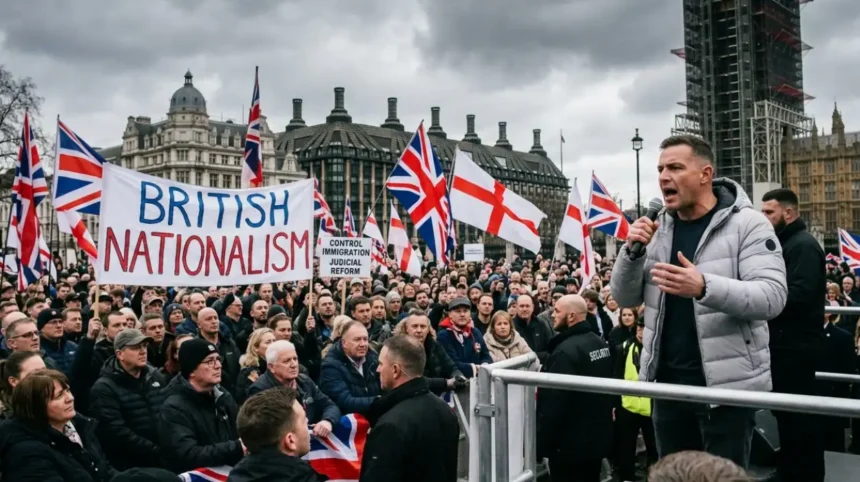
The Unite the Kingdom rally is a large-scale political demonstration held in London, primarily organised by activist Stephen Yaxley-Lennon, known by the pseudonym Tommy Robinson. These events advocate for British nationalism, stricter immigration controls, and judicial reform within the United Kingdom.
- What is the Unite the Kingdom rally?
- Who are the primary organisers of the Unite the Kingdom rally?
- What are the core objectives of the Unite the Kingdom movement?
- When and where did the most significant rallies take place?
- What is the impact of the Unite the Kingdom rally on British politics?
- How does the UK legal system interact with these demonstrations?
- What role does social media play in the Unite the Kingdom movement?
- What are the common criticisms and counter-movements against the rally?
- How does the rally address the issue of “Two-Tier Policing”?
- What is the historical context of nationalist rallies in the United Kingdom?
- What is the future relevance of the Unite the Kingdom movement?
- Data and Statistics on UK Migration and Public Perception
What is the Unite the Kingdom rally?
The Unite the Kingdom rally is a coordinated public demonstration held in central London to promote British nationalist interests. It focuses on opposition to mass migration, perceived two-tier policing, and legal actions taken against figures within the populist right-wing movement.
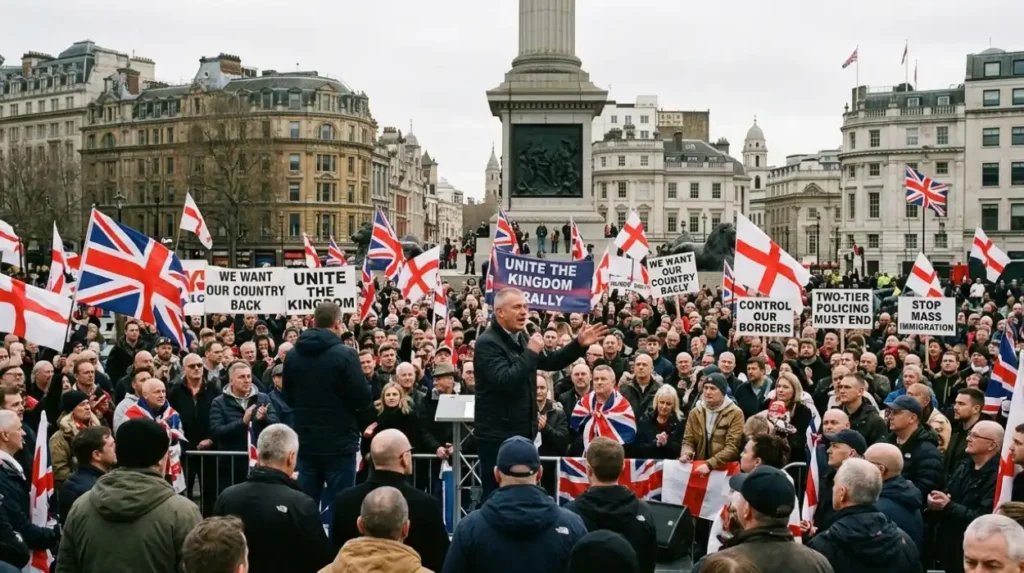
The event functions as a focal point for various nationalist and populist groups across the British Isles. Organisers frame the gathering as a peaceful demand for freedom of speech and governmental accountability regarding border security. The rally typically takes place at iconic landmarks, such as Trafalgar Square or Whitehall, to maximise public visibility and media coverage. Participants often carry the Union Jack, the St George’s Cross, and banners representing specific regional or political affiliations.
The core motivation behind the movement is a rejection of current Home Office policies. Supporters argue that the rapid demographic changes in British towns and cities are unsustainable. The rally serves as a platform for speakers to address crowds on issues ranging from the European Convention on Human Rights (ECHR) to the impact of the Online Safety Act 2023 on digital expression. By centralising these grievances under the Unite the Kingdom banner, organisers attempt to bridge the gap between different factions of the British right.
Who are the primary organisers of the Unite the Kingdom rally?
Stephen Yaxley-Lennon, known as Tommy Robinson, is the lead organiser of the Unite the Kingdom rally. He collaborates with several political figures, independent media outlets, and grassroots organisations to mobilise large crowds through digital platforms and social media campaigns.
Stephen Yaxley-Lennon founded the English Defence League (EDL) in 2009, though he later distanced himself from the group to pursue independent political activism. His role in the Unite the Kingdom rally involves using his significant social media following to coordinate logistics and fundraise for the event. He describes the movement as a response to what he labels the betrayal of the British working class by successive governments.
Secondary organisers include various independent journalists and political commentators who provide live-streamed coverage to international audiences. These individuals utilise platforms like X (formerly Twitter) and Telegram to bypass traditional media gatekeepers. Grassroots groups involved in the logistics often include veterans’ rights organisations and local community activists concerned with the placement of asylum seekers in residential areas, including those within north London and surrounding boroughs. The organisational structure relies heavily on decentralised digital networks to ensure a high turnout despite opposition from counter-protest groups.
What are the core objectives of the Unite the Kingdom movement?
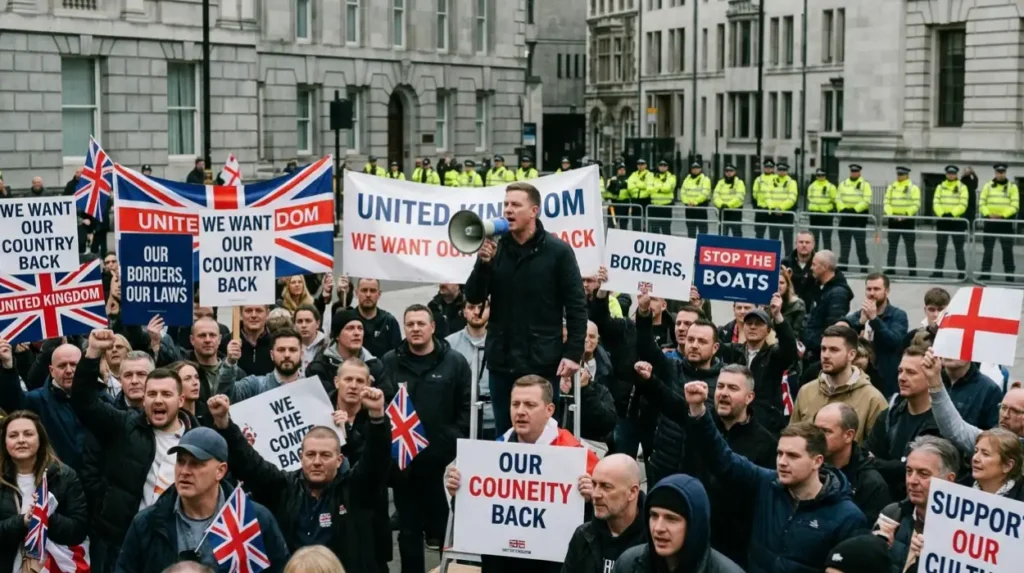
The movement seeks to influence British government policy regarding illegal immigration, national sovereignty, and legal transparency. Specifically, it demands the cessation of small boat crossings in the English Channel and the repeal of laws that limit public political expression.
A primary objective is the reform of the UK Border Force and the Home Office. The movement advocates for the immediate deportation of individuals who enter the country illegally. They cite the 2023 and 2024 migration statistics, which show record numbers of arrivals, as evidence of a failed system. The rally serves as a physical manifestation of this policy demand, aimed at pressuring the Prime Minister and the Home Secretary to adopt a zero-tolerance approach to undocumented entry.
Another central pillar is the opposition to two-tier policing. This term refers to the allegation that the Metropolitan Police Service and other regional forces treat nationalist protesters more harshly than those from minority or left-wing groups. Demonstrators demand an independent inquiry into police conduct during recent civil unrest. Furthermore, the movement calls for the protection of British cultural identity and historical monuments, which they believe are under threat from progressive social movements and cancel culture.
When and where did the most significant rallies take place?
The most significant Unite the Kingdom rally occurred on 27 July 2024 in central London, drawing tens of thousands of participants to the Westminster area. Other related demonstrations have taken place in major cities including Belfast, Manchester, and Leeds.
The July 2024 event in London saw a massive gathering at Trafalgar Square before moving toward Parliament Square. This date was chosen to coincide with ongoing national debates regarding public safety and immigration legislation. The Metropolitan Police deployed over 1,000 officers to manage the crowd and prevent clashes with counter-protesters from groups such as Stand Up To Racism. The scale of this event marked a resurgence in the visibility of the populist right in British politics.
In Belfast, a similar demonstration under the Unite the Union and Unite the Kingdom themes took place outside City Hall. These events often feature 3 types of activities: keynote speeches, marches through city centres, and the distribution of political literature. The geographic spread of these rallies indicates a coordinated effort to nationalise local grievances. Each location is selected for its symbolic value, typically near government offices or historical sites, to ensure the message reaches the highest levels of political power.
What is the impact of the Unite the Kingdom rally on British politics?
The rally has forced issues of immigration and national identity into the forefront of parliamentary debate and media discourse. It has also influenced the rhetoric of established political parties seeking to address the concerns of the nationalist-leaning electorate.
The presence of thousands of people on the streets of London creates a visual pressure cooker for the government. Members of Parliament (MPs) are forced to address the underlying causes of the unrest, such as housing shortages and the strain on public services like the National Health Service (NHS). While mainstream parties often condemn the organisers, they frequently adopt tougher stances on border control to prevent the further movement of voters toward populist factions. This phenomenon is known as the co-option of the fringe, where radical demands eventually shift the Overton Window of acceptable political policy.
Furthermore, the rally has significant implications for the Public Order Act 2023. The government has used these demonstrations to justify increased police powers to curb highly disruptive protests. This creates a legal feedback loop where the protest triggers stricter laws, which then provide fresh grievances for the next demonstration. The impact also extends to the digital realm, as the Office of Communications (Ofcom) monitors how these events are organised online, leading to debates about censorship and the role of tech companies in political mobilisation.
How does the UK legal system interact with these demonstrations?
The UK legal system regulates these rallies through the Public Order Act 1986 and subsequent amendments, which allow police to impose conditions on the timing and location of marches. Failure to comply with these conditions results in arrests.
Under Section 12 and Section 14 of the Public Order Act, senior police officers can restrict a demonstration if they believe it may result in serious public disorder, serious damage to property, or serious disruption to the life of the community. During the Unite the Kingdom rallies, the Metropolitan Police frequently issue specific routes that marchers must follow. Violations of these orders have led to numerous arrests for offences such as breach of the peace and obstructing a highway.
The judicial system also interacts with the movement through the prosecution of its leaders. Stephen Yaxley-Lennon has faced multiple legal challenges, including charges related to contempt of court and misuse of digital platforms. These legal proceedings often become a central theme of the rallies themselves, with supporters framing the court cases as political persecution. This creates a complex relationship between the street movement and the Crown Prosecution Service (CPS), where every legal action taken against the organisers is used to further radicalise and motivate the participant base.
What role does social media play in the Unite the Kingdom movement?
Social media serves as the primary infrastructure for recruitment, fundraising, and real-time coordination of the Unite the Kingdom rallies. Platforms like X and Telegram allow organisers to reach millions of users instantly without traditional media filters.
Before the advent of high-speed mobile internet, nationalist movements relied on physical newsletters and local meetings. Today, a single post by a key influencer can trigger a nationwide mobilisation. Organisers use 3 types of digital content: short-form video updates, live-streamed broadcasts of events, and infographics detailing government statistics on immigration. These tools allow the movement to control its own narrative, often presenting a starkly different version of events than that found on the BBC or Sky News.
The Online Safety Act is a direct response to the perceived dangers of such digital mobilisation. The UK government argues that social media platforms allow for the rapid spread of misinformation that can lead to real-world violence. In response, the Unite the Kingdom movement has migrated much of its sensitive planning to encrypted messaging apps like Signal and Telegram. This digital cat-and-mouse game between activists and regulators defines the modern landscape of British political protest, making it nearly impossible for authorities to fully suppress the movement’s communication channels.
What are the common criticisms and counter-movements against the rally?
Critics argue that the Unite the Kingdom rally incites racial hatred, promotes xenophobia, and endangers public safety. Counter-movements, led by groups like Stand Up To Racism and various trade unions, frequently hold simultaneous protests to oppose the nationalist message.
Opponents characterise the rally as a far-right gathering that targets vulnerable migrant communities. They point to the rhetoric used by speakers as a catalyst for hate crimes and social division. Labour Party politicians and civil rights organisations often call for the rallies to be banned, citing the potential for violence. These critics emphasise that the unity described by the organisers excludes millions of British citizens based on their ethnicity or religion.
Counter-protests are a standard feature of any Unite the Kingdom event. These groups aim to physically outnumber the nationalist marchers and provide a visible rejection of their ideology. This often leads to 3 types of conflict: verbal altercations between opposing lines, physical skirmishes requiring police intervention, and competing media campaigns to define the soul of Britain. The presence of these counter-groups necessitates a massive police presence, often costing taxpayers millions of pounds per event in security and cleanup operations.
How does the rally address the issue of “Two-Tier Policing”?
The movement defines two-tier policing as a systematic bias where nationalist protesters receive harsher treatment than groups like Black Lives Matter or pro-Palestine marchers. They demand equal enforcement of the law regardless of the political cause.
To support this claim, rally organisers frequently cite specific incidents where police appeared to take a hands-off approach to certain demonstrations while using riot gear against others. They point to 3 types of evidence: arrest statistics from different protests, video footage of police interactions, and the speed of sentencing for different groups of offenders. During the 2024 rallies, this narrative became a powerful unifying force, drawing in people who felt that the British state no longer represented their interests fairly.
The government and the National Police Chiefs’ Council (NPCC) consistently deny the existence of two-tier policing. They maintain that operational decisions are based on risk assessments and the specific behaviour of the crowd at the time. However, the perception of bias remains a cornerstone of the Unite the Kingdom movement. By focusing on the concept of fairness and justice, the movement appeals to a broader sense of British civic duty, framing their protest not just as a nationalist cause, but as a fight for the integrity of the British legal system.
What is the historical context of nationalist rallies in the United Kingdom?
Nationalist rallies in the UK have evolved from the post-war efforts of the British National Party (BNP) and the National Front to the modern, digitally-driven populist movements of the 21st century. The Unite the Kingdom rally is the latest iteration of this lineage.
In the 1970s and 1980s, groups like the National Front held marches that often ended in significant violence, such as the Battle of Lewisham in 1977. These earlier movements were explicitly racialist and often lacked broad public support. In the 2000s, the English Defence League (EDL) shifted the focus toward a critique of Islamic extremism, attempting to distance itself from traditional neo-Nazism while maintaining a confrontational street presence. This shift allowed the movement to tap into broader post-9/11 anxieties within the British working class.
The current Unite the Kingdom movement represents a civic nationalist shift, focusing more on border control, legal transparency, and freedom of speech than on biological race. This transition has allowed the movement to attract a more diverse range of supporters, including some from ethnic minority backgrounds and residential areas like north London who share concerns about illegal migration. By framing their arguments in the language of sovereignty and democracy, the modern organisers have successfully moved the movement away from the fringes of the 20th century into a more mainstream, albeit still highly controversial, political space.
What is the future relevance of the Unite the Kingdom movement?
The movement will likely remain a significant force in British politics as long as immigration remains a primary concern for the electorate. Its ability to mobilise large numbers of people ensures it will continue to influence government policy.
The future of the movement depends on 3 factors: the leadership of figures like Stephen Yaxley-Lennon, the effectiveness of government migration policies, and the evolving legal landscape regarding protest rights. If the government fails to significantly reduce small boat crossings, the grievances that fuel these rallies will persist. Conversely, if the movement faces total digital de-platforming or the permanent imprisonment of its leaders, it may fragment into smaller, more radicalised local cells.
Furthermore, the influence of the movement is likely to be felt in future general elections. While the rallies themselves are not a political party, the Unite the Kingdom sentiment aligns closely with the platform of parties like Reform UK. The pressure from the streets can act as a catalyst for electoral shifts, forcing mainstream parties to move further to the right to retain their voter base. As the UK continues to navigate its post-Brexit identity, the questions raised by these rallies—who belongs to the nation and how borders should be managed—will remain at the heart of the national conversation for the foreseeable future.
Data and Statistics on UK Migration and Public Perception
Research from the Office for National Statistics (ONS) and polling firms like YouGov indicates a high level of public concern regarding immigration levels, which provides the demographic backdrop for the Unite the Kingdom rallies.
In 2023, net migration to the UK reached approximately 685,000 people. Polling data suggests that a significant majority of the British public believes these numbers are too high and that the government has lost control of the borders. This sentiment is particularly strong in the Red Wall seats of the Midlands and Northern England, where many rally participants originate. The Home Office reports that the cost of housing asylum seekers in hotels exceeds £8 million per day, a figure frequently cited by rally speakers to highlight the perceived economic burden of current policies.
Furthermore, data from the Ministry of Justice shows a sharp increase in the number of individuals prosecuted for stirring up racial hatred following the 2024 summer unrest. This statistical trend is used by both sides of the debate: the government uses it to demonstrate a crackdown on extremism, while the movement uses it to support the two-tier policing narrative. These numbers provide the factual foundation upon which the political rhetoric of the Unite the Kingdom rally is built, ensuring that the debate is grounded in real-world socioeconomic tensions.
What is the Unite the Kingdom rally?
The Unite the Kingdom rally is a political demonstration held in London that promotes British nationalism, stricter immigration controls, and freedom of speech concerns. It is mainly associated with activist Stephen Yaxley-Lennon, also known as Tommy Robinson.