Key points
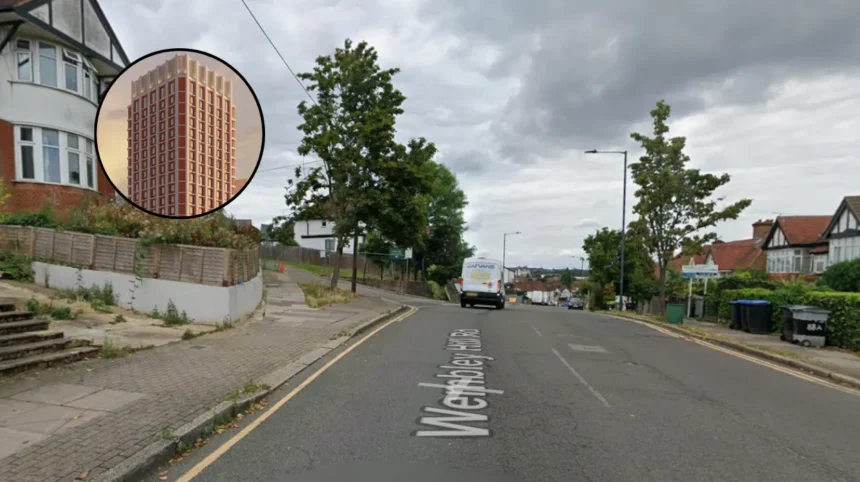
- A 25‑storey mixed‑use tower is proposed for Wembley Hill Road, housing a 90‑person care home on the lower eight floors and a 329‑bed co‑living block above.
- The site is currently an underused surface car park for the nearby Holiday Inn, directly west of Wembley Stadium.
- The developer, Splendid Hospitality Group (SHG), says the project will help meet a growing shortage of care beds while also offering single‑occupancy, affordable rental rooms.
- Layout plans show care‑home bedrooms arranged around the perimeter of the building to maximise natural light and privacy, with amenity spaces including dining rooms, lounges and a salon across the first eight floors.
- The co‑living element would include shared kitchens, lounges, laundry rooms and two roof terraces, aimed at younger, single workers and local employees.
- As reported publicly, nearly 50 objections have already been lodged, with residents raising concerns about overdevelopment, traffic, strain on local services, and the suitability of a high‑rise for vulnerable elderly residents.
- The scheme is due to be reviewed by Brent Council’s planning committee, which will decide whether to grant approval.
Wembley (North London News) May 19, 2026 – Splendid Hospitality Group (SHG) has submitted plans for a 25‑storey mixed‑use tower on Wembley Hill Road, a proposal that has drawn sharp scrutiny from local residents and campaigners. As reported by Harrow Online, the site is currently an underused surface car park for the adjacent Holiday Inn, one of several hotels clustered west of Wembley Stadium.
- Key points
- How is the care home designed?
- What about the co‑living apartments above?
- Why are residents objecting?
- What evidence backs the need for more care beds?
- How is the developer justifying the mixed‑use design?
- What happens next in the planning process?
- Background of this development
- Prediction: How this development could affect local residents and stakeholders
Under the scheme, the first eight floors would house a 90‑person care home offering 24‑hour residential care for older adults, including those living with frailty or dementia, while the upper 17 floors would contain 329 single‑occupancy co‑living rooms. A Brent Council planning document on the
“Wembley Operational Care Management Plan”
describes the care home as intended for older adults requiring ongoing support, although it does not itself draw a conclusion on the suitability of a high‑rise location.
The building would be an interconnected structure, with blocks ranging from eight to 25 storeys, close to the existing Holiday Inn, Premier Inn and Ibis hotels. SHG stresses that the tower would sit within an already dense hotel corridor, arguing that the site is “underutilised” and well‑connected to transport links.
Explore More Wembley News
Bridgwater HMO Expansion at Rhode Lane Refused by Somerset Council, Bridgwater 2026
Zephaniah House Topping Out: 54 Affordable Homes in Wembley 2026
How is the care home designed?
According to Harrow Online, SHG’s planning submission shows that care‑home bedrooms would be arranged around the perimeter of the lower floors to maximise access to natural light and privacy.
The developer states that ten rooms would be located on the first level, with 16 further rooms on each of the remaining care‑home floors.
On the first seven floors, a dining room and quiet lounge with balconies would be placed next to the bedrooms, while the eighth floor would contain additional amenity space including indoor and outdoor dining areas, a private dining room, a social lounge and a hair and beauty salon.
Brent Council‑linked operational‑care documents describe the facility as providing 24‑hour residential care, with staff on‑site to support residents living with age‑related conditions such as frailty and dementia.
The developer argues that this configuration can still meet clinical standards for care‑home environments, though objectors have countered that tall buildings may complicate evacuation, emergency response and day‑to‑day mobility for frail residents.
What about the co‑living apartments above?
The co‑living component, spread over 17 floors, would provide 329 single‑occupancy rooms targeted at workers and young professionals seeking affordable, flexible housing near Wembley.
SHG, as outlined in its own “In Development” portfolio, positions such co‑living projects as “more affordable and accessible than private sales or rental studios” and “better quality” than typical house‑share rooms.
Common amenities would include a laundry room, library, social lounges, communal kitchens and dining areas, plus two roof terraces.
The developer adds that the rental model is intended to ease pressure on local workers who are struggling to find housing close to employment hubs, including venues around Wembley Stadium.
Residents who have lodged objections, however, warn that the added density of hundreds of co‑living tenants could increase peak‑time congestion, particularly around Wembley Stadium events, and may strain existing transport and parking infrastructure.
Why are residents objecting?
As reported by Harrow Online and visible in the Brent Council planning portal, nearly 50 objections have been submitted against Application 26/0967 for the tower adjacent to the Holiday Inn on Empire Way, Wembley. Many objectors frame the proposal as effectively
“warehousing elderly people in the sky”,
arguing that high‑rise settings are ill‑suited for older, frail residents who may struggle with lifts, emergencies, noise and social isolation.
Planning‑portal comments emphasise overdevelopment, concerns that the tower would exacerbate traffic and parking pressures, and worries that local health and social services may prove insufficient to support a concentrated block of 90 care‑home residents.
Some objectors also question whether the glass‑rich, hotel‑style design prioritises aesthetics and commercial returns over the comfort and dignity of elderly residents.
In response, SHG has reiterated that the scheme would help meet a stated shortfall in care‑bed provision. A needs‑assessment document cited by Harrow Online suggests Brent currently faces an undersupply of around 563 care beds, with demand projected to rise by about 696 places by 2034.
Those projections are based on borough‑level demographic data rather than the specific site, but supporters argue that any new care‑bed capacity is necessary given the ageing population.
What evidence backs the need for more care beds?
The need‑assessment filed with the application is summarised by Harrow Online as indicating a current shortfall of roughly 563 care beds in Brent, with forecasts of additional demand in the years ahead. The developer says demand is
“set to continue over the next decade,”
pointing to broader national trends of an ageing population and increasing pressure on social‑care budgets.
Brent Council’s operational‑care planning documents describe the proposed home as designed for 24‑hour residential care, serving residents with frailty, dementia and similar age‑related conditions.
However, those documents do not themselves evaluate whether a 25‑storey tower is the optimal building type for such care, instead focusing on staffing levels, room sizes and safety systems.
Objectors have not disputed the overall need for more care beds, but many argue that tall towers carry inherent risks for vulnerable residents, including longer evacuation times, potential lift‑failure scenarios and limited access to ground‑level outdoor space.
How is the developer justifying the mixed‑use design?
SHG, as described in its own “In Development” page, specialises in hotels, care homes and restaurants, and positions the Wembley project as a way to combine “care and commerce” in a single, efficient structure.
The company says the tower would allow it to serve both an undersupplied care‑bed market and a constrained housing market for workers, particularly around the Wembley Stadium area.
In the application materials, the developer claims the co‑living rooms will be “more affordable and accessible than private sales or rental studios” and “better quality” than rooms in existing buy‑to‑let house shares.
The company adds that the homes should be affordable to local workers who are finding it increasingly difficult to live in good‑quality housing near their jobs, which it says would support local employers struggling to recruit and retain staff.
Residents who have lodged objections do not dispute the need for affordable housing, but several argue that stacking a care home above a hotel‑adjacent car park and below a large co‑living block creates an odd and potentially unsafe configuration for elderly residents.
What happens next in the planning process?
The application, listed as 26/0967 in Brent Council’s planning system, is set to be reviewed by the council’s planning committee in due course.
The committee will consider the design, height, transport‑impact assessments, environmental‑impact statements and the full run of objections before deciding whether to grant planning permission.
Planning‑portal comments show that objectors are also urging the council to scrutinise whether the proposed tower meets national planning policy and guidance on care‑home provision, particularly regarding accessibility, safety and the suitability of high‑rise environments for vulnerable groups.
SHG has not yet publicly commented beyond its submitted application materials, but the developer’s promotional content elsewhere stresses that it aims to deliver “high‑quality, sustainable developments” aligned with local‑authority housing and care‑needs strategies.
Background of this development
The proposal for the 25‑storey Wembley tower follows a broader push across London and the wider UK to convert underused car‑park and low‑density sites into mixed‑use developments that combine housing, care and commercial uses.
In Brent, planners have previously approved several tall buildings around Wembley Stadium, including the Holiday Inn and other hotels, which has led to a built‑up corridor of mid‑ to high‑rise structures along Wembley Hill Road.
The care‑bed shortfall cited by SHG is drawn from council‑ and borough‑level social‑care assessments that project rising demand for older‑adult services as the population ages.
Similar pressures have driven other local authorities to approve or consider tall care‑home or supported‑housing schemes, though each has sparked debate over density, scale and the balance between commercial and social‑care uses.
In this context, the Wembley proposal represents one attempt to reconcile a constrained inner‑London site with two competing pressures: the need for more care beds and the demand for affordable worker‑housing near major employment and leisure hubs.
The outcome of the planning committee decision will likely set a precedent for how Brent and other London boroughs handle high‑rise care‑home schemes in already dense, mixed‑use areas.
Prediction: How this development could affect local residents and stakeholders
If Brent Council approves the 25‑storey tower, residents and local businesses around Wembley Hill Road can expect a significant increase in population density above the current car‑park level, with 90 care‑home residents and 329 co‑living tenants sharing the same building. That shift could place new pressure on local transport, particularly during peak‑hour events at Wembley Stadium, and may intensify competition for parking and street‑level amenities.
From a social‑care perspective, an approved scheme would add to the borough’s stock of care‑bed places, which supporters argue is essential given the projected shortfall. However, objectors fear that concentrating a sizeable group of elderly, frail residents in a single tower could complicate emergency‑response logistics and raise questions about long‑term mental‑health and social‑isolation risks if outdoor, ground‑level spaces are limited.
For workers and younger tenants, the co‑living block could expand the supply of relatively affordable, single‑occupancy rooms near Wembley‑area employers, potentially easing recruitment challenges for local hotels, venues and businesses. At the same time, neighbours may see more footfall, increased demand for local services and a perceptible change in the character of the street, particularly if the building’s design emphasises glass‑facade hotel‑style aesthetics over human‑scale retail or community space.