Key Points
- Incident: A major townhouse fire broke out on Silverbrook Drive in North London early Wednesday morning, drawing a significant emergency response.
- Displacement and Injuries: A total of 12 residents were displaced by the blaze, though officials confirmed that no injuries were reported among residents or emergency crews.
- Property Damage: The London Fire Department initially projected losses near $1,000,000, but subsequent inspections revised the estimated damage down to approximately $800,000.
- Containment: Firefighters faced a fully engulfed unit with flames spreading rapidly to a second home and into the attic space, but crews successfully limited the structural damage to three homes.
- Investigation: Fire prevention officers have launched an official investigation to determine the origin and exact cause of the blaze.
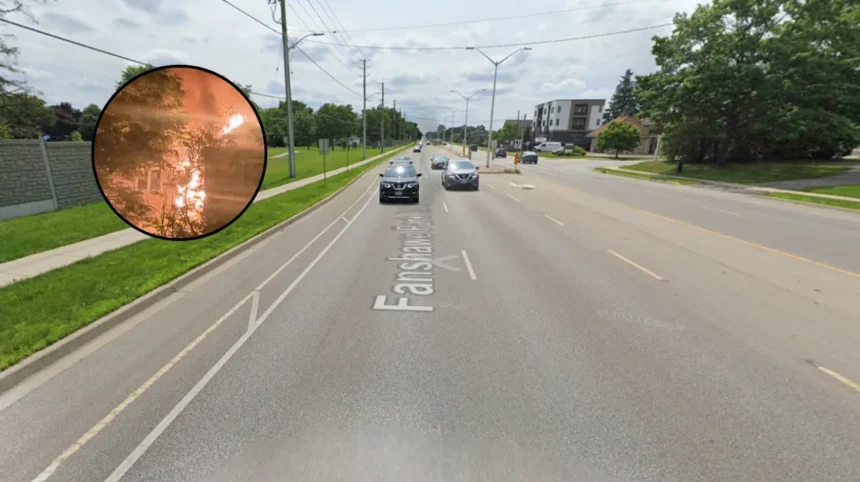
North London (Norh London News) June 4, 2026 – A fast-moving structural fire tore through a residential complex in the city’s north end early Wednesday morning, triggering a large-scale emergency deployment, displacing more than a dozen citizens, and incurring high-value property losses. According to official statements released by the London Fire Department, emergency dispatchers received the initial emergency calls shortly after midnight, directing first responders to a townhouse complex located on Silverbrook Drive, situated near the major intersection of Fanshawe Park Road East and Adelaide Street North. Upon arrival at the scene, initial fire crews encountered heavy fire and thick smoke venting visibly across multiple residential units, forcing an immediate offensive transition to prevent a wider suburban conflagration.
What Happened During the Silverbrook Drive Townhouse Fire?
The operational response began immediately after midnight when multiple pumper trucks, aerial ladders, and command units were dispatched to the North London residential sector.
As detailed in the public information logs released by the London Fire Department, the first arriving firefighting crews witnessed a chaotic scene, reporting that one specific townhouse unit was already completely engulfed in flames.
The fire was actively spreading laterally to an adjacent second unit and had breached the roofline to establish a deep seat within the shared attic space.
The presence of shared attic fire walls in modern townhouse rows presents a known operational hazard, as fire can rapidly track horizontally above the living spaces if not aggressively checked by suppression lines.
Firefighters deployed multiple hose lines to attack the main body of the fire while simultaneously launching a vertical ventilation strategy on the roof to release trapped superheated gases and smoke.
Because the fire had already compromised the attic structural framing of the primary unit, crews had to balance aggressive indoor suppression with exterior safety protocols.
Through rapid deployment and strategic water application, the London Fire Department successfully contained the forward progress of the fire, limiting severe structural impact to a total of three homes within the row, thereby saving neighboring attached units from similar destruction.
What is the Total Estimated Damage and Casualty Count?
In terms of human impact, the emergency response concluded with a highly favorable outcome regarding public safety. Fire officials confirmed that all occupants inside the affected structures were able to evacuate safely before interior conditions became untenable.
In total, 12 residents were forced from their homes due to smoke, water, and direct fire damage, requiring immediate displacement support. Fortunately, the London Fire Department reported zero civilian injuries and zero firefighter injuries during the multi-hour suppression operation.
The financial toll of the incident, however, remains substantial. In the immediate aftermath of the containment, initial damage assessments compiled by command officers on-scene placed the projected monetary losses close to $1,000,000, reflecting the severe structural compromise of the primary unit and the extensive smoke and water damage dealt to the adjacent properties.
However, following a more thorough daylight inspection conducted by specialized investigators, the London Fire Department subsequently revised the formal loss figure downward, stabilizing the estimated property and content damage at approximately $800,000.
How is the Cause of the Fire Being Investigated?
With the physical hazards mitigated and the site overhauled to prevent hidden hot spots from reigniting, the operational phase has transitioned fully into a forensic analysis.
As confirmed by the London Fire Department, fire prevention officers have been formally assigned to the scene and have initiated a comprehensive investigation.
The current investigative protocol involves a meticulous physical excavation of the primary unit’s remains to identify the exact point of origin and the specific ignition source that started the blaze. Investigators will be examining structural wiring, major appliances, and interviewing evacuated residents to piece together the moments leading up to the initial midnight emergency call.
As of the latest updates provided by municipal authorities, no official cause has been determined, and the scene remains under active review by fire prevention personnel.
Background of Suburban Fire Risks and Prevention Protocols
The structural layout of modern townhouse developments presents a specific set of challenges for municipal fire departments, particularly concerning shared roof spaces and common fire barriers. In North London, suburban expansions have frequently utilized multi-unit residential designs to maximize density.
While these structures strictly adhere to local building codes at the time of construction, a fire that successfully breaches the drywall or fire-rated assemblies of a single unit can quickly access the attic, which often acts as a continuous channel across multiple homes if fire stops are compromised or improperly sealed.
Historically, the London Fire Department has frequently emphasized the critical importance of early detection systems, such as interconnected smoke alarms, in these specific types of high-density residential zones.
Because a fire in one unit directly threatens the lives and property of everyone attached to that row, early warnings are the primary mechanism allowing large groups of residents—such as the 12 individuals displaced in this incident—to evacuate safely before toxic smoke permeates the entire structure.
This incident follows ongoing municipal efforts to audit older residential complexes and educate suburban homeowners on maintaining proper clearance around electrical panels and heating ventilation systems.
Explore More North London Fire News
£1M Townhouse Fire Damages Multiple Homes in North London 2026
North London house fire causes $1 million damage, 2026
Predictions: How This Development Can Affect North London Residents
This incident is highly likely to have direct, measurable impacts on the immediate neighborhood and the broader residential demographic of North London. In the short term, the 12 displaced residents will face prolonged logistical and financial challenges as they navigate insurance claims, structural rebuilds, and temporary housing transitions, which will likely put a localized strain on community housing resources and support agencies.
For the broader audience of local townhouse owners and tenants in North London, this event will almost certainly influence property insurance dynamics. Insurance providers regularly reassess risk portfolios following high-loss suburban fires; consequently, residents in similar multi-unit complexes across the region may see a marginal increase in their annual premiums as actuaries adjust for local structural fire risks.
Additionally, this prominent $800,000 loss is expected to prompt stricter municipal enforcement of fire safety compliance. Local fire prevention officers may increase the frequency of proactive fire code inspections in multi-family dwellings, and condominium corporations in the area will likely face pressure to conduct immediate reviews of their shared attic fire barriers and emergency evacuation protocols to protect against future liabilities.