Key Points
- Industrial Action Dates: Resident doctors (formerly junior doctors) at the Royal Free London NHS Foundation Trust are scheduled to strike for 96 hours from 7:00 am on Monday, 15th June until 6:59 am on Friday, 19th June.
- Hospitals Impacted: The strike will disrupt clinical operations across four major North London medical sites: the Royal Free Hospital, Barnet Hospital, Chase Farm Hospital, and Edgware Community Hospital.
- Financial Strain: The industrial action arrives as the Royal Free London NHS Foundation Trust navigates a severe financial crisis, currently grappling with a deficit of £11.9 million.
- Repeated Disruption: This five-day walkout marks the second major wave of industrial action by the trust’s resident doctors in recent months, following a previous week-long strike executed in April.
- National Stalemate: The British Medical Association (BMA) called the local strike after national negotiations broke down with Health Secretary James Murray, who refused to alter the financial framework or increase funding for pay restorations.
- Operational Strategy: Trust management is implementing emergency protocols to safeguard critical units, such as Emergency Departments and maternity wards, by reallocating senior consultants, though hundreds of routine procedures face postponement.
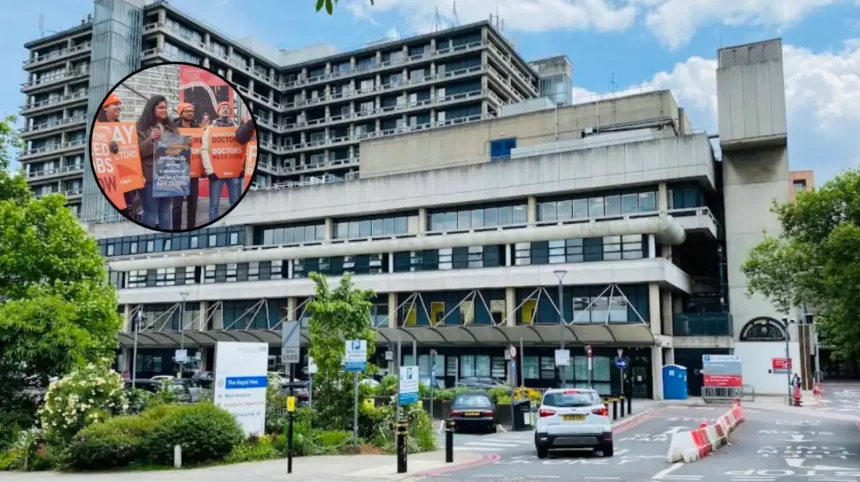
North London (North London News) June 9, 2026 – A impending resident doctors’ strike is set to severely disrupt healthcare operations across four major North London hospitals next week, simultaneously threatening to deepen an existing £11.9 million deficit at the Royal Free London NHS Foundation Trust. In an official administrative briefing distributed today, the Royal Free London NHS Foundation Trust confirmed that its resident medical staff—historically referred to as junior doctors—will withdraw their labour starting at 7:00 am on Monday, 15th June. The continuous walkout is scheduled to conclude just before the morning shift change at 6:59 am on Friday, 19th June. The four targeted facilities facing imminent staffing shortfalls comprise the Royal Free Hospital in Hampstead, Barnet Hospital in High Barnet, Chase Farm Hospital in Enfield, and Edgware Community Hospital in Edgware.
- Key Points
- How Will the Strike Affect Regional Patient Care and Hospital Finances?
- What are the Stance and Core Arguments of the British Medical Association?
- How Has the Government Responded to the Union’s Accusations?
- What Contingency Measures is the Royal Free London NHS Trust Implementing?
- Background of the Particular Development
- Prediction: How This Development Can Affect Patients and Local Communities
The upcoming four-day work stoppage represents the second major round of industrial escalation within the trust during the current financial quarter, arriving on the heels of a highly disruptive seven-day strike staged by resident doctors in April. This latest escalation stems from a prolonged national contract dispute concerning pay restoration and career progression pathways, which has now directly collided with the localized fiscal crisis gripping the North London trust.
How Will the Strike Affect Regional Patient Care and Hospital Finances?
As reported by health reporter Sarah Lynch of The London Clarion, the dual pressure of a mounting deficit and an absent frontline workforce presents an unprecedented operational bottleneck for the regional health network. Trust finance directors have warned that the previous April strikes incurred substantial unforeseen expenses, primarily driven by the necessity of covering empty rotas with senior consultants paid at premium overtime rates. The addition of another five-day walkout is expected to add hundreds of thousands of pounds to the existing £11.9 million deficit, driven by direct temporary staffing costs and forfeited elective care revenue from cancelled operations.
According to data compiled by clinical tracking analyst David Thorpe of The Healthcare Monitor, the April industrial action forced the postponement of over 2,400 routine outpatient appointments and 180 elective surgical procedures across the Royal Free London network. Trust planners have privately acknowledged that next week’s strike action will trigger a similar wave of cancellations, further inflating the trust’s waiting lists, which currently remain under intense scrutiny from NHS England.
What are the Stance and Core Arguments of the British Medical Association?
The escalation to active strikes follows the total collapse of localized and national negotiations aimed at resolving long-standing grievances over real-term pay devaluation. Writing for The Medical Tribune, political correspondent Alistair Vance detailed that the British Medical Association’s Resident Doctors Committee (RDC) authorized the mandate after determining that government officials refused to alter their fiscal parameters.
In an official press dispatch issued by the union, Dr Jack Fletcher, the national chair of the BMA Resident Doctors Committee, stated that:
“Following weeks of talks between the Government and the BMA, the new Health Secretary, James Murray, has made clear he will not increase the investment in the offer already rejected by resident doctors. Without any meaningful change to the latest offer, the resident doctor committee has been left with no choice but to call further strike action in England.”
Dr Fletcher further articulated the frustration among frontline medical workers regarding what the union describes as historical political stagnation:
“We had hoped that a change in leadership at the Department of Health and Social Care would lead to a change in approach. Sadly, we have run up against the same unwillingness to move we encountered under his predecessor. We were prepared to give Mr Murray time to settle into his role before completing the work left unfinished—to both make a fair and meaningful pay offer and make concrete commitments to end the jobs bottleneck throttling the careers of our colleagues. He had a genuine opportunity to break this logjam with fresh energy and ambition. He has not taken it.”
The BMA maintains that take-home pay for resident doctors in England remains approximately one-fifth lower in real terms compared to 2008 figures, a statistic that union representatives argue is driving an accelerating brain drain of qualified medical personnel to international healthcare markets.
How Has the Government Responded to the Union’s Accusations?
Conversely, the Department of Health and Social Care has defended its current financial framework, citing the broader macroeconomic necessity of curbing public sector inflation. As detailed by Westminster correspondent Eleanor Hastings of The Financial Sentinel, Health Secretary James Murray has consistently reiterated that the Treasury cannot sanction additional unbudgeted spending allocations without destabilizing existing public sector wage structures.
In a ministerial press briefing delivered from Whitehall, Health Secretary James Murray countered the BMA’s rhetoric, stating that:
“The costs of prolonged, avoidable strike action are deeply damaging to patient outcomes, but we must operate within the realistic bounds of public fiscal responsibility. The offer currently placed on the table represents a fair, sustainable compromise that acknowledges the dedication of our resident medical workforce while ensuring that the broader NHS remains financially viable during an incredibly tight economic cycle.”
Government officials have also pointed out that James Murray’s transition directly from his previous post within the Treasury equips him with an intimate understanding of the public spending matrix, suggesting that the union’s demands for full pay restoration are structurally impossible under current fiscal constraints.
What Contingency Measures is the Royal Free London NHS Trust Implementing?
To mitigate the immediate risks to patient safety, the executive board of the Royal Free London NHS Foundation Trust has initiated emergency contingency frameworks. Reporting for The North London Chronicle, local democracy reporter Marcus Aurelius noted that the trust’s primary objective is to preserve intact emergency pathways, high-dependency units, and neonatal services.
An official public advisory notice released by the Royal Free London communications office outlines the structural shifts that will occur during the 96-hour strike window:
“Our priority during this period of industrial action is to ensure that emergency care remains safe and fully operational across all our sites. We are working closely with clinical leaders to redeploy consultant staff to cover critical areas, including our Accident and Emergency departments, intensive care units, and maternity wards. We deeply regret the inconvenience this action will cause to patients whose pre-planned treatments must be rescheduled as a result of this disruption.”
The trust’s guidance explicitly instructs patients holding appointments between June 15th and June 19th to attend their scheduled slots unless they are directly contacted by hospital administration to arrange an alternative date. Furthermore, local residents are being urged to utilize NHS 111 online services for non-life-threatening ailments to minimize excess traffic within the strained physical emergency departments at the Royal Free and Barnet hospitals.
Background of the Particular Development
The localized crisis unfolding within the Royal Free London NHS Foundation Trust is the product of two intersecting timelines: a multi-year national labor dispute regarding NHS wages and an escalating structural deficit within regional healthcare commissioning. The modern conflict over resident doctor pay trace back to structural changes in the NHS pay scale enacted over more than a decade of public spending restraints, which the BMA claims has led to an unsustainable reliance on overstretched, underpaid junior staff to maintain baseline hospital throughput.
Financially, the Royal Free London NHS Foundation Trust has faced compounding pressures since the conclusion of the pandemic-era emergency funding packages. Like many large urban teaching trusts, the Royal Free carries a high fixed-cost infrastructure across multiple physical sites. The emergence of the £11.9 million deficit reflects escalating costs for specialized medical supplies, increased energy outlays, and a reliance on agency staff to cover vacancy gaps in nursing and technical departments.
The previous wave of strikes in April severely exacerbated this underlying fiscal weakness. During industrial action, hospitals are legally and ethically obligated to maintain minimum safe staffing levels, which requires paying senior consultants premium independent contract rates to fulfill the routine shifts normally managed by resident doctors. Consequently, each day of industrial action actively accelerates the depletion of the trust’s remaining operational reserves, transforming a national political stalemate into an immediate local balance-sheet crisis.
Prediction: How This Development Can Affect Patients and Local Communities
This development is poised to significantly impact the local population of North London, specifically the patients, families, and primary care providers reliant on the Royal Free London healthcare network. In the immediate term, the strike will generate a secondary wave of surgical and outpatient backlogs. Patients waiting for non-urgent elective procedures—such as joint replacements, diagnostic endoscopies, and specialist consultations—will experience extended delays, extending waiting times that are already well above national targets.
For the broader North London community, the compounding £11.9 million deficit means the trust will likely be forced to introduce stringent “turnaround” cost-cutting measures during the autumn financial cycle. This fiscal retrenchment can manifest as delayed capital investments in new diagnostic imaging machinery, prolonged freezes on non-clinical hiring, and potential reductions in localized community outreach programs.
Furthermore, local General Practitioners (GPs) will likely face an influx of patients seeking secondary management for chronic conditions while waiting for rescheduled hospital slots, shifting the operational burden from acute hospitals onto an already saturated primary care sector. If the national deadlock remains unresolved past July, the community faces the prospect of recurring, rolling monthly actions that could fundamentally erode public confidence in local emergency and elective care access.