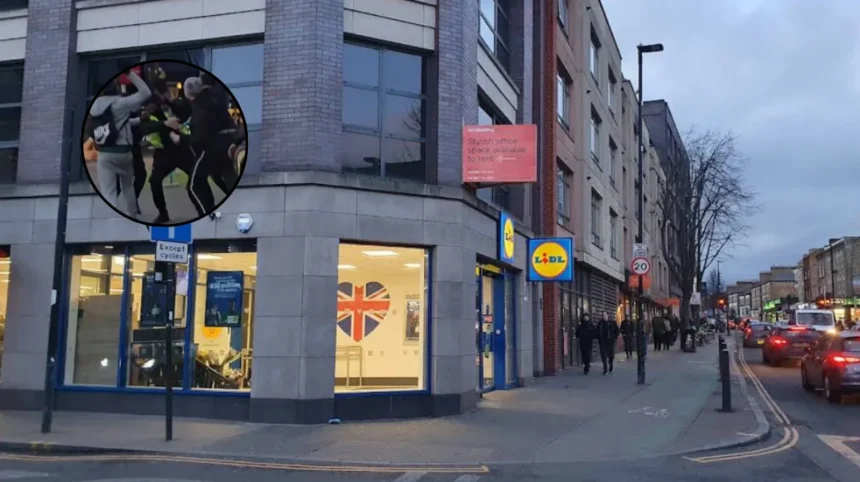
Key Points:
- A violent physical altercation erupted at a north London supermarket, leaving retail staff battered by a group of suspected criminals.
- Footage shared extensively across online platforms displays a group kicking and throwing punches at store employees.
- The shocking incident took place at a Lidl supermarket located in the Finsbury Park area.
- Shoppers watched in disbelief as the suspected shoplifting gang aggressively assaulted the workers on the shop floor.
- The attack highlights a growing nationwide epidemic of organised retail crime and violence directed at customer-facing staff.
Finsbury (North London News) June 11, 2026 – This is the shocking moment staff were attacked by a group of suspected shoplifters in a supermarket in north London. Footage shared online shows the group kicking and throwing punches at workers at a Lidl supermarket while shocked shoppers look on.
- Key Points:
- What Does the Online Footage Reveal About the Lidl Supermarket Attack?
- Why Are Shoplifting Gangs Targeting Supermarkets in the United Kingdom?
- What Are the Staggering Statistics Behind Britain’s Retail Crime Wave?
- How Are Law Enforcement and Retailers Responding to the Crisis?
- Background of the particular development
- Prediction: How Will This Development Affect Supermarket Shoppers and Staff?
What Does the Online Footage Reveal About the Lidl Supermarket Attack?
The newly emerged video footage captures a chaotic and violent scene unfolding within the aisles of the popular budget supermarket. The recording, which has been widely circulated on social media platforms, shows a group of individuals—suspected by witnesses to be attempting to steal goods—turning violently on the store’s employees. Instead of fleeing the premises when challenged, the group escalated the situation into a severe physical brawl.
In the footage, the suspected shoplifting gang can be seen actively engaging in a physical confrontation, repeatedly kicking and throwing punches at the retail staff members who were attempting to manage the situation.
The violent outburst occurred in broad daylight, leaving everyday customers and bystanders thoroughly shocked as they witnessed the staff being assaulted in their place of work.
The recording captures the immediate danger faced by the workers, with shocked shoppers looking on helplessly as the suspected thieves unleashed their physical assault before the video abruptly concludes.
Why Are Shoplifting Gangs Targeting Supermarkets in the United Kingdom?
This harrowing incident at the Finsbury Park Lidl is not an isolated event, but rather a symptom of a deeply rooted crisis affecting the British high street and retail parks. Across the United Kingdom, store employees are increasingly finding themselves in the firing line of aggressive thieves and highly organised criminal networks.
The landscape of retail theft has shifted dramatically in recent years, moving away from opportunistic, petty theft to brazen, co-ordinated operations. Retailers have frequently described gangs marauding into shops, sweeping high-value items off the shelves into large bags, and violently attacking or threatening any staff member or security guard who attempts to intervene.
Because shop workers are typically not equipped or legally protected to engage in physical restraint, they are left highly vulnerable to such physical outbursts.
Law enforcement and investigative journalists have noted that professional criminal rings are treating British supermarkets as lucrative targets. As reported by Antoine Allen of ITV News, an investigation into the crisis revealed that
“professional criminals are fuelling a shoplifting crisis — with stolen goods resold in other stores or online.”
These highly organised gangs often operate with a “stolen to order” mentality, targeting specific high-demand goods such as branded food, alcohol, cosmetics, and electrical devices.
Furthermore, police have previously stated that foreign organised crime gangs are even travelling to the country to go on shoplifting sprees, primarily because they perceive the UK retail environment and its legal deterrents as a soft target.
What Are the Staggering Statistics Behind Britain’s Retail Crime Wave?
The numbers painting the picture of the UK’s retail crime epidemic are grim, placing immense pressure on both the retail sector and the criminal justice system. Shoplifting in England and Wales has reached its highest level since police records began. The economic and human cost of these crimes is staggering.
As reported by News Correspondents of the Daily Express during their ongoing industry coverage, official figures recorded that there were
“more than 530,000 shoplifting offences in the year to March 2025, up 20% in a year.”
The financial toll on retailers is estimated to top £2.2 billion annually. Most alarmingly for public safety and the wellbeing of retail workers, a significant percentage of these incidents go completely unsolved. With nearly 800 cases going unsolved every single day, perpetrators operate with a perceived sense of impunity.
It is this exact lack of consequence that emboldens criminals to use blatant violence, such as the kicking and punching seen in the Finsbury Park Lidl footage, when they are eventually challenged by staff.
How Are Law Enforcement and Retailers Responding to the Crisis?
The frustration among retail executives and shop workers is palpable. With just 14% of shoplifting offences in England and Wales resulting in any kind of formal charge, many major retailers are being forced to take matters into their own hands to protect their staff and stock.
Supermarkets are increasingly investing in private security teams, deploying body-worn cameras for floor staff, and installing advanced CCTV networks to deter criminal gangs and gather robust evidence.
Simultaneously, police forces are attempting to mount targeted operations to dismantle the networks fencing these stolen goods. In recent large-scale crackdowns, the Metropolitan Police have targeted the end-point of this criminal supply chain.
As reported by News Correspondents of the Daily Express, a recent major police operation saw officers raid
“more than 120 shops suspected of buying items stolen from major retailers and reselling them at discounted prices,”
resulting in the seizure of hundreds of thousands of pounds worth of stolen goods and 32 arrests.
Despite these high-level crackdowns on the resale market, the frontline reality remains perilous for everyday retail staff. Workers who are simply trying to earn a living are instead facing the very real threat of being kicked and punched by aggressive gangs on the shop floor.
Background of the particular development
The underlying background to this violent incident in Finsbury Park is a systemic failure to adequately penalise repeat retail offenders and protect frontline workers over the past decade.
The reclassification of shoplifting goods under £200 as a summary-only offence in 2014 by the Anti-social Behaviour, Crime and Policing Act led to a widespread perception among criminals that lower-level theft would not be met with serious police action or significant jail time. Consequently, thieves became increasingly brazen.
Over time, this environment incubated the rapid growth of organised retail crime. Gangs realised that they could repeatedly loot stores with minimal risk of arrest.
As the volume of theft grew, so did the friction between thieves and store staff. Supermarket workers, who are trained primarily in customer service and stock management, found themselves inadvertently functioning as the last line of defence against aggressive criminals.
The Finsbury Park Lidl attack is the direct culmination of this legal and social background: an environment where suspected shoplifters feel confident enough to physically batter retail staff in broad daylight, fully aware that the immediate legal consequences are statistically minimal.
Prediction: How Will This Development Affect Supermarket Shoppers and Staff?
For the specific audience of everyday supermarket shoppers and retail staff, the fallout from violent incidents like the attack in Finsbury Park will profoundly alter the daily supermarket environment.
Firstly, for the retail staff, this development will likely force supermarket chains to universally enforce strict “no-touch” and “do not approach” policies. To protect their employees from being kicked or punched, management will instruct staff to step back and simply observe or record thefts rather than intervening.
While this prioritises physical safety, it may severely impact staff morale, leaving workers feeling helpless and deeply anxious as they are forced to watch their workplaces be repeatedly targeted by hostile gangs. Furthermore, there will be an amplified union demand for better protective measures, such as mandatory body-worn cameras for all floor staff and a heightened presence of trained, physical security personnel in high-risk branches.
Secondly, for the everyday shoppers who witnessed this violence or frequent these stores, the shopping experience will become increasingly fortified and less convenient. Consumers can predict an influx of restrictive security measures.
This will manifest in the form of more everyday items being locked behind glass cabinets, the implementation of receipt-scanning security gates at exits, and restricted store layouts designed to slow down fleeing thieves.