
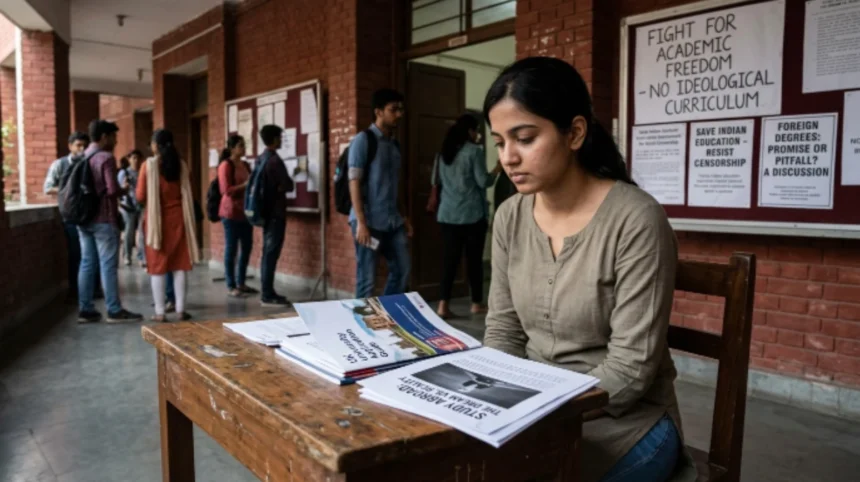
On 9th June 2026, the Union Education Minister, Shri Dharmendra Pradhan, handed over letters of approval to two good British universities (the University of Bristol and the University of York) and one Australian university (the University of New South Wales) to open their campuses in Mumbai and Bengaluru. He calls it a major step in fulfilling the “internationalisation vision” of the New Education Policy (NEP) of 2020 shaped by the BJP led Hindutva government under the Prime Minster Mr Narendra Modi. This is neither ‘internationalisation’ nor a ‘global education partnership’ development to strengthen Indian education in terms of knowledge, technology transfer, and innovation in curriculum development as per the requirements of Indian society.
The Rashtriya Swayamsevak Sangh (RSS) training and education domesticates the mind in the narrow lanes of ethno socialisation but does not teach one to learn and practice the concepts and strategies of ‘internationalisation’ and ‘partnership’ to promote scientific consciousness for designing curriculum for nation building in India. However, Anthropology, as one of the most dynamic and interdisciplinary discipline, can help Shri Dharmendra Pradhan learn about ‘internationalisation’ from his own discipline, as a student of Anthropology at the historic Utkal University in Odisha, where Mr Pradhan had great teachers and researchers of Indian anthropology.
Latin American anthropologist Gustavo Lins Ribeiro, in his commentary in the journal of Social Anthropology (2016, 24:4), defines the concept, nature, and trend of internationalisation as “a response to the quasi-colonialist exchange existing within the anthropological world system” shaped by ‘funding agencies’ in higher education, where hegemonic discourses represent dominant Western ideas, theories, and policy practices that undermine local knowledge traditions and available alternatives in the peripheries of the world. In international business and economy, internationalisation is a strategy of expanding business networks and operations across the world to seek profit and spread risk.
The transnational education (TNE) strategies of Australian, American, and British universities spread their offshore campuses to sell education as a product for profit, in order to sustain their universities at home, which are facing a funding crisis due to the very strategies of commercialisation, privatisation, and commodification of education that they preach and practice in their offshore campuses while delivering Eurocentric knowledge traditions. These universities are not only bastions of Eurocentric knowledge traditions but also represent colonial legacies in education which not only undermine local knowledge traditions but also fail to deliver skills and employability on their home campuses. There is no reason to believe that the result will be any different in India.
Mr Pradhan further claims that these offshore campuses as ‘global education partnerships’. Global partnership in education means staffs and students coming together to exchange ideas and create curriculam based on good practices in education that deepens science and innovation based on decolonial, demcoratic and secular knowledge traditions that is inclusive and egalitarian. Global educational partnership means to develop knowledge and skills to face challenges of our times. Eurocentric knowledge traditions promote western dominant narratives and undermines everything that is non western. Global partnership is about developing collaborative research and research led teaching that addresses local needs in terms of social, economic and cultural while imparting employability and developing scientific and secular minds for deepening of egalitarian global citizenship with local ethos and spirit. The American, Australian and British universities are running their universities as sausage factories which prints certificates for profit and destroys both essentialist and emancipatory logic of higher education in the country. There is no iota of partnership or education here. It is all about profit.
These offshore campuses do not have skilled researchers, teachers, laboratories, libraries, or other meaningful academic infrastructures for a meaningful learning and teaching environment to produce a critical workforce based on global or local needs. These institutions run their businesses in rented infrastructure with a rent-seeking approach. Education for profit does not produce knowledge and skills; it produces compliant minds and hands with a meaningless certificate that defines the degree and shows qualifications that are worthless without substantive research-led teaching and learning with all the modern facilities of a proper university.
Mr. Pradhan as Union Minister for Higher Education, under the BJP government led by Mr. Modi, is not only deceiving Indian students, education, and the people but also deceiving his own Hindutva ideology, which promised to Indianise education. Hindutva forces need to Indianise themselves and their ideology first before they can Indianise education. The opening of foreign universities in rented houses is neither education nor foreign, but pure marketisation of education that breeds profit for these foreign universities, which have opened education shops to sell certificates and destroy Indian education for the public good. This is Hindutva deception at its best.
There is nothing new in the Hindutva’ deceptive strategy that allows the first step of colonisation by foreign universities in the Indian education market, as Hindutva as an ideology is itself a product of Eurocentric thought. British colonialism supported the Hindutva political project in India during the colonial period, and American imperialism supports Hindutva crony capitalism in India today at the cost of Indians. So, Hindutva is paying back its European ideological mentors and contemporary imperial masters. Hindutva defines deception in politics, culture, nationalism and ideology. Mr. Pradhan, like his fellow members of the Sangh Parivar led by the RSS and fellow Indians are victims of such a reactionary and neo-colonial and imperial framework. Such a framework breeds business and profit for all kinds of corporations at the cost of education, livelihood and future of Indians and young Indian students in particular.
Scientific, historical, political, cultural, educational and local struggles to reclaim scientific and secular education is central to defeating profit driven Eurocentric institutional and knowledge traditions of dominance, and creating space to celebrate Indian local knowledge while opening doors to all forms of democratic, progressive, decarbonised and decolonial knowledge traditions in India. This would be the real internationalisation of education—where there would be free, fair and borderless exchange of staff, students, and ideas for the greater common good, to uphold humanity, solidarity, peace, and prosperity.