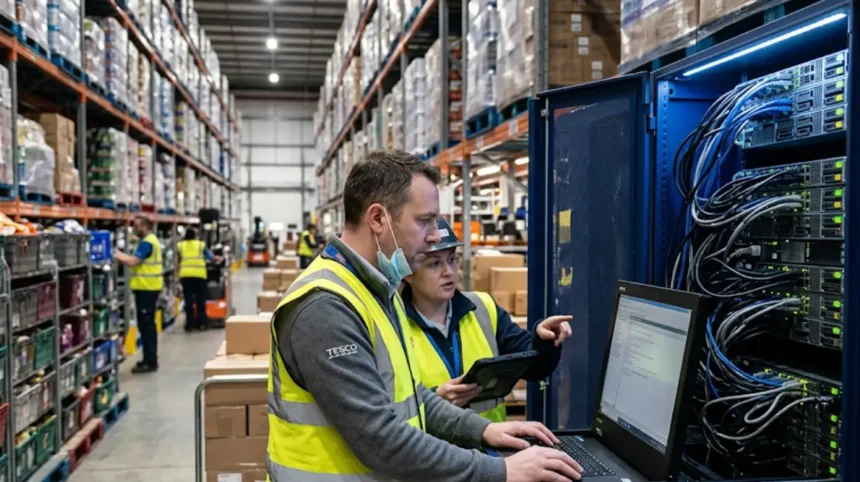
Tesco is migrating approximately 40,000 server workloads off VMware after Broadcom increased prices by roughly 175%, marking one of the largest publicly disclosed VMware migrations since Broadcom acquired VMware in late 2023. The UK supermarket chain is also suing Broadcom for more than £100 million in the UK High Court, alleging abusive conduct and anticompetitive behavior over licensing changes. This major IT infrastructure shift impacts retail operations across the UK, including Tesco stores and warehouses in North London, where critical systems keep food on shelves for communities in areas like Finchley, Arnos Grove, and Tottenham.
- What is Tesco VMware and why does it matter for UK retail and North London?
- Why is Tesco leaving VMware in 2026?
- What perpetual VMware licenses did Tesco purchase in 2021?
- How many servers is Tesco migrating off VMware?
- What alternative product is Tesco replacing VMware with?
- When will Tesco complete its VMware migration?
- What is the Tesco versus Broadcom lawsuit about?
- How does VMware virtualization work for enterprise servers serving North London?
- What impact does Tesco’s VMware exit have on UK retail technology and North London communities?
- What are the key facts about Broadcom’s VMware acquisition?
- How does Tesco’s VMware strategy compare to its historical virtualization approach in North London?
What is Tesco VMware and why does it matter for UK retail and North London?
Tesco VMware refers to the UK’s largest retailer using VMware virtualization software to run approximately 40,000 server workloads across its operations, including critical systems that keep food on shelves and manage retail operations nationwide. This matters because Tesco’s migration represents the most visible battleground in a widening enterprise revolt against Broadcom’s VMware licensing changes, affecting how UK retail infrastructure operates. For North London residents, this means Tesco stores in Finchley Road, Highbury, and Edgware rely on these virtualized systems for inventory management, online ordering, and payment processing.
VMware is a set of software solutions that convert physical computers, servers, and hardware into multiple virtual machines for various tasks, allowing multiple operating systems and applications to run on a single server. Tesco, founded in 1924 by John Edward Cohen and incorporated as Tesco Stores Limited in 1932, remains the UK’s biggest retailer and one of the largest globally. The company’s IT service manager Nigel Chubb previously stated their overall goal was to have everything running on virtual infrastructure, with only a couple of systems excluded.
Tesco’s VMware infrastructure supports mission-critical applications including its website, retail applications, float analytics, and back-office systems. This virtualization strategy dates back to 2009 when Tesco updated its Real Time Sales (RTS) systems, virtualizing key business applications with Citrix XenServer on HP ProLiant blade servers to increase efficiency and performance. By 2009, the retailer was virtualizing 1,500 Windows servers in partnership with Citrix to reduce datacentre carbon emissions by 20 percent.
The 2026 migration outcome will influence enterprise virtualization strategies across UK retail, as Tesco’s scale makes it a critical test case for alternative virtualization platforms at enterprise level. North London communities depending on Tesco’s reliable service—from Southgate to Wood Green—will see whether this migration maintains operational continuity at local stores.
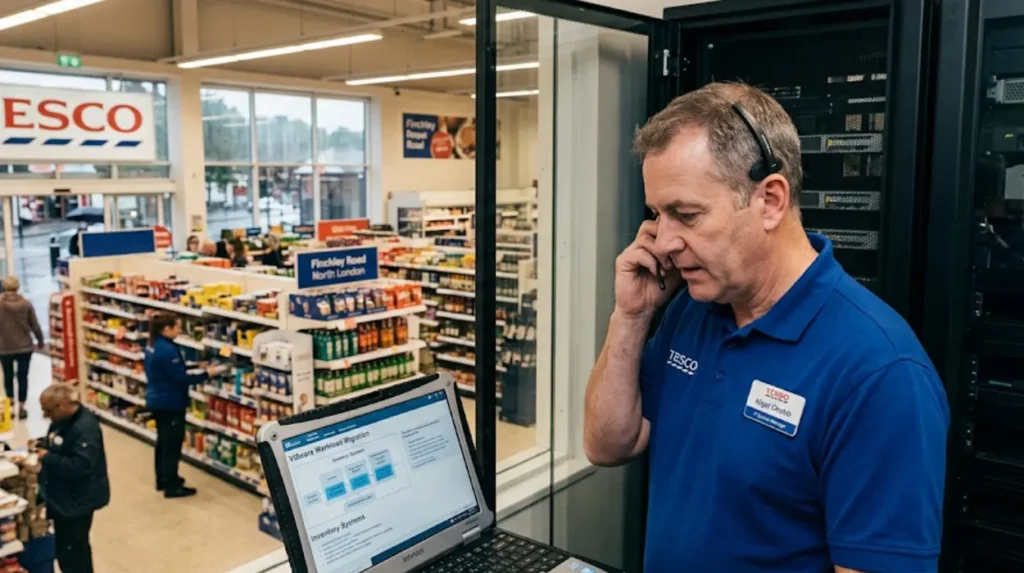
Why is Tesco leaving VMware in 2026?
Tesco is leaving VMware because Broadcom hiked prices by approximately 175% after acquiring VMware in November 2023, forced perpetual license holders into expensive subscription bundles, and refused to continue standalone support for licenses Tesco already paid for. The company purchased perpetual VMware licenses in 2021 with support until 2026 and an option to extend four more years, but Broadcom changed these terms. These changes affect Tesco operations across the UK, including distribution centres serving North London areas like Wembley and Tottenham.
Broadcom closed its $69 billion acquisition of VMware (announced at $61 billion plus assumed debt) in November 2023, and by December 2023 announced it would stop selling perpetual VMware licenses entirely. Within weeks of finalizing the deal, Broadcom replaced perpetual licenses with a subscription-based approach, collapsing over 8,000 SKUs into a handful of per-core subscription bundles.
Tesco’s 2021 agreement with Computacenter (technology reseller) gave access to VMware products until January 2026, with renewal options until 2030. In April 2026, Broadcom proposed a quote requiring Tesco to pay $23.5 million (approximately £1.59 billion at current exchange rate) for one year of VMware Cloud Foundation 9.0 plus large machine software and support services. Tesco stated this price was 175% higher than expected under the 2021 contract, with large machine products and services rising 350%.
Other enterprises report similar pain: AT&T claimed Broadcom proposed a 1,050% price hike, while numerous customers reported costs rising 300 percent post-takeover. Gartner observed clients moving from basic vSphere licenses to complete Cloud Foundation encountering “very large price rises,” with Forrester reporting increases from 400% up to 700%. An IDC report determined renewal costs could climb from 100% to 800% in extreme instances due to new bundling and licensing metrics.
The migration creates operational and commercial risk for Tesco, resulting in “material cost and disruption to the business” due to the accelerated timeframe. Tesco warned in September 2025 that the licensing dispute could disrupt its ability to keep food on shelves, making this a critical supply chain issue for North London supermarkets.
What perpetual VMware licenses did Tesco purchase in 2021?
Tesco purchased perpetual VMware licenses for vSphere Foundation and Cloud Foundation software in 2021, along with Tanzu subscriptions and support services running until 2026, through technology reseller Computacenter. The agreement included an option to renew the contract until 2030, providing additional four years of access to VMware products and support. These licenses support infrastructure serving North London stores from Finchley to Enfield.
Perpetual licenses allow customers to use software indefinitely without recurring subscription fees, unlike subscription-based models requiring ongoing payments. Tesco’s 2021 purchase included standalone support for these perpetual licenses, which Broadcom refused to continue after the acquisition.
VMware vSphere Foundation is the flagship virtualization platform combining ESXi (hypervisor) and vCenter (management), enabling server virtualization across enterprise infrastructure. VMware Cloud Foundation delivers comprehensive cloud infrastructure capabilities, combining virtualization, storage, and networking into an integrated solution. Tanzu is VMware’s container and Kubernetes management platform, supporting modern application development alongside traditional virtual machines.
The contract specified VMware International owed Tesco obligation to supply VMware Software and Support Services via Dell and/or Computacenter. In a February 2026 legal filing, Tesco requested court intervention to prevent Broadcom/VMware from denying access to products originally acquired through Computacenter.
This license structure became contentious because Broadcom eliminated perpetual licenses entirely in December 2023, forcing existing perpetual license holders into subscription models they hadn’t originally purchased. Tesco’s North London operations depend on these systems for daily retail functions.
How many servers is Tesco migrating off VMware?
Tesco is migrating approximately 40,000 server workloads off VMware, making it one of the largest publicly disclosed VMware migrations since Broadcom completed its acquisition in late 2023. This represents the supermarket giant’s entire VMware installation across the business. These servers support operations across the UK, including Tesco stores and distribution centres serving North London.
The migration timeframe is accelerated, with the replacement scheduled to be deployed across the business by the end of 2027. This creates significant operational pressure, as the rushed timeline generates “operational and commercial risk” alongside “material cost and disruption to the business”.
40,000 servers represent massive enterprise infrastructure. Typical large enterprises run 10,000-50,000 virtual servers, so Tesco’s migration covers the full spectrum of a major retailer’s IT operations. This includes systems supporting UK stores, online operations, supply chain management, and customer services across the country, including North London communities in Barnet, Haringey, and Enfield.
The scale makes Tesco’s migration a critical test case for alternative virtualization platforms at enterprise level, as few organizations have attempted migrations of this magnitude since Broadcom’s acquisition. Success or failure will influence enterprise virtualization strategies across UK retail and beyond.
Alternative products can run VMware VMs almost immediately, enabling faster migration than traditional approaches. This capability is critical for Tesco’s accelerated timeline, as manual reconfiguration of 40,000 servers would take years rather than the planned 18-month window.
What alternative product is Tesco replacing VMware with?
Tesco is replacing VMware with an unspecified alternative product, though the industry standard enterprise alternatives include Nutanix AHV, KVM, XenServer, Proxmox VE, Microsoft Hyper-V, and OpenStack. The company has not publicly confirmed which specific alternative it selected. For North London Tesco customers, the choice of alternative affects whether local stores maintain seamless service during the transition.
Nutanix AHV is best for organizations consolidating compute, storage, and networking under a single hyperconverged platform, making it suitable for large retailers like Tesco. KVM (Kernel-based Virtual Machine) is an open-source hypervisor integrated into Linux, offering enterprise capabilities without licensing fees.
Proxmox VE is best for Linux-savvy teams needing an open-source hypervisor with KVM and LXC support without license fees, popular among cost-conscious enterprises. Microsoft Hyper-V works best for organizations already running Windows Server, providing built-in hypervisor integration with the Microsoft ecosystem.
OpenStack is best for large organizations with cloud operations teams needing open-source private cloud infrastructure at scale, though it requires significant technical expertise. VergeOS delivers simplified hyperconverged infrastructure with low total cost of ownership and scalable deployment.
HPE announced it would offer customers a year’s free license to its Morpheus VM Essentials alternative, plus $1 license for separate Zerto migration software, as enterprises seek VMware alternatives. Red Hat OpenShift Virtualization offers unified, cloud-native platforms for managing VMs and containers.
Without Tesco’s public confirmation, the industry analyzes which alternative best fits retail infrastructure requirements: scalability for 40,000 servers, compatibility with existing applications, and cost efficiency compared to Broadcom’s 175% price increase. North London residents shopping at Tesco Metro stores in Finchley or Tesco Extra in Edgware will benefit from whichever platform maintains operational reliability.
When will Tesco complete its VMware migration?
Tesco plans to deploy its replacement for VMware across the business by the end of 2027, with the accelerated migration creating operational risk due to the compressed 18-month timeframe from mid-2026. The UK High Court case regarding the licensing dispute is scheduled to be heard starting in November 2027. This timeline affects North London Tesco customers who rely on consistent store availability and online ordering services.
The migration timeline spans from announcement in June 2026 through deployment completion in December 2027, representing approximately 18 months for moving 40,000 servers. This accelerated schedule creates “operational and commercial risk” alongside “material cost and disruption to the business” for Tesco.
Tesco originally purchased VMware licenses in 2021 with support through January 2026, plus option to renew until 2030. Broadcom’s acquisition in November 2023 and subsequent licensing changes cut short the expected license lifespan, forcing the accelerated migration.
The November 2027 court hearing date was set after Tesco filed its claim in July 2025 at the competition division of UK High Court. This legal timeline overlaps with the technical migration, meaning Tesco will complete its VMware exit while simultaneously pursuing its £100 million+ damages claim.
The compressed timeline means Tesco cannot conduct gradual, risk-averse migration. Instead, it requires rapid deployment of alternative virtualization across all 40,000 servers, testing minimal disruption to retail operations. North London shoppers in areas like Tottenham, Wood Green, and Southgate will experience the migration’s impact on store operations.
What is the Tesco versus Broadcom lawsuit about?
Tesco is suing Broadcom for more than £100 million in the UK High Court, alleging abusive conduct and anticompetitive behavior over VMware licensing changes that forced perpetual license holders into expensive subscriptions. The lawsuit was filed in July 2025 at the competition division, also targeting IT systems integrator Computacenter UK. This legal action protects Tesco’s ability to serve North London communities without supply chain disruption.
Tesco claims Broadcom’s conduct violated contractual obligations to continue delivering perpetual software licenses and product support originally acquired. The company argues that changes since Broadcom acquired VMware left it without the support it contracted for in 2021.
In a February 11, 2026 legal filing, Tesco requested court intervention to prevent Broadcom/VMware from denying access to products originally acquired through Computacenter. Tesco stated VMware International owed obligation to supply VMware Software and Support Services via Dell and/or Computacenter.
The case alleges anticompetitive conduct under UK competition law, as Broadcom eliminated perpetual licenses entirely and forced customers into subscription models at significantly higher prices. Tesco characterizes this as “abusive conduct” that violates fair competition principles.
Broadcom’s actions include refusing to continue standalone support for perpetual licenses Tesco already paid for, despite the 2021 contract specifying support until 2026 with renewal options. The company also killed perpetual license support entirely in December 2023, weeks after finalizing the VMware acquisition.
The lawsuit represents one of the most significant enterprise legal challenges to Broadcom’s VMware licensing strategy, with potential implications for thousands of other VMware customers facing similar price hikes. Success could benefit UK retail technology across North London and beyond.
How does VMware virtualization work for enterprise servers serving North London?
VMware virtualization creates virtual versions of physical IT resources—servers, desktops, storage, and networks—using software to simulate hardware functionality, enabling multiple virtual machines to run on a single physical server with isolated operating systems and applications. This technology supports Tesco operations across North London, from Finchley to Enfield.
The hypervisor is VMware’s core technology, abstracting hardware and managing virtual machines. Type 1 hypervisors (like ESXi) run directly on hardware, while Type 2 hypervisors (like Workstation) run on operating systems.
Virtual Machine (VM) is software-based emulation of a physical computer, running its own OS and applications independently from other VMs on the same server. Each VM remains isolated, so bugs or faults in one VM don’t affect others.
vSphere is VMware’s flagship virtualization platform combining ESXi (hypervisor) and vCenter (management), enabling enterprise-scale server virtualization. VMware Horizon delivers virtual desktops and applications securely to end users.
Benefits include resource efficiency (maximizing hardware by running multiple VMs on one server), isolation (fixing issues without affecting other systems), scalability (expanding infrastructure without buying more hardware), disaster recovery (fast, reliable data recovery), and cost savings (reducing hardware, power, and maintenance costs).
Tesco’s 2009 virtualization project updated mission-critical sales systems with blade-based virtualization for increased efficiency and performance, reducing datacentre carbon emissions by 20 percent. By 2013, Tesco adopted private cloud infrastructure within internal datacentres that became “cloud-ready” after virtualization and datacentre consolidation projects.
Explore More Area Guide
What Are the Best Things to Do in Barnet During Summer?
Which Areas of Barnet Are Best for Short-Term Visitors? Top 3 Neighborhoods
What impact does Tesco’s VMware exit have on UK retail technology and North London communities?
Tesco’s VMware exit will influence enterprise virtualization strategies across UK retail, as the migration of 40,000 servers represents the most visible test case for alternative virtualization platforms at enterprise scale. The outcome affects how UK retail infrastructure operates, since Tesco’s systems keep food on shelves and manage retail operations nationwide, including North London communities.
The migration creates “material cost and disruption to the business” for Tesco, demonstrating the financial impact of Broadcom’s licensing changes on major retailers. Other UK retailers face similar price increases, with enterprises reporting renewal costs running 2–5× previous spend and some cases far higher.
Tesco’s accelerated timeline (completion by end of 2027) forces rapid deployment of alternative virtualization across all servers, testing whether non-VMware platforms can handle enterprise retail workloads at this scale. Success validates alternative platforms for other retailers; failure warns against rushed migrations.
The £100 million lawsuit against Broadcom sets legal precedent for enterprise challenges to Broadcom’s VMware licensing strategy, potentially benefiting thousands of other VMware customers facing similar 175%-1,500% price hikes.
UK retail technology infrastructure depends on virtualization for efficiency, cost management, and scalability. Tesco’s migration demonstrates that licensing disputes can force complete infrastructure overhauls, increasing operational risk for retail technology teams. North London residents in areas like Tottenham, Wood Green, Finchley, and Edgware depend on Tesco’s reliable technology for daily shopping.
The case highlights digital sovereignty concerns, as enterprises seek control over virtualization infrastructure independent of single vendors who can dramatically change pricing and licensing terms.
What are the key facts about Broadcom’s VMware acquisition?
Broadcom completed its $69 billion acquisition of VMware (announced at $61 billion plus assumed debt) in November 2023, immediately eliminating perpetual licenses and forcing subscription-based purchasing within weeks. This transformed VMware’s business model from perpetual licensing to per-core subscription bundles, affecting enterprises across the UK including those serving North London.
Within weeks of finalizing the deal, Broadcom announced it would stop selling perpetual VMware licenses entirely in December 2023, replacing them with subscription-based approaches. The company collapsed over 8,000 SKUs into a handful of per-core subscription bundles, simplifying product lines dramatically.
Broadcom purged most of the VMware partner program, affecting resellers like Computacenter who originally sold Tesco’s 2021 licenses. This partner program reduction forced customers into direct relationships with Broadcom or limited res渠道.
Customer pain became immediate: numerous VMware customers reported costs rising 300 percent after Broadcom’s takeover, with some companies citing even higher hikes including AT&T’s claimed 1,050% increase. Gartner observed clients moving from basic vSphere licenses to complete Cloud Foundation encountering “very large price rises”.
Forrester reported “notable price escalations for some customers, with anecdotal accounts of increases from 400% up to 700%”. An IDC report determined renewal costs could climb from 100% to 800% in extreme instances due to new bundling and licensing metrics.
The acquisition transformed VMware from an independent virtualization leader into a Broadcom product, with licensing changes triggering enterprise revolts including Tesco’s 40,000-server migration and £100 million lawsuit.

How does Tesco’s VMware strategy compare to its historical virtualization approach in North London?
Tesco’s historical virtualization approach pursued “almost all-virtual IT infrastructure strategy” with Nigel Chubb stating their goal was everything running on virtual except only a couple of systems, which aligns with current infrastructure but now requires alternative virtualization technology. The 2026 migration maintains this strategic direction while changing the underlying technology provider, ensuring North London stores continue operating efficiently.
In 2009, Tesco updated mission-critical sales systems with new blade-based virtualization platform using Citrix XenServer running on HP ProLiant BL680c G5 blade servers for increased efficiency and performance. This virtualization reduced datacentre carbon emissions by 20 percent while improving system performance.
By 2009, one main datacentre project due for April completion involved virtualizing 1,500 Windows servers in partnership with Citrix to drive down spending and reduce emissions. Tesco IT chief Nick Folkes explained how lessons from UK technology-led improvements would apply to global operations.
In 2013, Tesco adopted private cloud infrastructure within internal datacentres that became “cloud-ready” after virtualization and datacentre consolidation projects from the previous year. The private cloud hosted website and retail applications by mid-2013, with sensitive mission-critical applications in-house and web services on private cloud.
The current 2026 migration maintains Tesco’s long-term virtualization strategy while replacing VMware with alternatives, demonstrating the company’s commitment to virtual infrastructure regardless of vendor. The 40,000-server migration represents evolution of the strategy started in 2009, not abandonment of virtualization principles.
Tesco Bengaluru’s infrastructure operational support covers both public and private cloud under hybrid cloud strategy, including data engineering capabilities. This global infrastructure approach continues the vision Nigel Chubb articulated in 2004 at Citrix’s iForum conference.
The migration proves Tesco’s virtualization strategy is vendor-independent—the goal remains “everything virtual” regardless of whether VMware, Citrix, Nutanix, or other platforms provide the technology. North London Tesco customers in Finchley, Highbury, Arnos Grove, and Tottenham will benefit from continued operational reliability throughout this transition.
What is Tesco VMware?
Tesco VMware refers to the virtualization infrastructure used by Tesco to run approximately 40,000 server workloads that support retail operations, inventory management, online shopping, payment processing, and supply chain systems across the UK.