Key Points
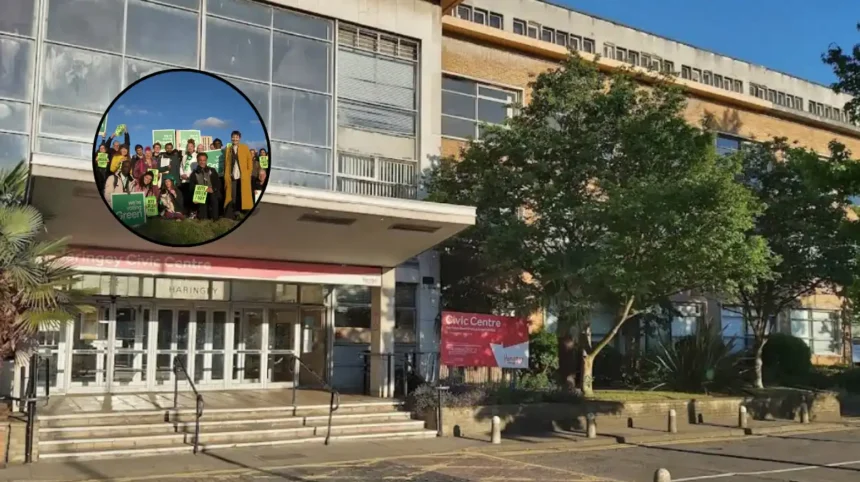
- Historic Defeat: The Labour Party has lost overall control of Haringey Borough Council for the first time in decades following a massive political shift in the 2026 local elections.
- Green Party Resurgence: The Green Party experienced an unprecedented surge, jumping from just two seats before the election to securing 28 seats, making them the largest single political group on the council.
- No Overall Control: With 57 council seats contested, no single party achieved the 29 seats required for a working majority, pushing the local authority into a state of “No Overall Control”.
- Labour Leader Defeated: Incumbent Labour Council Leader Peray Ahmet lost her Noel Park ward seat during the sweeping changes across the borough.
- Turnout Boost: Voter turnout saw a sharp rise across Haringey, reaching 43.81 per cent, marking a significant 27 per cent increase in participation compared to the 2022 local elections.
- Broader Context: The political upset coincided with pan-London local elections on 7 May 2026, where more than six million citizens were eligible to cast ballots across all 32 boroughs.
Haringey (North London News) June 20, 2026 –The political landscape of North London has shifted fundamentally following the declaration of the 2026 local council election results, which saw the incumbent Labour administration suffer a devastating defeat and lose overall control of Haringey Borough Council. In an unprecedented swing, the Green Party surged to become the largest political force within the local authority, securing 28 seats—an increase of 28 compared to the previous full council election cycle.
Labour fell drastically to 21 seats, losing 30 from their 2022 high of 50 seats. The Liberal Democrats managed to make minor gains, expanding their representation slightly to hold eight seats.
Because a minimum of 29 seats is necessary to command an absolute legislative majority on the 57-seat council, Haringey has formally entered a state of “No Overall Control”. This outcome requires formal power-sharing negotiations or the establishment of a minority administration to govern the borough over the next four years. Adding to the dramatic nature of the night, the incumbent leader of the council, Peray Ahmet, lost her personal council seat in the Noel Park ward to the Green Party wave.
Following the declaration, Mark Blake of the Green Party has emerged as the prospective figure to lead the shifted council landscape.
When Were the 2026 Local Elections in London?
The democratic exercise took place on Thursday, 7 May 2026, as part of the broader United Kingdom local government elections. Across the capital, more than six million Londoners were eligible to participate in a massive polling day that saw all 32 London boroughs up for regular four-year terms.
The expansive polling day also included vital executive mayoral elections across five distinct London boroughs, specifically Croydon, Hackney, Lewisham, Newham, and Tower Hamlets.
As published in an official declaration by the electoral services division at Haringey Council, the local counting process concluded at the iconic Alexandra Palace on Friday, 8 May 2026.
A total of 273 candidates registered to run in this cycle, representing a massive 54 per cent escalation in candidate numbers from the 2022 local baseline.
The heightened political engagement translated directly to the ballot boxes, where the total voter turnout reached 43.81 per cent, marking a sharp 27 per cent increase in local voter activity relative to the historical numbers recorded four years prior.
What Are the Direct Declarations and Political Reactions?
The historic scale of the shift has drawn major observations from media commentators and tracking bodies. According to data analysis published by Wikipedia contributors and local government data compilers, the final popular vote allocation in Haringey saw the Green Party pull ahead with 75,046 votes (35.6 per cent of the total share), followed closely by Labour at 71,264 votes (33.8 per cent).
The Liberal Democrats took a 17.4 per cent slice with 36,630 votes, while the Conservatives and Reform UK finished without any seats, capturing 6.3 per cent and 4.1 per cent of the borough-wide vote respectively.
The structural collapse of the traditional Labour hold in Haringey matches a larger national trend observed during this specific electoral cycle.
As reported by national political correspondents monitoring the 2026 United Kingdom Local Elections, the Labour Party faced substantial net losses across England, dropping 1,498 councillors and losing absolute authority over 38 separate councils.
This widespread shift has triggered severe internal debate within Westminster, with several Labour Members of Parliament actively calling on Prime Minister Keir Starmer to step down from the leadership.
Before the final vote, major warning signs had already appeared from traditional allies. As reported by national political editors detailing the campaigns, the General Secretary of the Unite union, Sharon Graham, explicitly warned in a public address to striking municipal workers that the Labour leadership would face severe consequences at the ballot box, stating that the party would be “decimated” in the local council determinations.
While Prime Minister Keir Starmer attempted to push back against these grim projections during his national campaign launch at the City of Wolverhampton College, the actual results from areas like Haringey have confirmed the scale of voter dissatisfaction.
Where Is Haringey and Who Lives There?
The London Borough of Haringey is situated directly in North London and serves as a major geographic link between the inner and outer areas of the capital. It shares its administrative borders with six adjacent boroughs: Enfield to the north, Waltham Forest to the east, Hackney and Islington to the south, and Camden and Barnet to the west.
The borough is widely recognised for its sharp contrasts, featuring leafy, highly affluent suburban neighbourhoods alongside densely populated, active urban districts.
It contains iconic landmarks such as the Tottenham Hotspur Stadium, the historical Alexandra Palace, the expansive Tottenham Marshes, the Markfield Beam Engine and Museum, the Bernie Grant Arts Centre, and the heavily used Finsbury Park.
Historically, it holds a unique cultural status: the world’s very first regular public television service commenced broadcasting from Alexandra Palace on 2 November 1936, with an initial schedule lasting exactly one hour.
The multi-mile borough contains distinct, highly recognisable neighbourhoods, including:
- Tottenham
- Wood Green
- Crouch End
- Muswell Hill
- Green Lanes
- Stroud Green
- Fortis Green
- Seven Sisters
- St Ann’s
- Noel Park
- Hornsey
What Do the Current Local Statistics Show?
Administratively and economically, Haringey supports a large, highly diverse population that faces unique urban challenges.
Population and Demographics
According to official civic estimates, the total population of Haringey stood at approximately 263,850 residents. The demographic composition recorded in the 2021 national census indicates that 57 per cent of the population identify as white, 17.6 per cent as black, 8.7 per cent as Asian, 7 per cent as mixed race, and 7 per cent as belonging to other distinct ethnic groups.
Property and Rental Markets
The cost of living and housing remain major issues within the borough. Data published by the Office for National Statistics (ONS) indicated that the average residential property price in Haringey was recorded at £625,046.
Furthermore, supplementary monthly reports compiled by the ONS showed that the average monthly private rental cost within the borough had reached £2,197, highlighting the high financial pressures facing local residents.
Transport and Infrastructure
The local infrastructure is highly dependent on Transport for London (TfL) networks to keep the population moving. According to official TfL asset tracking documents, the borough contains seven distinct London Underground stations, five London Overground stations, and approximately 425 operational bus stops.
The area is also served by multiple suburban overground rail lines, with major transport hubs and interchanges situated at Tottenham Hale, Seven Sisters, and Finsbury Park stations.
Background of the Haringey Political Shift
The dramatic results of the 2026 election are rooted in long-term structural adjustments and strategic political shifting within the borough.
Historically, Haringey Council operated as a secure stronghold for the Labour Party, which controlled the local authority with massive majorities for most of the past few decades. However, internal tensions within the local party began to surface heavily after the 2022 election cycle.
Between 2022 and early 2026, the ruling Labour group lost six seats due to internal political defections and unexpected losses in local by-elections.
A major structural fracturing occurred in July 2025, when two sitting Green Party councillors joined forces with two independent left-wing councillors to officially form the “Green Socialist Alliance” group within the council chambers.
This alliance systematically challenged the centrist policies of the Labour leadership on local issues, including housing redevelopments, environmental low-traffic schemes, and council tax adjustments.
Furthermore, a critical tactical pact shaped the run-up to the 2026 vote. The Green Party and the Haringey Socialist Alliance established a formal electoral co-operation agreement.
Under this deal, the Green Party intentionally limited itself to standing just one single candidate in the highly contested wards of Northumberland Park, Bruce Castle, and West Green, allowing the Haringey Socialist Alliance to run two candidates without splitting the left-wing, anti-administration vote.
This targeted strategy, combined with rising local anger over national economic factors and municipal service management, ultimately eroded the traditional Labour base and cleared the way for the historic Green Party surge.
Prediction: How This Development Can Affect Local Residents
The transition to a council with “No Overall Control” and a dominant Green Party block will directly alter everyday life for the 263,850 residents of Haringey. Without a single party holding an absolute majority, local governance will require continuous cross-party negotiation.
This could slow down the approval process for major infrastructure decisions, but it will also mean greater scrutiny for local policies.
For local homeowners and renters facing average house prices of £625,046 and steep monthly rents of £2,197, the massive influx of Green Party councillors is highly likely to reshape local planning and development rules.
The Green Party’s platform traditionally focuses on blocking large-scale, corporate-led urban regenerations in favour of strictly affordable, low-carbon social housing projects.
Residents can expect much tougher environmental conditions placed on corporate developers, which may slow down private construction pipelines in areas like Tottenham and Wood Green, but could increase the focus on retrofitting existing council properties.
Furthermore, transport users across Haringey’s seven Tube stations and 425 bus stops will likely see changes in local streets. The new council composition is expected to push heavily for expanded low-traffic neighbourhoods (LTNs), pedestrianisation schemes, and protected cycling lanes.
While these policies aim to tackle climate issues and improve air quality, they may initially increase traffic congestion on major arterial roads, impacting local drivers and business deliveries. Ultimately, Haringey residents are entering an era of localized environmental regulation and consensus-based politics, breaking decades of predictable single-party rule.