Key Points
- Systemic Failure: Hospital insiders report that treating patients in corridors has become fully normalised within the NHS following the publication of official data.
- Fatal Incident: A staff source revealed an 83-year-old patient suffered a fatal cardiac arrest in a corridor at the Royal Free Hospital after being transferred from Barnet Hospital.
- Data Revelations: Newly published national figures show that more than 3,000 patients across England were subjected to corridor care during May alone.
- Trust Breakdown: The Royal Free London NHS Foundation Trust averaged 13 corridor patients daily at its main site in late May, and 86 patients a day across its entire network.
- Resource Strain: Frontline staff report that a surge in mental health patients in Accident and Emergency (A&E) departments is severely stretching limited personnel resources.
- Government Intervention: Health Secretary James Murray has labelled the practice “unacceptable and undignified,” promising bespoke intervention plans for the worst-affected hospital trusts.
Hampstead (North London News) June 27, 2026 — A systemic crisis in patient dignity and safety has been exposed across the National Health Service (NHS) as frontline hospital insiders reveal that treating patients in corridors has officially become “the norm.” Following a landmark government decision to publish official metrics on the phenomenon known as “corridor care,” data from the final week of May indicates that London hospitals are at the absolute epicentre of an emergency bed shortage. A patient is officially classified as receiving corridor care if their clinical assessment, monitoring, and treatment take place outside of a standard, safe, and clinically appropriate environment, such as a designated ward bed.
- Key Points
- What Do the Official Figures Reveal About the Scale of the Crisis?
- How Are Hospital Staff Adapting to the Shortage of Clinical Space?
- Who Is Attributed for Exposing the Conditions Facing Frontline Nurses?
- Why Has the Capacity of NHS Hospitals Collapsed Over Time?
- How Has the Government and Trust Management Responded to the Scandal?
- Background of the Particular Development
- Prediction: How This Development Can Affect the Particular Audience
The crisis has entered the public spotlight after a whistleblowing staff member from the Royal Free London NHS Foundation Trust disclosed a catastrophic failure of patient safety.
According to the internal source, an 83-year-old male patient was recently discharged from Barnet Hospital and transferred to the Royal Free Hospital. Upon arrival, the elderly patient suffered a sudden cardiac arrest while waiting on a trolley in the hospital corridor.
Though he was rapidly rushed to the resuscitation unit, clinicians were unable to revive him, and he died shortly thereafter. The anonymous staff source warned that frontline workers have become completely “sanitised” to these conditions because overcrowding has become an everyday reality.
What Do the Official Figures Reveal About the Scale of the Crisis?
The newly released data underscores that the problem extends far beyond individual isolated incidents. Across England, more than 3,000 vulnerable patients were subjected to corridor care throughout May. Within the Royal Free London NHS Foundation Trust—which oversees Barnet, Chase Farm, and North Middlesex hospitals—an average of 86 patients per day were kept waiting across the entire hospital network.
At the flagship Royal Free Hospital site in Hampstead, official logs recorded between 10 and 17 patients being actively treated in corridors while waiting for an available inpatient bed every single day during the final week of May.
However, whistleblowers insist that the official data represents only a fraction of the true operational chaos. Internal sources allege that the actual number of individuals waiting in corridors to be properly triaged and assessed by medical teams is vastly higher than the figures published by management.
While the Royal Free has begun logging these numbers, neighboring providers, including the Whittington Hospital and University College London Hospitals (UCLH), have yet to publish any official corridor care data. Despite this lack of formal reporting, healthcare watchdogs confirm that corridor care is known to actively exist within those institutions as well.
How Are Hospital Staff Adapting to the Shortage of Clinical Space?
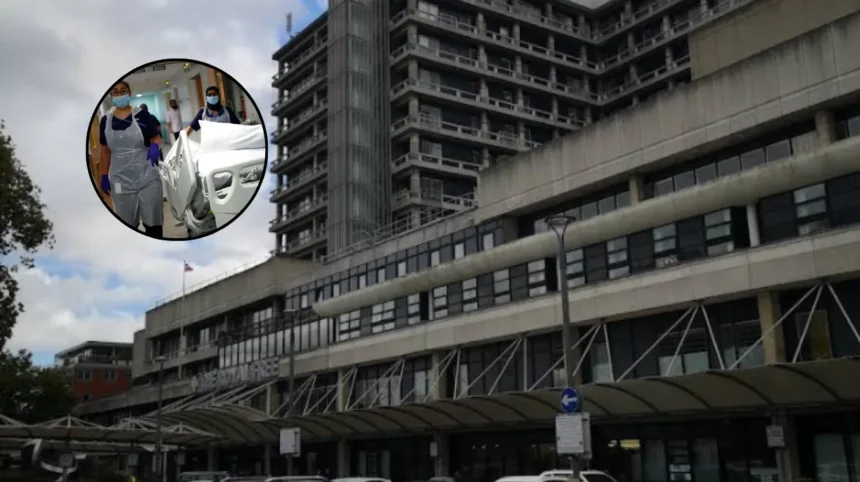
To cope with the unrelenting influx of emergency admissions, administrators have implemented a controversial operational strategy known as “cohort nursing.” According to details provided by the Royal Free staff source, this system involves keeping arrived patients inside the physical ambulances parked in bays directly outside the hospital’s main entrance.
Under cohort nursing protocols, teams of nurses are deployed to the ambulance bays to monitor and treat multiple patients simultaneously within the vehicles, effectively transforming emergency transport into makeshift stationary ward space to prevent the physical A&E department from completely locking up.
Simultaneously, the nature of admissions has shifted, placing an unprecedented burden on emergency staff. The internal whistleblower highlighted that the single largest operational issue currently facing the A&E department is the sheer volume of psychiatric and mental health patients occupying clinical bays.
Frontline managers attempt to concentrate staff resources by keeping mental health patients grouped together in one dedicated sector of the emergency room for safety and specialized monitoring, but the relentless volume of arrivals means this protocol frequently breaks down, scattering acute psychiatric patients across standard medical bays.
Who Is Attributed for Exposing the Conditions Facing Frontline Nurses?
The human toll of this logistical gridlock has drawn sharp condemnation from professional bodies. As reported by the editorial team of the Camden New Journal, the Whittington Hospital has gone so far as to actively advertise vacancies for external nursing staff specifically recruited to work with corridor care patients—a move that effectively acknowledges the practice as a permanent, structured fixture of modern British healthcare delivery rather than a temporary winter contingency.
The Royal College of Nursing (RCN) has issued an urgent warning that its members are routinely being forced into positions where they cannot fulfill their legal and professional duty of care.
One frontline nurse, speaking through the RCN, provided a harrowing account of having to change an incontinent, frail elderly patient suffering from advanced dementia directly on an open corridor floor, positioned immediately next to a public vending machine.
Commenting on the publication of the figures, Professor Nicola Ranger, the General Secretary of the Royal College of Nursing, stated:
“Behind these figures aren’t just patients and families suffering, but nursing staff demoralised at being forced to deliver poor care, day in day out. This data is an important step and can help us understand more about the prevalence of corridor care, but attention and investment must also be on eradicating the practice for good. That means renewed urgency and new system-wide investment in beds, the nursing workforce in hospitals, and crucially, long-overdue action to boost capacity in community services and in social care to deliver care closer to home.”
Why Has the Capacity of NHS Hospitals Collapsed Over Time?
The origins of the current infrastructure deficit stem from decades of structural reorganization. Over successive political administrations, NHS managers and health economists executed deliberate strategic decisions to close physical hospital wards and aggressively reduce the total number of overnight hospital beds.
This long-term contraction was framed as a cost-saving and modernization drive designed to shift the British healthcare model away from expensive acute hospital stays and toward a system where more patients are looked after in their own homes or via “in the community” healthcare teams.
However, this managed reduction in physical infrastructure failed to account for demographic realities. The volume of patients physically turning up at acute hospitals for emergency treatment has risen consistently year on year. Healthcare analysts frequently attribute this unrelenting hospital demand to a severe breakdown in primary care infrastructure, noting that a chronic lack of timely access to local GP surgeries leaves desperate patients with no viable medical alternative other than presenting themselves to local A&E departments.
To bridge the gap between rising patient numbers and fixed ward spaces, hospitals have purchased fleets of extra mobile trolleys. This temporary measure has now backfired, with staff reporting that heavy machinery and transport trolleys are frequently breaking down under the mechanical strain of constant, uninterrupted use.
How Has the Government and Trust Management Responded to the Scandal?
The political fallout from the data publication has put both past and present government figures under intense scrutiny.
Former Health Secretary Wes Streeting visited the Royal Free Hospital earlier this year to assess operational pressures; however, hospital insiders noted with dissatisfaction that his itinerary did not include a physical inspection of the overcrowded A&E department where the corridor care was taking place.
The current Health Secretary, James Murray, defended the decision to release the sensitive statistics, emphasizing that transparency is a prerequisite for systemic reform. In an official ministerial statement, Secretary Murray declared:
“Corridor care is unacceptable, undignified and has no place in our NHS. That is why, for the first time, we are publishing this data to shine a spotlight on where the problems are greatest and ensure trusts get the support they need, with the vast majority of corridor care concentrated in a small number of organisations.”
The Department of Health and Social Care has confirmed that ending the practice is an absolute national priority, promising that civil servants and NHS England directors will immediately begin drafting “bespoke plans” explicitly tailored for the specific hospital trusts exhibiting the highest baseline rates of corridor treatment.
In response to the data release and whistleblower allegations, an official spokesperson for the Royal Free London NHS Foundation Trust defended the organization’s broader operational track record while acknowledging the need for structural change, stating:
“We have made significant improvements to urgent and emergency care waiting times over the past year, including for our ambulance handovers and four-hour performance. We are committed to eliminating corridor care and have invested in our emergency departments to increase capacity and improve patient flow. Additionally, we have increased the use of virtual wards and expanded our same-day emergency care which allows patients to be seen and discharged on the same day.”
Background of the Particular Development
The formal publication of corridor care metrics marks a watershed moment in the institutional accountability of the NHS, evolving out of a multi-year campaign by clinical leaders, healthcare unions, and investigative journalists.
Historically, NHS performance data focused primarily on the standard “four-hour target”—the statutory metric dictating that 95% of A&E patients should be admitted, transferred, or discharged within four hours of arrival. Because corridor care occurred after a patient was clinically accepted but before a ward bed became physically vacant, it occupied a regulatory blind spot, colloquially referred to by hospital managers as the “hidden waiting list.”
The policy shift to mandate the daily logging and public disclosure of these numbers was accelerated by the post-pandemic collapse of patient discharge pathways.
As the social care sector faced unprecedented staffing shortages, hospitals found themselves trapped in a state of “bed blocking,” where clinically fit patients could not be safely discharged because there were no available care home spots or community nursing teams to receive them. With beds occupied by patients who did not require acute care, newly arrived emergency patients backed up into the corridors.
The decision by the Department of Health and Social Care to officially publish these numbers represents a tactical pivot: by exposing the precise data, the government aims to force local integrated care boards to redirect funding into social care infrastructure, acknowledging that the corridor crisis cannot be resolved within the four walls of the emergency department alone.
Prediction: How This Development Can Affect the Particular Audience
The publication of this data and the subsequent implementation of “bespoke plans” will profoundly alter the healthcare experience for the primary audience affected: emergency patients, their families, and local communities within North and Central London.
In the short to medium term, patients presenting at emergency departments like the Royal Free or Barnet Hospital are likely to experience highly disruptive logistical changes.
As management faces intense political pressure to eliminate corridor data from official Ledgers, hospitals will aggressively expand “virtual wards”—a system where patients receive acute monitoring via digital wearable devices while staying in their own beds at home.
For local families, this will shift a significant portion of the daily caregiving and observation burden onto relatives, who will have to act as the primary point of contact for visiting remote medical teams.
Furthermore, to keep patients out of the physical corridors, the audience can expect stricter gatekeeping at the front door of the hospital.
Triage protocols will tighten significantly, and patients arriving with non-life-threatening ailments will face systemic diversion to community hubs or urgent treatment centres, effectively ending the era of using the A&E as a catch-all safety net.
For the elderly and vulnerable population in the catchment area, this development will eventually reduce the immediate risk of receiving undignified care next to public vending machines, but it creates a secondary risk of delayed admissions, as hospitals prioritize empty hallways over immediate physical entry into the building.